16
Mar
Lifting Elderly Safely: Real Solutions for the Hardest Patient Transfer Problems Caregivers Face
This guide is built to help families, caregivers, and care teams understand the hardest patient transfer problems — and then choose safer, smarter solutions with more confidence, dignity, and control.
If you are trying to understand lifting elderly safely, avoid caregiver strain, or find the right patient transfer device for homecare or commercial use, this guide is designed to give you practical direction. It does not stop at describing the problem. It also explores the best patient transfer lifts, explains the most important features to look for, and helps match different lift types to different patient scenarios and care environments.
Why Lifting Elderly Safely Has Become One of the Biggest Challenges in Home Care and Mobility Support
For many families, caregivers, and facilities, the hardest part of daily care is not scheduling, medication, or supervision — it is the moment a person needs to be moved.
The phrase lifting elderly safely sounds simple, but in real life it often involves a deeply difficult physical and emotional challenge. A patient may be weak, fearful, partially paralyzed, unable to stand steadily, recovering from surgery, living with advanced arthritis, or experiencing a neurological condition that makes every transfer unpredictable. A caregiver may be trying to help that person move from bed to wheelchair, from wheelchair to toilet, or from a seated position into a car without causing pain, losing control, or risking a fall. That is why so many people search for better methods of transferring patients and for the right patient transfer device that can support these moments more safely.
In many homes and care environments, patient transfers become the most stressful part of the day. The movement itself may only take a few minutes, but the risk behind it is enormous. One wrong pivot, one moment of weakness, one unstable foot placement, or one unexpected collapse can quickly turn a routine transfer into an injury event for both the patient and the caregiver. This is exactly why modern mobility guidance no longer treats transfers as a small task. Transfers are one of the most important — and most hazardous — physical actions in caregiving.
Why transfers become so dangerous
- Reduced leg strength: many elderly or disabled patients cannot generate enough force to stand, pivot, or lower themselves safely.
- Poor balance and instability: even a patient who can stand briefly may not be able to control sway, weakness, or sudden collapse.
- Pain during movement: arthritis, hip issues, spinal pain, fractures, or post-surgical sensitivity can interrupt the transfer mid-motion.
- Cognitive impairment or fear: dementia, confusion, and fear of falling often make cooperation inconsistent and increase unpredictability.
- Caregiver strain: many family caregivers are not trained in body mechanics and end up lifting with their back, shoulders, and arms.
Where problems happen most
- Bed to wheelchair
- Bed to commode or toilet
- Chair to standing position
- Wheelchair to dining chair
- Vehicle seat transfers
- Narrow bathroom and doorway movement
There is also a major emotional side to this issue. Many patients feel embarrassed when they cannot move independently. Others become anxious because they know how easily a transfer can go wrong. Family caregivers often feel guilt, pressure, and fear because they are trying to protect someone they love while also knowing that they themselves could get hurt. This is why the best educational resources on transferring patients must go beyond generic advice. People need to understand the specific types of patients, the specific moments of risk, and the specific transfer environments where better support is needed.
Another reason this topic matters so much today is that more care is happening at home, in outpatient recovery, in assisted living, in rehabilitation settings, and in long-term care environments where staff and families need practical systems that are repeatable. This has pushed more people to look for a safer patient transfer device that can reduce direct lifting, improve patient comfort, and make daily movement more controlled. For many situations, the issue is no longer whether support equipment is needed. The real question is which type of transfer solution fits the patient’s actual problem.
That is also why this guide goes beyond problem awareness. In addition to explaining the hardest transfer challenges, it also features top patient transfer lifts, compares the most useful lift categories, and helps readers understand which options make the most sense for different scenarios — whether the goal is simpler homecare, safer toileting support, easier wheelchair transfers, better bariatric handling, or a stronger commercial transfer setup.
This article is built around those exact realities. Instead of only listing products, it breaks down the real transfer problems people face, the situations where different lift styles make the most difference, and the features that matter when choosing between them. In the next section, we will move directly into the most difficult patient transfer scenarios and the kinds of patients for whom these situations become especially dangerous, exhausting, or complex.
For readers already comparing equipment while learning, MedCare Mobility also offers a dedicated patient lift chair category along with models such as the MedCare Mobility Electric Patient Lift Transfer Chair, the EZ Lift Assist Patient Lift Chair, and the MedCare Mobility Hydraulic Manual Patient Transfer Lift.
The 5 Most Difficult Patient Transfer Situations Caregivers Face
Most people searching for help with lifting elderly safely are trying to solve one very specific, very difficult daily movement. These are the transfer moments that most often push families and caregivers to start exploring a better patient transfer device.

Using a patient transfer device helps caregivers reduce fall risk, improve control, and make daily mobility routines less physically demanding.
These are the situations where everyday transfers become the hardest part of care.
Many caregivers do not begin by looking for a specific product. They begin by trying to solve a painful daily problem: helping a loved one move from bed to wheelchair, guiding someone to the toilet, supporting a weak patient who can no longer stand steadily, or trying to avoid injury while transferring patients several times a day.
The difficulty grows quickly once weakness, poor balance, pain, tight spaces, fear of falling, or repeated heavy assistance become part of the routine. That is when transfers stop feeling simple and start becoming one of the hardest parts of caregiving.
The problem is not the same for every patient. Some people have one-sided weakness after stroke. Others are severely frail and cannot hold themselves upright for more than a moment. Some struggle most in the bathroom, where space is limited and urgency increases the risk. Others need much heavier assistance or face the added difficulty of getting into a vehicle for appointments and outside care.
Watch the transfer concept in action
This short demonstration helps show how a seated transfer approach can support safer movement between common daily surfaces.
Bed to Wheelchair Transfers for Stroke Patients or People With One-Sided Weakness
One-sided weakness makes transfers unpredictable because the patient may look able to help, yet lose balance or collapse without warning.
For a person recovering from a stroke or living with hemiparesis, one side of the body may be significantly weaker, less coordinated, or unable to bear weight correctly. That creates a major problem during bed-to-wheelchair movement. A caregiver may think the patient can stand and pivot, but the weaker leg may buckle, the patient may lean heavily to one side, or they may lose trunk control halfway through the transfer.
This is where many families quickly discover that lifting elderly safely is not simply about effort — it is about control, positioning, and reducing the need for unsafe manual support. These transfers become even harder when the patient is tired, fearful, or recovering from recent hospitalization.
Toilet and Bathroom Transfers: One of the Highest-Risk Daily Situations in Caregiving
Tight spaces, urgency, and slippery conditions make bathroom transfers one of the most stressful and risky parts of daily care.
If there is one movement that regularly pushes caregivers into panic, it is the transfer to and from the toilet. Bathroom transfers are physically tight, emotionally sensitive, and often time-pressured. The patient may already be weak, sleepy, in pain, or moving urgently, which increases the chance of instability.
Unlike a bedroom or living room transfer, bathroom movement usually happens in a narrow environment with hard surfaces, limited turning space, and more obstacles. This is often the point where caregivers begin urgently looking for transferring patients solutions that reduce strain and make repeated toileting routines safer.
Transfers for Frail Elderly Patients Who Are Too Weak to Stand Reliably
Frail patients are often the hardest to move because they cannot support themselves consistently, even for a few seconds.
Frailty changes everything about patient movement. A person may not be fully bedridden, yet still lack the leg strength, trunk stability, endurance, or confidence to complete even a short transfer safely. This is especially common in advanced age, after hospitalization, or during recovery from illness.
Frail patients may look light, but they are often harder to transfer than heavier patients who can assist. They may collapse without warning, lose knee control, or simply be unable to hold themselves upright long enough to complete a pivot. This is one of the clearest situations where lifting elderly safely becomes extremely difficult without better support.
Bariatric and Heavy-Assist Transfers Where Manual Lifting Becomes Dangerous Fast
In heavy-assist transfers, the issue is not only body weight — it is leverage, control, repeated strain, and what one caregiver can realistically handle safely.
Bariatric and heavy-assist transfers are among the most demanding situations in both home care and facility care. A patient may have limited mobility, poor balance, or difficulty following a multi-step movement sequence. If a caregiver tries to compensate manually, the load on the back, shoulders, hands, and knees can become overwhelming very quickly.
What makes these situations especially difficult is that every mistake becomes harder to correct once the transfer has started. If the patient leans unexpectedly, begins to slide, or cannot complete the movement, the caregiver may not be physically able to recover the transfer by hand.
Car Transfers and Outside-the-Home Movements That Are Harder Than Most People Expect
Transportation transfers are often the moment families realize that indoor routines do not automatically work once they leave the house.
A patient may manage reasonably well between bed, chair, and bathroom inside the home, but everything changes when a medical appointment or outing requires getting into a vehicle. Now the transfer includes doorway clearance, car seat height, limited angles, and a completely different type of positioning challenge.
Car transfers are especially difficult because the destination surface is tighter and lower than most indoor surfaces. The caregiver may be trying to guide the patient through a narrow opening while also managing pain, stiffness, fear, or poor trunk control. This is often where families begin actively comparing a better patient transfer device for outside mobility.
What These Scenarios Reveal
Each of these situations highlights a different reason why patient transfers become difficult — whether it is weakness, instability, limited space, repeated strain, or the challenge of moving between specific surfaces.
How to Choose the Right Transfer Solution for the Patient’s Actual Needs
Once you understand the transfer challenges, the next step is choosing the right lift style for the patient, the caregiver, and the setting. This section compares some of the most important lift options for both homecare and commercial environments, so families and facilities can make more confident decisions.
Top Patient Transfer Lifts for Homecare, Rehab, and Commercial Use
These lift styles serve different needs. Some are best for sling-free seated transfers, some are ideal for full-body lifting with portability, and others are better suited for heavier-duty daily use in homes, rehab settings, assisted living communities, and long-term care facilities.

MedCare Mobility Electric Patient Lift Transfer Chair
A chair-based transfer system designed for patients who benefit from seated, sling-free movement. It stands out for bed-to-wheelchair, commode, dining chair, and car-seat alignment where dignity, speed, and simpler daily routines matter.

Protekt Take-A-Long Folding Electric Patient Lift
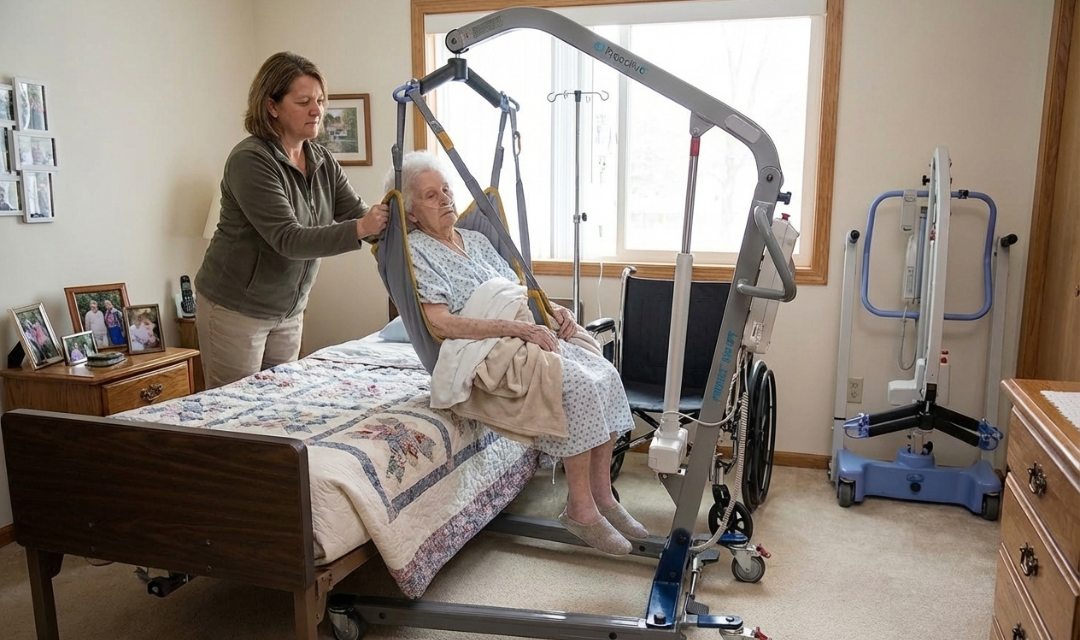
A foldable full-body electric lift built for portability, compact storage, and travel-ready caregiving. It offers powered lifting with a folding frame that fits into many vehicles and storage spaces.

Protekt Transformer Homecare Patient Lift
A dependable homecare lift that starts as a manual hydraulic solution and can be upgraded to electric operation. It offers a strong value point for caregivers wanting safe sling-based transfers at home.

Joerns Hoyer Manual Hydraulic Lift HML400
A trusted manual Hoyer-style lift with an adjustable U-base, ergonomic pump handle, and strong brand recognition. It is built for safe, dependable transfers in both home and light clinical settings.

Protekt Onyx Manual Patient Lift
A strong manual lift with a 450 lb capacity, flexible sling compatibility, and a durable frame built for repeated patient handling. It offers more capacity than many standard manual lifts while staying caregiver-friendly.

Joerns Advance Portable Hoyer Lift
A highly portable aluminum Hoyer lift with a no-tools folding design and tapered swan-neck legs that help the lift get closer to chairs, commodes, and other obstacles. It is a strong choice where portability and compact maneuvering matter.

Protekt 500 Electric Hoyer Lift
A heavier-duty electric Hoyer lift built for higher-capacity full-body transfers, low-bed access, floor recovery lifts, and more demanding daily care routines. It is one of the strongest all-around electric options for larger users and high-use environments.

Invacare Birdie Evo XPLUS Hoyer Lift
A premium commercial-grade lift with advanced stability, high durability, and service-oriented design. Its slow boom dampening and ergonomic sling hook design make it especially attractive for facilities that prioritize smoother handling and long-term dependability.
Which Lift Is Best for Which Problem, Setting, and Transfer Style?
Choosing the right lift comes down to the patient’s transfer pattern, how much weight-bearing they can do, whether sling-based transfers are acceptable, and whether the lift will be used mostly in a home, rehab environment, assisted living setting, or more demanding commercial program.
Best when the patient prefers seated, sling-free transfers
A seated transfer chair can be a strong option when the goal is faster, more natural-feeling movement between a bed, wheelchair, commode, dining chair, or even some vehicle settings without the extra setup of full-body sling lifting.
Best when portability and folding matter most
If the lift needs to travel, fit in a vehicle, or store compactly between uses, portable and folding lift models become much more attractive than larger standard frames.
Best for budget-conscious homecare buyers
Manual hydraulic lifts remain highly relevant because they offer reliable full-body sling transfers without requiring power systems. They are especially attractive for caregivers who want proven transfer support at a lower cost.
Best for heavier patients or higher-capacity needs
Once bariatric or heavy-assist transfers become part of the routine, capacity, stability, sling compatibility, and overall frame confidence matter much more than basic portability.
Best for rehab, assisted living, and commercial use
Facilities often need lifts that can stand up to frequent transfers, multiple caregivers, varied patient sizes, and long-term service expectations. Reliability and stability become more important than convenience alone.
Best when future flexibility matters
Some buyers want to start with a more affordable manual lift but still leave room to move into powered lifting later if the patient declines or the routine becomes more demanding.
Fast Comparison of the Most Important Differences
| What matters most | Strongest fit | Why it stands out |
|---|---|---|
| Seated, sling-free daily transfers | MedCare Mobility Electric Patient Lift Transfer Chair | Ideal for practical everyday movement where dignity, speed, and reduced setup matter. |
| Compact travel and folding transport | Protekt Take-A-Long / Joerns Advance | Both offer strong portability advantages for mobile caregiving and tighter storage situations. |
| Budget-friendly full-body sling lifting | Protekt Transformer / Joerns HML400 | Strong value for homecare buyers who need reliable manual transfer support. |
| Higher manual lift capacity | Protekt Onyx | 450 lb capacity plus broad sling compatibility makes it a strong manual upgrade choice. |
| Higher-end heavy-duty electric lifting | Protekt 500 | Excellent for low-bed access, floor lifts, and heavier full-body transfer demands. |
| Premium facility-focused performance | Birdie Evo XPLUS | Designed for smoother, more stable, professional-grade transfer handling. |
What Features Matter Most in a Patient Transfer Lift
The right patient transfer lift should match the patient’s strength, the room layout, the care setting, and the type of transfers happening every day. This section breaks down the features that matter most so buyers in both homecare and commercial environments can make better decisions with more confidence.
Which Features Matter Most Based on Patient Type and Care Setting?
A feature only matters if it solves the real transfer problem. The most effective way to compare lifts is to look at the patient’s mobility level, how much help the caregiver can provide, and whether the lift is being used at home, in rehab, or in a higher-volume facility setting.
For frail, weak, or unpredictable patients
Focus first on stability, controlled lifting, and a transfer style that reduces unsupported standing time.
- Electric lifting can reduce caregiver strain and create smoother movement.
- Stable bases and consistent alignment matter more than speed alone.
- If the patient cannot reliably assist, full-body support becomes a higher priority.
For bariatric or heavier-assist patients
The most important features are weight capacity, frame stability, and sling flexibility.
- Look beyond basic capacity and consider how often the lift will be used.
- Heavier users often benefit from stronger spreader bar options and more stable bases.
- Facilities may want premium heavy-duty lifts that hold up better under repeated use.
For homecare and tight residential spaces
Focus on base width, maneuverability, storage footprint, and how easily the lift works around beds, toilets, and chairs.
- Compact or folding models can be much easier to live with day to day.
- If the home has narrow hallways or bathrooms, clearance becomes a major decision factor.
- Seated transfer systems may be more practical than full-body sling lifts for certain daily routines.
For facilities, rehab, and commercial use
The biggest priorities are usually durability, repeatability, serviceability, and lift performance over repeated daily transfers.
- Commercial settings often need stronger long-term reliability than occasional homecare use.
- Premium lifts can improve consistency and smoother handling during high-frequency use.
- Maintenance access, battery systems, and sling compatibility matter more in larger care programs.
Choose This Lift for This Situation
This section is designed to make the buying process easier. If a reader is comparing specific lift types, these summaries help clarify which models make the most sense for different transfer needs, patient types, and care settings.
MedCare Mobility Electric Patient Lift Transfer Chair
A seated transfer solution for everyday room-to-room movement where sling-free support, dignity, and faster practical transfers matter.
Protekt Take-A-Long Folding Electric Patient Lift
A folding electric full-body lift designed for portability, compact storage, and travel-friendly caregiving.
Protekt Transformer Homecare Patient Lift
A value-focused hydraulic lift with the option to upgrade to electric later, making it a flexible homecare choice.
Joerns Hoyer Manual Hydraulic Lift HML400
A trusted manual Hoyer-style lift with a strong reputation for reliable day-to-day patient handling.
Protekt Onyx Manual Patient Lift
A higher-capacity manual lift with broad sling compatibility and a stronger frame for more demanding transfers.
Joerns Advance Portable Hoyer Lift
A compact, folding Hoyer lift designed for portability and better access around obstacles in tighter spaces.
Protekt 500 Electric Hoyer Lift
A heavier-duty electric Hoyer lift built for higher-capacity full-body lifting, floor recovery, and more demanding transfer routines.
Birdie Evo XPLUS Invacare Hoyer Lift
A premium commercial-grade lift designed for smoother handling, stronger stability, and higher-end long-term performance.
What Matters Most in Homes vs Facilities?
At Home
Homecare buyers usually benefit most from lifts that are easier to maneuver, easier to store, less intimidating, and practical for daily routines like bed, chair, commode, and wheelchair transfers.
In Facilities and Commercial Settings
Commercial buyers often need stronger durability, smoother daily performance, broader patient range support, and equipment that can hold up under repeated staff use and higher transfer volume.
Helpful Categories and Related Guides
If you are still comparing lift styles, sling needs, or related standing-assist equipment, these pages can help narrow the decision further.
A Simple Final Guide for Safer Transfers at Home and in Care Settings
Before choosing a lift, think about the patient’s strength, the room layout, the caregiver’s physical limits, and whether the daily routine involves bed, wheelchair, toilet, recliner, or car transfers. The safest transfer plan is the one that matches the real routine — not just the lift with the biggest spec sheet.
Top Questions About Lifting Elderly Safely, Transferring Patients, and Choosing the Right Lift
These are the kinds of questions people commonly ask when comparing Hoyer lifts for sale, patient transfer lifts, patient transfer lift chairs, slings, and safer transfer solutions for both residential and commercial care.
The safest approach is to avoid treating the transfer like a raw lifting task. Start by matching the transfer method to the patient’s real condition. If the person is weak, unstable, fearful, or cannot stand reliably, a properly matched transfer device is often safer than repeated manual lifting. The safest home setup usually involves the right lift style, enough room to maneuver it, and a routine that reduces sudden pivoting or catching.
“Hoyer lift” is often used as a broad term for floor-based patient lifts, especially full-body sling lifts. “Patient transfer lift” is a wider category that can include manual and electric Hoyer-style lifts, seated transfer chairs, foldable portable lifts, and other transfer systems. In practical terms, many buyers use “Hoyer lift” when they mean a sling-based lift, while “patient transfer lift” can describe a broader range of patient-moving solutions.
A patient transfer lift chair focuses on seated movement and is often easier for everyday routines like bed, commode, wheelchair, and dining chair transfers. A full-body sling lift is better suited to patients who need more complete support, especially when they cannot safely assist during the transfer. If you are deciding between the two, compare the patient’s balance, standing tolerance, and how much support is needed throughout the entire movement.
For a closer fit comparison, see the section on Choosing & Comparing Patient Lifts.
A manual Hoyer lift can be a good fit for budget-conscious homecare if the caregiver is comfortable operating a hydraulic pump and the patient’s routine is manageable with manual effort. An electric Hoyer lift usually becomes the better choice when transfers happen often, the patient is heavier or more dependent, or caregiver strain is already a problem. The better option depends on frequency of use, caregiver strength, and how smooth and controlled the lift needs to feel during daily routines.
The best patient transfer lift for home use depends on the patient’s mobility level and the layout of the home. In smaller residential spaces, compact or folding lifts can be a stronger fit. If toileting and seated daily routines matter most, a transfer chair may be more practical. If the patient needs full-body sling support, a hydraulic or electric Hoyer-style lift is usually the better path.
The most helpful starting point is to compare lift styles first, then features. See Choosing & Comparing Patient Lifts and What Features Matter Most.
Start with the patient’s current weight, but do not stop there. Capacity should also reflect how often the lift will be used, how much stability is needed, and whether the patient may need more support over time. Buyers often benefit from choosing some margin above the current need, especially in higher-assist or long-term care situations where transfer demands may increase.
Sometimes yes, but only when the lift matches the patient and the environment properly. If the patient is weak, non-weight-bearing, unpredictable, or heavier-assist, solo manual transfers quickly become riskier. One caregiver is far more likely to manage safely when the transfer system reduces direct lifting, improves control, and fits the room without awkward positioning.
Measure doorway width, bed height, toilet or commode clearance, turning room, and any tight spaces around recliners, wheelchairs, and bathroom fixtures. Buyers often focus on lift capacity but forget that poor fit in the room can make the lift much harder to use. In many homes, clearance and maneuverability are just as important as lift type.
The best option depends on whether the patient needs seated daily toileting support or a full-body sling-based lift. In many bathroom-focused routines, a transfer chair or a very practical compact lift becomes more appealing than a larger standard setup. The right answer depends on the room size, the patient’s tolerance for sitting, and how much support is needed before and after toileting.
Bed-to-wheelchair transfers are usually best handled by a lift that offers good alignment, predictable control, and enough clearance around the bed and wheelchair base. If the patient can tolerate seated transfer support, a transfer chair can be attractive. If they need full-body support, a Hoyer-style sling lift is often the stronger choice.
They can be extremely valuable when portability, compact storage, or multi-location caregiving matters. A folding lift is often a strong choice for families who travel, need to fit the lift into a vehicle, or want easier storage between uses. The tradeoff is that portability should never come at the expense of the support level the patient actually needs.
Sling choice should match the patient’s body support needs, transfer purpose, and lift compatibility. Full-body slings are common for non-weight-bearing users, while other sling types may be better for toileting or partial support needs. Sling selection is just as important as lift selection, especially for comfort, safety, and ease of use.
You can explore patient lift slings here or read the guide to choosing the right sling.
A sit-to-stand device is meant for patients who can still bear some weight and participate in the movement. A full-body patient lift is meant for people who need more complete support and cannot safely stand through the transfer. If the patient still has some standing ability, sit-to-stand devices may be worth comparing before choosing a full-body lift.
For that decision, see the guide to sit-to-stand devices.
Commercial buyers often need lifts that can handle frequent daily use, varied patient sizes, stronger service expectations, and smoother repeat performance across multiple caregivers. In those settings, durability, stability, and long-term reliability often matter more than simple portability. Facilities usually benefit from choosing lifts that match transfer volume and patient mix, not just price point.
Bariatric or heavier-assist situations usually call for stronger capacity, better frame stability, and sling support that can handle more demanding transfer loads. These buyers often benefit from comparing higher-capacity manual and electric lifts rather than relying on a standard entry-level model. Floor-lift capability and low-bed access may also matter more in these situations.
If you are ready to compare lift types more directly, you can browse Hoyer lifts for sale, explore hydraulic patient lifts, review patient lift slings, or go back to Choosing & Comparing Patient Lifts to review which lift styles fit different scenarios.