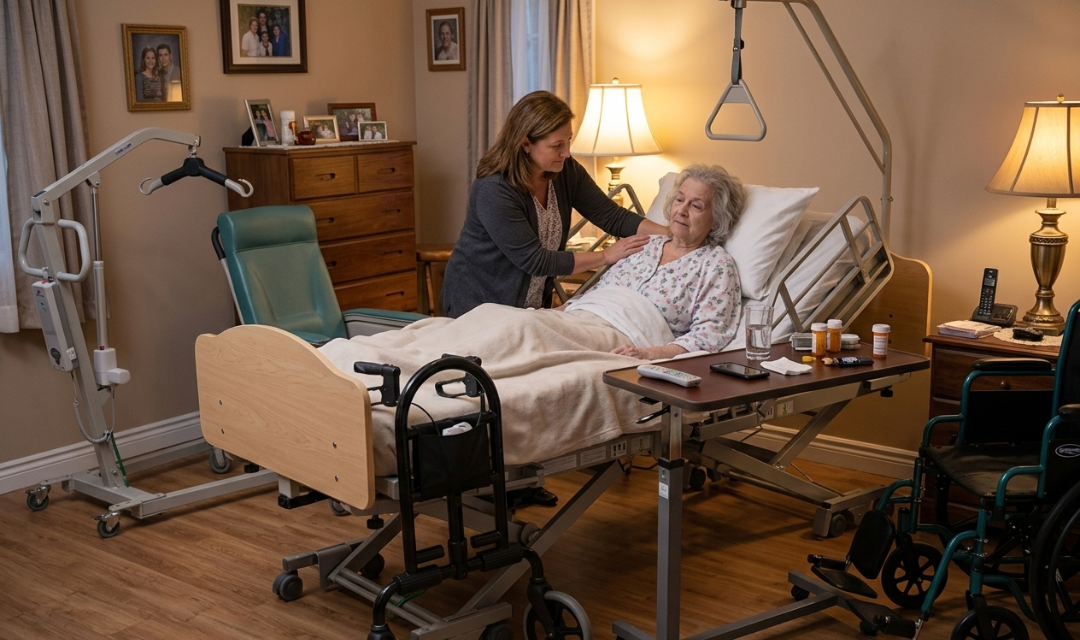
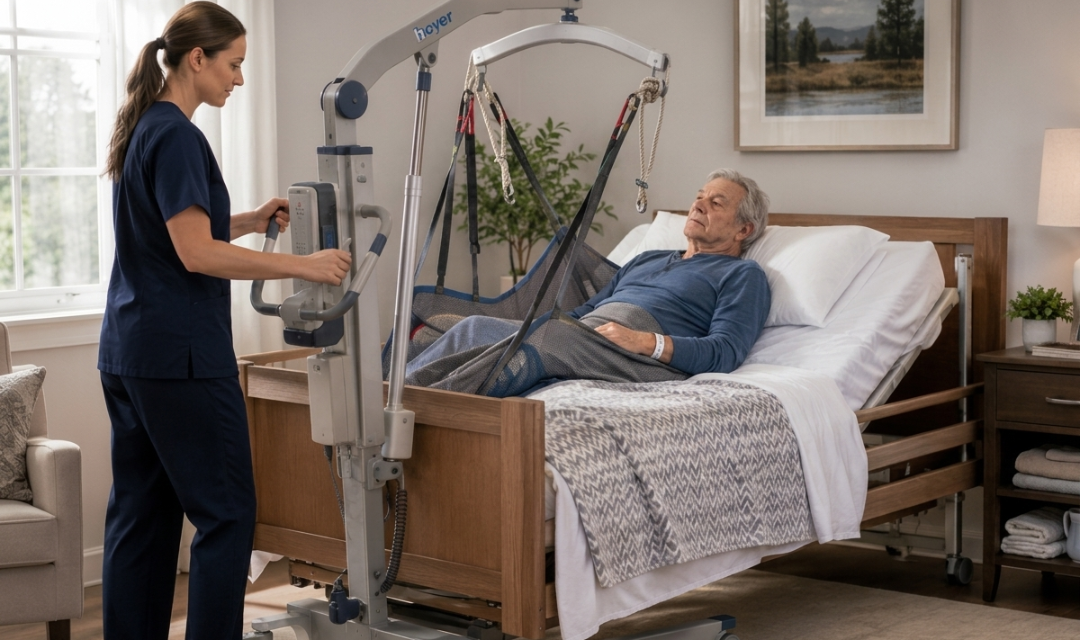
Caregiver preparing a bedridden elderly patient transfer using an electric Hoyer lift and full-body patient sling in a homecare bedroom

26

May

How to Transfer an Elderly Patient Safely at Home: Hoyer Lifts, Slings & Real Caregiver Solutions

How to Transfer an Elderly Patient Safely at Home

When families search for how to transfer an elderly patient, they are usually not looking for general caregiver advice. They are facing a real problem at home. A loved one may be too weak to stand, unable to walk, recovering from surgery, living with stroke paralysis, sliding during transfers, or becoming too difficult to move safely from bed to wheelchair, toilet, recliner, or shower chair.

The safest transfer method depends on the patient’s strength, balance, weight, medical condition, and ability to follow directions. A patient who can stand and pivot may need a very different solution than a bedridden patient who cannot move or bear weight. This is why families often start asking questions like how to lift a bedridden patient, how to use a Hoyer lift, how to use a patient lift at home, or what is the best sling for a Hoyer lift?

The goal is not simply to move the patient from one place to another. The goal is to transfer them safely while reducing the risk of falls, skin injuries, caregiver back strain, shoulder injuries, fear, embarrassment, and daily stress.

Start by Identifying the Patient’s True Transfer Ability

Before choosing any transfer method, ask one important question:

Can the patient safely help with the movement, or are they fully dependent on the caregiver?

This question matters because unsafe transfers often happen when families continue using strength, pulling, or manual lifting after the patient can no longer safely assist. If the patient cannot sit upright, stand, pivot, or support their own weight, the safer answer may be a patient lift sling, sit-to-stand lift, full-body Hoyer lift, or another patient transfer solution.

  • Can the patient sit upright on the edge of the bed?
  • Can the patient bear weight through their legs?
  • Can the patient stand and pivot safely?
  • Does the patient slide, lean, stiffen, shake, or lose balance?
  • Is one side weaker from stroke, paralysis, surgery, or illness?
  • Is the caregiver using full body strength to move the patient?
  • Has the patient fallen, slipped, or nearly fallen during a transfer?

If the patient is unstable, weak, non-weight-bearing, confused, obese, paralyzed, or fully dependent, the goal should not be to “lift harder.” The goal should be to choose a safer transfer method that supports the patient’s body and protects the caregiver from injury.

Common Patient Transfer Problems Families Search For

Most people do not begin by searching for medical equipment. They begin by searching for the exact problem happening in their home. These are the real-world situations that often lead families to explore Hoyer lifts, patient lifts, transfer slings, toileting slings, and safer home transfer equipment:

  • “My father is bedridden and cannot move.”
  • “How do I lift a bedridden patient safely?”
  • “How do I transfer an elderly patient from bed to wheelchair?”
  • “How do I move someone who cannot stand?”
  • “My mother keeps sliding during transfers.”
  • “Can one person use a Hoyer lift at home?”
  • “How do I use a patient lift at home?”
  • “What is the best sling for a Hoyer lift?”
  • “How do I transfer an elderly patient to the toilet safely?”

These questions usually mean the patient’s care needs have changed. What worked last month may no longer be safe today. A patient may lose strength after surgery, become weaker after a hospital stay, develop balance issues, decline after a stroke, or become too fearful to cooperate during transfers.

Match the Transfer Method to the Patient’s Condition

There is no single best way to transfer every elderly patient. The safest option depends on whether the patient can stand, partially stand, pivot, sit upright, follow directions, or support their own body weight.

Patient Situation Safer Transfer Option to Consider
Patient can stand and pivot with help Caregiver assistance, transfer belt, or pivot transfer support
Patient has weak legs but some standing ability Sit-to-stand lift or standing patient lift sling
Patient cannot stand or bear weight Full-body patient lift with proper sling support
Patient is bedridden or fully dependent Electric Hoyer lift with full-body patient lift sling
Patient needs toilet transfers Toileting sling, commode opening sling, or transfer toileting aid
Patient is obese or bariatric Bariatric patient lift with reinforced bariatric sling
Patient has stroke weakness or one-sided paralysis Supportive full-body sling or lift system based on weight-bearing ability

This is why choosing the right patient transfer method is not only about convenience. It is about matching the equipment to the patient’s real condition. A patient who can still stand may not need the same device as someone who is fully bedridden. A patient who needs bathroom transfers may need a different sling than someone being moved from bed to wheelchair.

When a Hoyer Lift or Patient Lift May Be Needed

A Hoyer lift, also called a patient lift, may be needed when manual transfers are no longer safe. This often happens when the elderly patient cannot stand, cannot pivot, has weak legs, is recovering from a serious surgery, has paralysis, or places too much strain on the caregiver during daily transfers.

Families often start researching how to use a Hoyer lift after a near fall, a painful caregiver injury, or a difficult transfer from the bed to a wheelchair. A patient lift can help raise and move the patient with more support, while the sling holds the patient’s body during the transfer.

A patient lift may be helpful when:

  • The patient cannot safely stand or bear weight.
  • The patient’s legs buckle during transfers.
  • The patient is fully bedridden or mostly bedbound.
  • The caregiver has back, shoulder, or wrist pain from lifting.
  • The patient has slipped, fallen, or nearly fallen.
  • Transfers to the toilet, wheelchair, or recliner have become stressful.
  • The patient is obese, bariatric, paralyzed, or recovering from stroke.
  • The caregiver is afraid of dropping or hurting the patient.

Using a patient lift at home does not mean the caregiver has failed. It means the transfer has become too risky to handle with strength alone. For many families, the right lift and sling can make daily care safer, calmer, and more manageable.

Important Safety Reminder

An elderly patient should never be dragged across the bed, pulled by the arms, lifted under the shoulders, or rushed through a transfer when they cannot safely assist. A safer transfer should support the patient’s body, reduce caregiver strain, and use the right equipment for the patient’s mobility level.

Why the Patient Lift Sling Is Just as Important as the Lift

A patient lift sling is the fabric support that goes under and around the patient’s body and connects to the Hoyer lift or patient lift. The sling helps hold the patient during the transfer, which is why sling choice is one of the most important parts of safe patient transfers at home.

The best sling for a Hoyer lift depends on the patient’s size, weight, body control, transfer goal, toileting needs, skin sensitivity, and ability to sit or support themselves. A fully bedridden patient may need a full-body sling. A patient who needs bathroom help may need a toileting sling or commode opening sling. A heavier patient may need a bariatric sling with the right weight capacity and reinforced support.

Choosing the wrong sling can make transfers uncomfortable, unstable, or unsafe. Choosing the right sling can improve positioning, reduce slipping, protect the patient’s dignity, and make the transfer easier for the caregiver.

The Safer Goal: Move the Patient Without Forcing the Body

The safest patient transfer is not about using more strength. It is about using the right method for the patient’s condition. When a loved one becomes too weak to move safely, the caregiver should not have to risk their back, shoulders, or health every day just to complete basic transfers.

Whether the main concern is how to transfer an elderly patient, how to lift a bedridden patient, how to use a patient lift at home, or which patient lift sling is safest, the most important starting point is the same: understand the patient’s mobility level first, then match the transfer solution to the real problem.

Section One Summary

The safest way to transfer an elderly patient at home depends on whether the patient can stand, pivot, sit upright, and assist during the movement. If the patient is bedridden, non-weight-bearing, weak, obese, paralyzed, or at risk of falling, a Hoyer lift, patient lift, and properly selected sling may provide a safer transfer solution than manual lifting.

How to Lift a Bedridden Patient Safely Without Causing Injury

One of the most common and stressful situations families face at home is trying to figure out how to lift a bedridden patient safely. Many caregivers suddenly become responsible for moving a loved one who can no longer stand, walk, reposition themselves, or help during transfers. This often happens after a stroke, surgery, hospitalization, paralysis, severe weakness, dementia progression, or advanced illness.

At first, families may try to manage using strength alone. A caregiver may pull under the patient’s arms, attempt to manually lift from the bed, or try to “quickly move” the patient from bed to wheelchair without proper support. Unfortunately, this is where many injuries, falls, and transfer accidents begin.

Important: A bedridden patient should never be manually dragged, lifted under the shoulders, or forced into unsafe movements when they cannot support their own body weight. Safer transfer methods often involve a patient lift sling, transfer device, or Hoyer lift designed to support the patient’s full body during movement.

Why Bedridden Patient Transfers Become So Difficult

Bedridden patients are often unable to assist during movement. Some cannot sit upright without support. Others cannot control their trunk, neck, or legs during transfers. This means the caregiver is trying to manage the patient’s full body weight while also preventing slipping, skin injuries, falls, and panic during movement.

Families commonly experience problems such as:

  • The patient sliding during transfers.
  • The caregiver hurting their back or shoulders.
  • The patient becoming fearful during lifting.
  • Difficulty transferring from bed to wheelchair.
  • Unsafe bathroom or toileting transfers.
  • Near falls while trying to pivot manually.
  • Difficulty repositioning heavier or bariatric patients.
  • The patient being too weak to stand anymore.

These situations usually signal that manual lifting is no longer the safest solution. At this point, families often begin researching safer home transfer methods and exploring equipment like electric Hoyer lifts, transfer aids, or supportive patient lift slings.

The Safest Way to Lift a Bedridden Patient Depends on Their Mobility Level

There is no single transfer method that works for every bedridden patient. The safest approach depends on how much mobility the patient still has and whether they can assist during movement.

Patient Condition Safer Transfer Method
Can slightly assist and sit upright Pivot transfer or sit-to-stand support
Weak but partially weight-bearing Sit-to-stand lift with standing sling
Cannot stand safely Full-body patient lift and sling system
Fully bedridden and dependent Electric Hoyer lift with full-body sling
Obese or bariatric patient Bariatric patient lift and reinforced sling

Understanding the patient’s true mobility level is extremely important. A patient who cannot support themselves safely should not be transferred using force, pulling, or unstable manual lifting methods.

How a Hoyer Lift Helps Move a Bedridden Patient

A Hoyer lift, also called a patient lift, is designed to safely raise and transfer a patient from one surface to another while reducing physical strain on the caregiver. Instead of manually carrying or pulling the patient, the lift uses a supportive sling system attached to a hydraulic or electric lifting frame.

Families often search how to use a Hoyer lift because they are overwhelmed by daily transfers and worried about dropping the patient. In many situations, the lift becomes safer for both the caregiver and the patient because the patient’s body is fully supported during the movement.

A Hoyer lift may help with transfers involving:

  • Bed to wheelchair transfers.
  • Wheelchair to recliner transfers.
  • Toilet and commode transfers.
  • Shower and bathing transfers.
  • Floor recovery after a fall.
  • Moving heavier or bariatric patients.
  • Patients recovering from stroke or paralysis.

Families comparing transfer options often explore both electric patient lifts and hydraulic Hoyer lifts depending on the patient’s condition, caregiver strength, transfer frequency, and home environment.

Helpful Related Guides

If you are still exploring the safest transfer solution for a bedridden patient, these detailed guides may help:

Why the Sling Matters So Much During Transfers

The sling is one of the most important parts of safe patient lifting. A patient lift sling supports the patient’s body during the transfer and connects directly to the lift system. Choosing the wrong sling can lead to discomfort, instability, poor positioning, sliding, or unsafe transfers.

The best sling for a Hoyer lift depends on the patient’s specific needs. Some patients require full-body support while others need easier toileting access or additional positioning assistance.

Common sling types include:

  • Full-body slings for fully dependent or bedridden patients.
  • Commode opening slings for toilet and hygiene transfers.
  • Mesh bathing slings for shower and bathing use.
  • Bariatric slings for heavier patients requiring reinforced support.
  • Sit-to-stand slings for patients with partial standing ability.

Families dealing with fully dependent patients often explore supportive full-body patient lift slings, while patients struggling with bathroom transfers may need commode opening slings designed specifically for toileting access.

Common Mistakes Families Make When Lifting a Bedridden Patient

Many home caregivers are never properly trained in patient transfers. They simply do their best in difficult situations. Unfortunately, some common transfer habits can increase the risk of injury for both the caregiver and patient.

Unsafe transfer mistakes may include:

  • Pulling the patient by the arms or shoulders.
  • Trying to “carry” the patient manually.
  • Rushing bathroom transfers.
  • Using the wrong sling size.
  • Attempting one-person transfers when two caregivers are needed.
  • Not locking wheelchair brakes before transfer.
  • Using equipment beyond its weight capacity.
  • Trying to manually reposition obese patients without support.

Over time, these situations can lead to caregiver burnout, chronic back pain, shoulder injuries, patient fear, bruising, and dangerous falls. Safer transfer systems are designed to reduce these risks and create more controlled patient movement at home.

How Families Know It Is Time for a Safer Transfer Solution

Families often delay getting transfer equipment because they feel uncertain, overwhelmed, or emotionally unprepared for the patient’s decline. However, there are usually clear signs that safer transfer support is becoming necessary.

Common signs include:

  • The patient can no longer stand safely.
  • The caregiver experiences back pain after transfers.
  • The patient has become too heavy to move safely.
  • The patient has already slipped or nearly fallen.
  • Transfers now require extreme physical effort.
  • Bathroom transfers have become unsafe or embarrassing.
  • The caregiver feels afraid during transfers.
  • The patient has become fully dependent after stroke, illness, or surgery.

At this stage, many families begin researching safer home transfer systems, including Hoyer lifts, transfer aids, slings, and even patient transfer lift chairs that help reduce the physical strain of daily movement.

Section Two Summary

The safest way to lift a bedridden patient is to first understand how much mobility the patient still has. When the patient can no longer stand, pivot, or support their own body weight safely, manual lifting may become dangerous. In many situations, a Hoyer lift, patient lift sling, or supportive transfer device can help create safer and more controlled patient transfers at home.

My Loved One Cannot Stand Anymore — What Are the Safest Transfer Options?

One of the biggest turning points families face at home is when an elderly parent, disabled loved one, or recovering patient suddenly cannot stand safely anymore. Sometimes the decline happens slowly over time. Other times it happens after a stroke, surgery, hospitalization, fall, paralysis, or severe illness.

At first, many caregivers continue trying to transfer the patient manually. They may attempt to lift the patient under the arms, pull them upward from the bed, or support their full weight during bathroom or wheelchair transfers. Eventually, however, the transfer becomes unsafe, exhausting, and emotionally stressful for everyone involved.

This is the stage where families begin searching questions like:

  • How do you transfer a patient who cannot stand?
  • What is the safest way to move a bedridden patient?
  • How does a Hoyer lift work at home?
  • Can one person use a Hoyer lift?
  • What type of sling does my loved one need?
  • Should we use a sit-to-stand lift or full-body lift?

The safest answer depends on one important factor:

Key Point: The best transfer solution is based on how much mobility the patient still has. Some patients can still partially stand and participate during transfers, while others require full-body support because they are non-weight-bearing, paralyzed, bedridden, or unable to safely control their movement.

Not Every Patient Needs the Same Transfer Method

One of the biggest misconceptions families have is assuming every patient needs the same type of lift or sling. In reality, transfer equipment should match the patient’s condition, strength, balance, weight, cognition, and ability to cooperate during movement.

A patient recovering from knee surgery may still be able to stand with assistance, while a stroke patient with one-sided paralysis may need much more body support during transfers. A dementia patient may physically stand but become unstable, confused, or unpredictable during movement. A bariatric patient may require reinforced lifting systems due to weight distribution and caregiver safety concerns.

This is why patient transfer systems are typically divided into two main categories:

  • Sit-to-stand transfer systems for patients with some standing ability.
  • Full-body patient lifts for patients who cannot safely stand or bear weight.

When a Sit-to-Stand Lift May Be the Better Option

A sit-to-stand lift is often used when the patient still has partial strength in their legs and can assist during the transfer. Instead of fully lifting the patient off the ground like a full-body Hoyer lift, the device helps raise the patient from a seated position into a supported standing position.

This type of transfer system is commonly used for:

  • Patients with weak legs but some weight-bearing ability.
  • Patients recovering from surgery or rehabilitation.
  • Elderly patients struggling to stand from bed or toilet.
  • Patients with fatigue or instability during pivot transfers.
  • Frequent bathroom and toileting transfers.
  • Caregivers trying to reduce physical lifting strain.

Many caregivers prefer sit-to-stand systems because the transfers can feel faster, more natural, and less intimidating for patients who still have some mobility.

Families exploring these options often compare different sit-to-stand patient lift devices and supportive sit-to-stand slings designed to stabilize the patient during movement.

A Sit-to-Stand Lift May Work Best If:

  • The patient can still bear some weight through their legs.
  • The patient can follow instructions during transfers.
  • The patient can partially stand with support.
  • The caregiver wants safer toilet or wheelchair transfers.
  • Manual pivot transfers are becoming unsafe.

When a Full-Body Hoyer Lift Becomes the Safer Choice

If the patient can no longer stand safely, cannot support their own weight, is fully bedridden, or becomes unstable during transfers, a full-body patient lift is often the safer solution.

This is where many families begin researching how to use a Hoyer lift at home. A full-body patient lift uses a sling system that supports the patient underneath their body while the lift slowly raises and transfers them from one location to another.

These systems are commonly used for:

  • Bedridden patients.
  • Stroke patients with paralysis or severe weakness.
  • Non-weight-bearing patients.
  • Patients with advanced dementia instability.
  • Bariatric or obese patients.
  • Patients recovering from severe illness or surgery.
  • Caregivers unable to safely lift manually anymore.

Many caregivers fear that using a Hoyer lift will feel dangerous or complicated. In reality, modern patient lifts are specifically designed to create more controlled, supported, and stable transfers when used correctly with the proper sling.

Families comparing transfer systems often explore both electric Hoyer lifts and hydraulic patient lifts depending on caregiver strength, transfer frequency, home space, and patient needs.

How a Hoyer Lift Actually Works at Home

One of the biggest fears caregivers have is not understanding how the lifting process works. Many imagine the patient dangling unsafely in the air or fear that the patient will slip during movement. Understanding the process usually helps reduce much of this anxiety.

A Hoyer lift transfer generally works like this:

  1. The sling is positioned underneath the patient. Depending on the patient’s condition, the sling may remain under the patient in bed or be carefully positioned before transfer.
  2. The sling straps attach to the lift spreader bar. Different sling loops affect how upright or reclined the patient sits during the movement.
  3. The lift slowly raises the patient. The patient remains supported by the sling while the caregiver guides the lift frame.
  4. The patient is transferred to the new surface. This may include a wheelchair, recliner, commode, shower chair, or another bed position.
  5. The patient is gently lowered into position. Once safely positioned, the sling straps are removed.

The goal is not speed. The goal is stability, support, and controlled movement.

Important: The sling does most of the patient support during a Hoyer lift transfer. This is why choosing the correct patient lift sling is extremely important for comfort, positioning, toileting access, body support, and transfer safety.

Can One Person Use a Hoyer Lift at Home?

This is one of the most commonly searched patient transfer questions online.

In some situations, a trained caregiver may safely use a Hoyer lift alone depending on the patient’s condition, the lift type, the sling fit, the patient’s cooperation level, and the transfer environment. However, certain patients may still require two caregivers for safer positioning and control during movement.

Factors that may affect one-person transfer safety include:

  • The patient’s body weight.
  • Whether the patient is confused or combative.
  • The patient’s trunk control and stability.
  • How narrow or crowded the room is.
  • Bathroom transfer difficulty.
  • The caregiver’s experience using the lift.
  • Whether the patient has paralysis or severe weakness.

Many families are surprised to learn that a proper patient lift system can actually reduce transfer fear for both the caregiver and patient because the movement becomes more supported and controlled.

How the Right Sling Improves Stability and Comfort

One reason families sometimes struggle with Hoyer lift transfers is because the sling itself is not properly matched to the patient’s needs.

The best sling for a Hoyer lift depends on:

  • The patient’s body size and weight.
  • Whether the patient can sit upright independently.
  • Toileting and hygiene needs.
  • Stroke paralysis or one-sided weakness.
  • Amputation or positioning challenges.
  • Skin sensitivity and pressure concerns.
  • The patient’s comfort level during transfers.

For example, a fully dependent patient may require a supportive full-body patient lift sling, while a patient needing bathroom assistance may benefit from a commode opening sling designed to provide easier toileting access.

Families who are still unsure which sling type is safest can also explore this detailed patient lift sling guide explaining different sling styles, positioning levels, and transfer uses.

The Goal Is Safer Transfers — Not More Physical Strength

Many caregivers wait too long before exploring safer transfer equipment because they feel guilty, overwhelmed, or emotionally unprepared for the patient’s decline. But needing a lift system does not mean the caregiver has failed. It simply means the patient’s condition now requires more support than manual lifting can safely provide.

Whether the patient is recovering from stroke, living with paralysis, struggling with obesity, becoming unstable from dementia, or simply too weak to stand safely anymore, the goal is always the same:

Create safer, more controlled, and less physically dangerous transfers for both the patient and caregiver.

Section Three Summary

The safest transfer option depends on how much mobility the patient still has. Patients who can partially stand may benefit from sit-to-stand transfer systems, while bedridden or non-weight-bearing patients often require a full-body Hoyer lift and supportive sling. Understanding how Hoyer lifts and patient slings work can help families create safer and more stable transfers at home while reducing physical strain and fall risk.

What Is a Patient Lift Sling and How Do You Choose the Right One?

One of the most confusing parts of choosing a patient transfer system is understanding the sling itself. Many families focus entirely on the Hoyer lift or patient lift frame, only to later realize that the patient lift sling is actually one of the most important parts of safe transfers.

The sling is the supportive fabric system that holds the patient’s body during movement. It connects directly to the patient lift and determines how the patient sits, reclines, feels supported, and transfers between surfaces.

This is why many caregivers begin searching questions like:

  • What is the best sling for a Hoyer lift?
  • What type of sling does my loved one need?
  • How do I choose a patient lift sling?
  • What sling is best for a bedridden patient?
  • What sling works best for toileting?
  • Are patient lift slings universal?

Choosing the wrong sling can lead to discomfort, instability, sliding, poor positioning, difficult toileting access, and unsafe transfers. Choosing the correct sling can dramatically improve comfort, stability, safety, caregiver control, and daily transfer confidence.

Important: The safest transfer system is not only about choosing the right Hoyer lift. The sling itself must match the patient’s body type, mobility level, transfer goals, toileting needs, positioning needs, and weight capacity.

What Does a Patient Lift Sling Actually Do?

A patient lift sling is designed to support the patient’s body while the lift raises and transfers them between surfaces. The sling wraps underneath the patient and attaches to the lift spreader bar using secure connection loops.

Depending on the sling design, the patient may sit more upright, more reclined, or receive additional support around the head, neck, hips, thighs, or back.

The sling plays a major role in:

  • Patient stability during transfers.
  • Preventing slipping or sliding.
  • Comfort during lifting movement.
  • Pressure distribution and positioning.
  • Toileting and hygiene access.
  • Reducing caregiver strain.
  • Supporting weak or paralyzed body areas.

This is why sling choice matters so much for patients recovering from stroke, paralysis, surgery, obesity, dementia decline, weakness, or long-term immobility.

Families exploring different sling styles often begin with these patient lift sling options and compare them based on the patient’s condition and daily transfer needs.

Why Sling Sizing Is Extremely Important

One of the biggest mistakes caregivers make is assuming that any sling will work for any patient. In reality, improper sling sizing can create serious transfer problems.

A sling that is too small may feel tight, unstable, or uncomfortable. A sling that is too large may allow the patient to slide too deeply into the fabric or become poorly positioned during movement.

Proper sizing affects:

  • Patient comfort.
  • Transfer stability.
  • Body positioning.
  • Pressure support.
  • Toileting access.
  • Head and neck support.
  • Overall transfer safety.

Most slings are available in multiple sizes and weight capacities ranging from smaller patient support up to reinforced bariatric models for heavier patients.

Common Signs the Sling May Not Fit Correctly

  • The patient slides excessively during transfers.
  • The patient feels unstable or tilted.
  • The sling bunches underneath the body.
  • The patient complains of discomfort or pressure.
  • The patient sits too reclined or too upright.
  • The patient’s legs or shoulders are poorly supported.
  • Transfers feel awkward or unsafe.

Different Types of Patient Lift Slings Explained

There is no single “best” patient sling for every situation. Different sling styles are designed for different mobility levels, transfer goals, and patient conditions.

Understanding these differences is extremely important when choosing the safest transfer solution at home.

Full-Body Slings

Full-body patient lift slings are among the most common options for bedridden, non-weight-bearing, paralyzed, or fully dependent patients.

These slings support most of the patient’s body during transfers and may include additional head and neck support for patients with poor trunk control.

Full-body slings are commonly used for:

  • Bedridden patients.
  • Stroke recovery.
  • Paralysis.
  • Advanced weakness.
  • Long-term immobility.
  • Patients unable to safely sit unsupported.

Divided Leg Slings

Divided leg slings separate underneath each leg rather than using a full hammock-style support. These slings are commonly used for seated transfers because they allow easier positioning into wheelchairs, recliners, and commodes.

Many caregivers prefer divided leg slings for:

  • Wheelchair transfers.
  • General seated positioning.
  • Patients with some upper body control.
  • Transfers requiring easier leg positioning.

Toileting & Commode Slings

Commode opening slings, also called toileting slings, are designed to provide easier bathroom and hygiene access during transfers.

These slings expose more of the lower body area to help with:

  • Toilet transfers.
  • Bathroom assistance.
  • Hygiene care.
  • Changing assistance.

They are often used for patients who still have some upper body strength and can tolerate a more upright transfer position.

Mesh Bathing Slings

Mesh slings are commonly used during showering and bathing because the material allows water drainage and dries faster than traditional padded fabric.

These slings may help with:

  • Shower chair transfers.
  • Bathing routines.
  • Pool therapy situations.
  • Reducing moisture buildup.

Some caregivers also prefer mesh slings because they feel lighter and easier to reposition underneath the patient.

Padded Slings

Padded slings include additional cushioning for patients requiring longer transfer times, greater comfort, skin protection, or pressure reduction.

These slings may be beneficial for:

  • Fragile skin conditions.
  • Elderly patients with pressure sensitivity.
  • Long-term seated positioning.
  • Patients easily irritated during movement.

Amputee Slings

Amputee slings are designed to improve balance and positioning for patients missing one or both lower limbs.

Because standard slings rely heavily on leg positioning for stability, amputee slings provide modified support systems to help reduce slipping and maintain safer positioning during transfers.

Bariatric Slings

Bariatric slings are reinforced for heavier patients requiring higher weight capacities and additional body support.

These slings are often used alongside bariatric patient lifts for:

  • Obese or bariatric patients.
  • Higher weight distribution needs.
  • Greater caregiver safety.
  • More secure body positioning.

How to Choose the Right Sling for the Patient’s Real Situation

The safest sling is not simply the “most popular” sling. It is the sling that best matches the patient’s real transfer challenges, body control, and daily care routine.

Patient Situation Sling Type Often Used
Fully bedridden patient Full-body sling
Toileting assistance Commode or toileting sling
Bathing or shower transfers Mesh bathing sling
Stroke paralysis or poor trunk control Supportive full-body sling with head support
Amputee patient Amputee sling
Obese or bariatric patient Bariatric reinforced sling
Patient with some standing ability Sit-to-stand sling

Families who are still uncertain which sling is safest for their loved one often explore this complete patient lift sling buying guide which explains transfer situations, sling positioning levels, toileting access, body support differences, and compatibility considerations.

The Right Sling Can Completely Change Daily Transfers

For many caregivers, the correct sling becomes the difference between stressful transfers and controlled transfers. The right sling can help reduce caregiver strain, improve positioning, prevent slipping, simplify bathroom routines, and make the patient feel more secure during movement.

Whether the patient is bedridden, recovering from stroke, struggling with obesity, unable to stand safely, or requiring frequent toileting assistance, the sling should match the patient’s real-world care needs — not just the lift itself.

Section Four Summary

A patient lift sling is one of the most important parts of safe patient transfers. Different sling styles are designed for different situations including bedridden patients, toileting assistance, bathing, bariatric care, stroke recovery, amputees, and partial standing support. Choosing the correct sling based on the patient’s condition, body support needs, and transfer goals can greatly improve transfer safety, positioning, comfort, and caregiver control.

Stroke, Bariatric & Bathroom Transfer Challenges — Safer Solutions for High-Risk Patient Transfers

Some patient transfers become far more difficult and dangerous because of the patient’s medical condition, body weight, weakness level, or bathroom transfer needs. Families caring for stroke patients, obese or bariatric loved ones, paralyzed patients, or patients needing toileting assistance often face transfer situations that standard lifting techniques simply cannot safely handle.

This is where many caregivers begin urgently searching questions like:

  • How do you transfer a stroke patient safely?
  • How do you move a paralyzed patient without injury?
  • What is the safest way to transfer an obese patient?
  • What sling is best for bariatric patients?
  • How do you transfer an elderly patient to the toilet safely?
  • Can a Hoyer lift fit into a bathroom?
  • What is a commode sling used for?

These are not minor caregiving concerns. These are high-risk transfer situations involving falls, instability, caregiver injuries, patient embarrassment, loss of dignity, bathroom accidents, and daily physical strain.

Key Point: Stroke patients, bariatric patients, and patients requiring bathroom assistance often need more specialized transfer solutions than standard manual lifting methods. Proper support, safe positioning, reinforced slings, and controlled transfer systems can greatly reduce fall risk and caregiver strain.

How to Transfer a Stroke Patient Safely

Stroke patients often present some of the most difficult transfer challenges at home because the body may no longer move evenly or predictably. Many stroke survivors experience one-sided weakness, paralysis, poor trunk control, balance instability, muscle stiffness, fatigue, or limited coordination during movement.

This creates major transfer risks because the patient may suddenly lean, collapse, lose balance, or become unable to support one side of the body during standing or repositioning.

Families caring for stroke patients often struggle with:

  • Weakness on one side of the body.
  • Loss of arm or leg control.
  • Difficulty standing safely.
  • Shoulder instability during lifting.
  • Fear of falling during transfers.
  • Difficulty repositioning in bed or wheelchair.
  • Unsafe bathroom transfers.
  • Caregiver exhaustion from constant physical support.

One of the most important safety concerns during stroke transfers is avoiding shoulder injuries. Pulling a stroke patient upward by the affected arm can lead to serious shoulder strain, pain, or joint damage.

Instead, the transfer should focus on:

  • Supporting the patient’s trunk and hips.
  • Maintaining balanced positioning.
  • Reducing sudden twisting movements.
  • Using controlled transfer assistance.
  • Preventing slipping or leaning during movement.

Depending on the patient’s mobility level, caregivers may use:

  • Transfer belts for mild weakness.
  • Sit-to-stand systems for partial standing ability.
  • Full-body patient lift slings for paralysis or severe instability.
  • Electric Hoyer lifts for non-weight-bearing stroke patients.

Patients with severe weakness, poor balance, or paralysis often require supportive full-body patient lift slings that help stabilize the body during transfers while reducing the risk of sudden collapse or leaning.

Why Bariatric Patient Transfers Become So Dangerous

Transferring obese or bariatric patients safely is one of the most physically demanding situations caregivers face at home. The challenge is not simply “weight.” The real issue is how body weight distribution, instability, limited mobility, and caregiver strain combine during movement.

Many caregivers attempt to manually reposition or lift bariatric patients without realizing how dangerous the situation has become. Over time, this can lead to:

  • Severe caregiver back injuries.
  • Shoulder and wrist strain.
  • Unsafe lifting posture.
  • Falls during transfers.
  • Patient sliding or instability.
  • Difficulty repositioning in bed.
  • Multiple caregiver dependency.

Manual lifting becomes especially dangerous when the patient cannot stand safely, loses balance suddenly, or requires full-body support during movement.

Signs a Bariatric Transfer Has Become Unsafe

  • The caregiver cannot safely control the patient’s weight.
  • Transfers require extreme physical effort.
  • The patient slides during lifting.
  • Manual repositioning causes back pain.
  • Transfers require multiple people.
  • The patient cannot pivot or stand steadily.
  • The caregiver fears dropping the patient.

In these situations, many families begin exploring reinforced transfer systems such as:

  • Bariatric patient lifts.
  • Electric Hoyer lifts with higher weight capacities.
  • Reinforced bariatric slings.
  • Wider-base lift systems for improved stability.
  • Full-body transfer slings with greater support.

These systems help distribute body weight more safely while reducing strain on the caregiver during transfers.

Families comparing bariatric transfer options often explore electric patient lifts, hydraulic Hoyer lifts, and reinforced patient lift slings designed for higher weight support and safer positioning.

Bathroom & Toileting Transfers Are One of the Biggest Homecare Challenges

One of the most emotionally stressful caregiving situations is helping an elderly or disabled patient safely transfer to the toilet or shower. Many families do not realize how difficult bathroom transfers become until the patient can no longer stand, pivot, or move safely in a small bathroom space.

Bathroom transfers often involve:

  • Slippery floors.
  • Narrow room layouts.
  • Tight wheelchair positioning.
  • Weak standing ability.
  • Urgent movement situations.
  • Fear of embarrassment.
  • Loss of patient dignity.

This is why bathroom transfers are one of the most common locations for patient falls and caregiver injuries.

Families frequently search:

  • How do you transfer an elderly patient to the toilet safely?
  • What sling works best for toileting?
  • Can a Hoyer lift fit into a bathroom?
  • What is a commode sling?
  • How do you shower a bedridden patient safely?

Why Toileting Slings Matter So Much

Standard full-body slings may not always provide practical bathroom access during toileting transfers. This is why many caregivers explore specialized commode opening slings, also called toileting slings.

These slings are designed to allow easier lower-body access while still supporting the patient during movement.

Toileting slings may help with:

  • Toilet transfers.
  • Bathroom hygiene routines.
  • Reducing awkward repositioning.
  • Caregiver access during hygiene care.
  • Improving patient dignity during transfers.

Many patients prefer toileting slings because they feel less confined and allow more practical bathroom assistance compared to traditional full-body sling positioning.

Shower Transfers & Wet Environment Safety

Bathing and shower transfers create additional safety concerns because water, moisture, and slippery flooring significantly increase fall risk.

Caregivers often struggle with:

  • Moving the patient safely into the shower.
  • Preventing slipping on wet surfaces.
  • Supporting weak or paralyzed patients.
  • Managing narrow shower spaces.
  • Reducing physical strain during bathing routines.

Depending on the patient’s condition, some caregivers use shower transfer chairs, mesh bathing slings, or patient lift systems designed for wet environments to create more controlled transfers.

For fully dependent patients, the combination of a supportive sling and patient lift system can significantly reduce the physical strain of shower transfers while improving stability during movement.

The Emotional Side of Bathroom & High-Risk Transfers

Many caregivers underestimate how emotionally difficult bathroom transfers become for both the patient and caregiver. Patients often feel embarrassed, exposed, fearful of falling, or ashamed that they need assistance.

At the same time, caregivers may experience:

  • Fear of dropping the patient.
  • Stress during rushed bathroom transfers.
  • Physical exhaustion.
  • Anxiety about falls or injuries.
  • Emotional burnout from daily lifting.

This is one reason safer transfer systems matter so much. The right lift, sling, toileting support, or transfer setup can help restore stability, reduce fear, and make daily care routines feel more manageable for everyone involved.

Section Five Summary

Stroke patients, bariatric patients, and patients needing bathroom assistance often require more specialized transfer solutions because of paralysis, instability, weight distribution, fall risk, or toileting challenges. Supportive slings, bariatric transfer systems, Hoyer lifts, and toileting transfer aids can help create safer, more stable, and less physically dangerous transfers at home while reducing caregiver strain and protecting patient dignity.

How to Prevent Falls During Patient Transfers & Know When It Is Time for a Patient Lift

Many families do not realize how dangerous patient transfers have become until a serious accident almost happens. A patient may suddenly slip while standing, lose balance during a bathroom transfer, collapse while pivoting, or nearly fall while moving from bed to wheelchair.

These moments are terrifying for both the caregiver and patient because they often happen unexpectedly and very quickly.

This is why so many caregivers begin urgently searching questions like:

  • How do you prevent falls during patient transfers?
  • When is it time for a patient lift?
  • How do you transfer an elderly patient safely at night?
  • What causes patients to fall during transfers?
  • How do I move my parent without hurting them?
  • How do caregivers avoid back injuries?

In many homes, the problem is not lack of effort. The problem is that the patient’s condition has changed while the transfer method has not.

Important: Most transfer accidents happen because the patient has become weaker, more unstable, heavier, or more dependent than before. Safer transfers are often achieved by slowing down the process, improving positioning, reducing physical strain, and using the proper support equipment for the patient’s condition.

Why Falls Happen During Patient Transfers

Patient falls rarely happen because a caregiver “does not care.” They usually happen because the transfer has become physically unsafe without the caregiver fully realizing it.

Many falls occur during everyday movements such as:

  • Bed to wheelchair transfers.
  • Wheelchair to toilet transfers.
  • Standing pivot movements.
  • Nighttime repositioning.
  • Bathroom assistance.
  • Shower transfers.

As patients become weaker, balance problems and instability increase. A transfer that worked safely three months ago may suddenly become dangerous today.

Common Causes of Transfer Falls at Home

Understanding what actually causes transfer accidents is one of the most important parts of improving patient safety.

Common Transfer Risk Why It Becomes Dangerous
Weak or buckling legs The patient suddenly collapses during standing or pivoting.
Unlocked wheelchair brakes The chair moves unexpectedly during transfer.
Improper sling sizing The patient may slide, tilt, or become unstable during lifting.
Slippery bathroom floors Moisture increases the risk of caregiver and patient falls.
Rushed transfers Quick movements reduce control and positioning stability.
Uneven surfaces or tight spaces Limited maneuverability increases transfer difficulty.
Nighttime transfers Poor visibility and fatigue increase accident risk.

Many families underestimate how quickly these risks can escalate once the patient loses strength, becomes heavier, develops balance problems, or requires more physical support during movement.

Simple Ways Families Can Improve Transfer Safety

Safer patient transfers are often about preparation and positioning rather than strength alone. Small changes can dramatically reduce fall risk and caregiver strain.

Helpful transfer safety habits may include:

  • Locking wheelchair brakes before every transfer.
  • Removing clutter and obstacles from transfer paths.
  • Keeping floors dry and slip-resistant.
  • Using proper sling sizing and positioning.
  • Moving slowly and communicating with the patient.
  • Avoiding rushed nighttime transfers when possible.
  • Using transfer systems appropriate for the patient’s mobility level.
  • Requesting additional caregiver help for difficult transfers.

For many caregivers, one of the most important safety improvements comes from realizing that the patient’s condition has progressed beyond safe manual lifting.

Signs It May Be Time for a Patient Lift

One of the biggest mistakes families make is waiting too long before exploring safer transfer equipment. Caregivers often continue manually lifting because they feel emotionally responsible for “handling it themselves.”

Over time, however, the transfers may become increasingly dangerous.

There are usually warning signs that the current transfer method is no longer safe.

Common Signs a Patient Lift May Be Needed

  • The patient can no longer pivot safely.
  • The patient’s legs buckle during transfers.
  • The caregiver has ongoing back or shoulder pain.
  • The patient has nearly fallen multiple times.
  • Transfers require extreme physical effort.
  • The patient has become heavier or more dependent.
  • Stroke complications or paralysis are worsening.
  • Bathroom transfers have become unsafe.
  • The caregiver fears dropping the patient.
  • Transfers now require multiple people.

At this point, many caregivers begin researching safer solutions such as:

For many families, the right transfer system does not just improve safety. It reduces fear, physical exhaustion, and emotional stress during daily care routines.

The Emotional Reality of Patient Transfers

One reason this topic is so difficult is because patient transfers are not only physical. They are deeply emotional.

Caregivers are often trying to protect someone they love while also dealing with exhaustion, fear, guilt, and emotional pressure every single day.

Patients may also experience:

  • Fear of falling.
  • Embarrassment during toileting assistance.
  • Loss of independence.
  • Fear of being dropped.
  • Shame about needing physical help.
  • Anxiety during lifting movement.

At the same time, caregivers commonly struggle with:

  • Fear of hurting their parent or loved one.
  • Constant physical exhaustion.
  • Caregiver burnout.
  • Stress during rushed transfers.
  • Chronic back and shoulder pain.
  • Emotional guilt about needing equipment assistance.

Many families never expected they would eventually need to lift, reposition, or toilet a loved one. This emotional adjustment can be overwhelming, especially when the patient’s condition changes quickly after stroke, surgery, dementia decline, or severe illness.

Reality: Needing a patient lift or transfer system does not mean the caregiver has failed. In many situations, it means the caregiver is finally recognizing that safer support is necessary for both the patient and themselves.

Safer Transfers Can Restore Confidence & Dignity

For many families, safer transfer equipment changes much more than physical movement. It changes the emotional atmosphere surrounding care.

When transfers become more stable and controlled:

  • The patient often feels safer and less anxious.
  • The caregiver may feel less fearful during movement.
  • Bathroom routines become less stressful.
  • Daily care becomes more manageable.
  • The risk of falls and injuries may decrease.
  • Caregivers can focus more on comfort rather than physical strain.

Whether the challenge involves stroke recovery, obesity, weakness, paralysis, dementia instability, or simple caregiver exhaustion, the goal remains the same:

Create safer, more respectful, and less physically dangerous patient transfers at home.

Section Six Summary

Patient transfer accidents often happen because the patient’s condition has become too physically demanding for manual lifting alone. Weak legs, improper sling sizing, slippery floors, rushed transfers, caregiver exhaustion, and increasing patient dependency can all increase fall risk. Recognizing when it is time for safer transfer equipment can help reduce injuries, protect patient dignity, and make daily caregiving safer and more manageable for families at home.

Frequently Asked Questions About Patient Transfers, Hoyer Lifts & Patient Lift Slings

Below are answers to some of the most commonly searched questions families ask when trying to safely transfer elderly, disabled, bedridden, stroke, bariatric, or non-weight-bearing patients at home.

How do you lift a bedridden patient safely?

The safest way to lift a bedridden patient depends on whether the patient can help during movement. If the patient is fully dependent, non-weight-bearing, paralyzed, or unable to safely sit or stand, a full-body patient lift sling and Hoyer lift are often safer than manual lifting. Pulling a patient under the arms or attempting to manually carry them can increase the risk of falls, skin injuries, shoulder injuries, and caregiver back strain.

What is the safest way to transfer an elderly patient?

The safest transfer method depends on the patient’s mobility level. Patients who can still stand and pivot may use transfer belts or sit-to-stand assistance, while bedridden or non-weight-bearing patients often require a Hoyer lift and patient lift sling for safer movement. The goal is to reduce falls, instability, and physical strain on both the caregiver and patient.

Can one person use a Hoyer lift?

In some situations, a trained caregiver may safely use a Hoyer lift alone depending on the patient’s condition, body weight, cooperation level, and sling positioning. However, some patients may still require two caregivers for safer transfers, especially if the patient has paralysis, severe instability, confusion, obesity, or poor trunk control.

What type of sling do I need?

The best patient lift sling depends on the patient’s mobility, transfer goals, toileting needs, body support requirements, and weight capacity. Full-body slings are often used for bedridden patients, commode slings for toileting assistance, mesh slings for bathing, bariatric slings for heavier patients, and sit-to-stand slings for patients who still have partial standing ability.

Are patient lift slings universal?

Not always. Some patient lift slings are compatible across multiple lift brands, while others are designed specifically for certain lift systems. Sling attachment styles, loop systems, weight capacities, and sizing can vary between manufacturers. It is important to confirm compatibility before using a sling with a patient lift.

How do you transfer a patient to a toilet safely?

Safe toilet transfers depend on the patient’s strength and stability. Patients who can partially stand may use sit-to-stand assistance, while non-weight-bearing patients may require a Hoyer lift and commode sling for safer toileting transfers. Bathroom transfers should always prioritize stability, slow movement, locked wheelchair brakes, and dry non-slip flooring.

Can a Hoyer lift fit under a bed?

Many Hoyer lifts are designed with low-clearance bases that fit underneath hospital beds, homecare beds, and some standard beds. However, bed frame height and under-bed clearance vary, so caregivers should always verify lift dimensions and compatibility before purchasing.

How do you prevent falls during patient transfers?

Transfer falls are often prevented by slowing down the movement, locking wheelchair brakes, clearing obstacles, using the proper sling size, avoiding slippery floors, and matching the transfer method to the patient’s mobility level. If the patient can no longer safely stand or pivot, a patient lift may help reduce fall risk.

What is the best sling for stroke patients?

Many stroke patients benefit from supportive full-body slings because they provide greater trunk stability and help reduce leaning or imbalance during transfers. Patients with one-sided weakness, paralysis, or poor sitting control often require more support than standard transfer slings provide.

What is the best sling for obese or bariatric patients?

Bariatric slings are designed for higher weight capacities, reinforced support, and improved body positioning during transfers. These slings are commonly used with bariatric patient lifts to help improve caregiver safety and reduce instability during movement.

How often should patient lift slings be replaced?

Patient lift slings should be inspected regularly for signs of wear, tearing, stretched fabric, weakened stitching, damaged loops, or compromised support areas. Replacement timing depends on usage frequency, patient weight, laundering conditions, and manufacturer recommendations.

Can a patient stay in a sling?

Some slings are designed for temporary seated positioning, while others are intended only for transfers. Leaving a patient in a sling for extended periods may increase pressure, discomfort, heat buildup, or positioning issues depending on the sling style and patient condition.

What is the easiest patient lift for home use?

Electric patient lifts are often considered easier for home caregivers because the powered lifting mechanism reduces physical effort during transfers. However, the best lift depends on the patient’s mobility, body weight, transfer frequency, available space, and caregiver comfort level.

How do you transfer someone who cannot stand?

Patients who cannot stand safely often require a full-body patient lift and supportive sling system. These devices help raise and move the patient while supporting their full body weight during transfers between the bed, wheelchair, recliner, toilet, or shower chair.

Are electric Hoyer lifts worth it?

Many caregivers prefer electric Hoyer lifts because they reduce physical lifting effort and create smoother transfers. Electric models may be especially beneficial for frequent transfers, heavier patients, or caregivers with physical limitations or back pain.

What is the difference between a sit-to-stand lift and a full-body lift?

Sit-to-stand lifts are designed for patients who still have some standing ability and can assist during transfers. Full-body lifts are intended for patients who are non-weight-bearing, bedridden, paralyzed, or unable to safely support themselves during movement.

Can Hoyer lifts be used on carpet?

Many Hoyer lifts can be used on carpet, but thick carpeting may make rolling and maneuvering more difficult. Wider-base lift systems and powered lift models may help improve stability and movement in carpeted home environments.

What size sling does a patient need?

Patient lift slings are typically sized based on body weight, body measurements, support needs, and positioning goals. A sling that is too small or too large may create instability, discomfort, sliding, or unsafe positioning during transfers.

How do you transfer a patient without hurting your back?

Caregivers can help reduce back strain by avoiding manual lifting, using proper positioning techniques, slowing down transfers, using transfer devices when appropriate, and matching the transfer system to the patient’s mobility level. If transfers require extreme physical effort, a patient lift may be safer for both the caregiver and patient.

Can a Hoyer lift lift someone from the floor?

Many full-body Hoyer lifts are designed to help safely lift a patient from the floor after a fall, depending on the lift design, sling compatibility, and patient condition. Caregivers should always follow manufacturer guidelines and ensure the sling is properly positioned before lifting.


Leave a Reply

RELATED

Posts