How to Transfer an Elderly Patient Safely at Home
When families search for how to transfer an elderly patient, they are usually not looking for general caregiver advice. They are facing a real problem at home. A loved one may be too weak to stand, unable to walk, recovering from surgery, living with stroke paralysis, sliding during transfers, or becoming too difficult to move safely from bed to wheelchair, toilet, recliner, or shower chair.
The safest transfer method depends on the patient’s strength, balance, weight, medical condition, and ability to follow directions. A patient who can stand and pivot may need a very different solution than a bedridden patient who cannot move or bear weight. This is why families often start asking questions like how to lift a bedridden patient, how to use a Hoyer lift, how to use a patient lift at home, or what is the best sling for a Hoyer lift?
The goal is not simply to move the patient from one place to another. The goal is to transfer them safely while reducing the risk of falls, skin injuries, caregiver back strain, shoulder injuries, fear, embarrassment, and daily stress.
Helpful Patient Transfer Resources
➜ Visit our Complete Patient Transfer Knowledge Base
Start by Identifying the Patient’s True Transfer Ability
Before choosing any transfer method, ask one important question:
Can the patient safely help with the movement, or are they fully dependent on the caregiver?
This question matters because unsafe transfers often happen when families continue using strength, pulling, or manual lifting after the patient can no longer safely assist. If the patient cannot sit upright, stand, pivot, or support their own weight, the safer answer may be a patient lift sling, sit-to-stand lift, full-body Hoyer lift, or another patient transfer solution.
- Can the patient sit upright on the edge of the bed?
- Can the patient bear weight through their legs?
- Can the patient stand and pivot safely?
- Does the patient slide, lean, stiffen, shake, or lose balance?
- Is one side weaker from stroke, paralysis, surgery, or illness?
- Is the caregiver using full body strength to move the patient?
- Has the patient fallen, slipped, or nearly fallen during a transfer?
If the patient is unstable, weak, non-weight-bearing, confused, obese, paralyzed, or fully dependent, the goal should not be to “lift harder.” The goal should be to choose a safer transfer method that supports the patient’s body and protects the caregiver from injury.
Common Patient Transfer Problems Families Search For
Most people do not begin by searching for medical equipment. They begin by searching for the exact problem happening in their home. These are the real-world situations that often lead families to explore Hoyer lifts, patient lifts, transfer slings, toileting slings, and safer home transfer equipment:
- “My father is bedridden and cannot move.”
- “How do I lift a bedridden patient safely?”
- “How do I transfer an elderly patient from bed to wheelchair?”
- “How do I move someone who cannot stand?”
- “My mother keeps sliding during transfers.”
- “Can one person use a Hoyer lift at home?”
- “How do I use a patient lift at home?”
- “What is the best sling for a Hoyer lift?”
- “How do I transfer an elderly patient to the toilet safely?”
These questions usually mean the patient’s care needs have changed. What worked last month may no longer be safe today. A patient may lose strength after surgery, become weaker after a hospital stay, develop balance issues, decline after a stroke, or become too fearful to cooperate during transfers.
Match the Transfer Method to the Patient’s Condition
There is no single best way to transfer every elderly patient. The safest option depends on whether the patient can stand, partially stand, pivot, sit upright, follow directions, or support their own body weight.
| Patient Situation | Safer Transfer Option to Consider |
|---|---|
| Patient can stand and pivot with help | Caregiver assistance, transfer belt, or pivot transfer support |
| Patient has weak legs but some standing ability | Sit-to-stand lift or standing patient lift sling |
| Patient cannot stand or bear weight | Full-body patient lift with proper sling support |
| Patient is bedridden or fully dependent | Electric Hoyer lift with full-body patient lift sling |
| Patient needs toilet transfers | Toileting sling, commode opening sling, or transfer toileting aid |
| Patient is obese or bariatric | Bariatric patient lift with reinforced bariatric sling |
| Patient has stroke weakness or one-sided paralysis | Supportive full-body sling or lift system based on weight-bearing ability |
This is why choosing the right patient transfer method is not only about convenience. It is about matching the equipment to the patient’s real condition. A patient who can still stand may not need the same device as someone who is fully bedridden. A patient who needs bathroom transfers may need a different sling than someone being moved from bed to wheelchair.
When a Hoyer Lift or Patient Lift May Be Needed
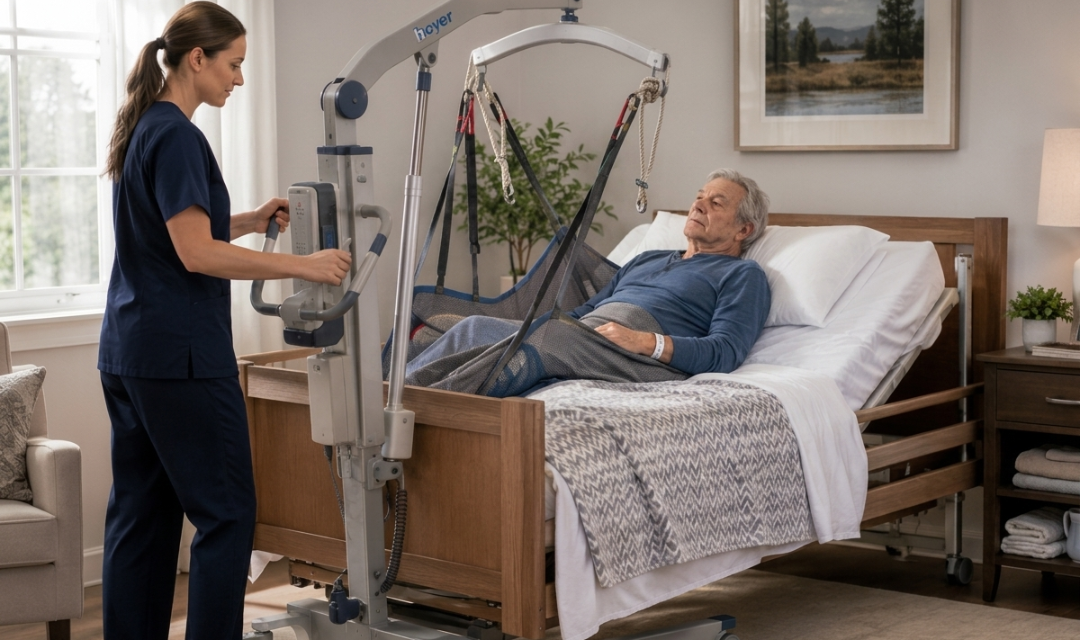
A Hoyer lift, also called a patient lift, may be needed when manual transfers are no longer safe. This often happens when the elderly patient cannot stand, cannot pivot, has weak legs, is recovering from a serious surgery, has paralysis, or places too much strain on the caregiver during daily transfers.
Families often start researching how to use a Hoyer lift after a near fall, a painful caregiver injury, or a difficult transfer from the bed to a wheelchair. A patient lift can help raise and move the patient with more support, while the sling holds the patient’s body during the transfer.
A patient lift may be helpful when:
- The patient cannot safely stand or bear weight.
- The patient’s legs buckle during transfers.
- The patient is fully bedridden or mostly bedbound.
- The caregiver has back, shoulder, or wrist pain from lifting.
- The patient has slipped, fallen, or nearly fallen.
- Transfers to the toilet, wheelchair, or recliner have become stressful.
- The patient is obese, bariatric, paralyzed, or recovering from stroke.
- The caregiver is afraid of dropping or hurting the patient.
Using a patient lift at home does not mean the caregiver has failed. It means the transfer has become too risky to handle with strength alone. For many families, the right lift and sling can make daily care safer, calmer, and more manageable.
Important Safety Reminder
An elderly patient should never be dragged across the bed, pulled by the arms, lifted under the shoulders, or rushed through a transfer when they cannot safely assist. A safer transfer should support the patient’s body, reduce caregiver strain, and use the right equipment for the patient’s mobility level.
Why the Patient Lift Sling Is Just as Important as the Lift
A patient lift sling is the fabric support that goes under and around the patient’s body and connects to the Hoyer lift or patient lift. The sling helps hold the patient during the transfer, which is why sling choice is one of the most important parts of safe patient transfers at home.
The best sling for a Hoyer lift depends on the patient’s size, weight, body control, transfer goal, toileting needs, skin sensitivity, and ability to sit or support themselves. A fully bedridden patient may need a full-body sling. A patient who needs bathroom help may need a toileting sling or commode opening sling. A heavier patient may need a bariatric sling with the right weight capacity and reinforced support.
Choosing the wrong sling can make transfers uncomfortable, unstable, or unsafe. Choosing the right sling can improve positioning, reduce slipping, protect the patient’s dignity, and make the transfer easier for the caregiver.
The Safer Goal: Move the Patient Without Forcing the Body
The safest patient transfer is not about using more strength. It is about using the right method for the patient’s condition. When a loved one becomes too weak to move safely, the caregiver should not have to risk their back, shoulders, or health every day just to complete basic transfers.
Whether the main concern is how to transfer an elderly patient, how to lift a bedridden patient, how to use a patient lift at home, or which patient lift sling is safest, the most important starting point is the same: understand the patient’s mobility level first, then match the transfer solution to the real problem.
Section One Summary
The safest way to transfer an elderly patient at home depends on whether the patient can stand, pivot, sit upright, and assist during the movement. If the patient is bedridden, non-weight-bearing, weak, obese, paralyzed, or at risk of falling, a Hoyer lift, patient lift, and properly selected sling may provide a safer transfer solution than manual lifting.