Senior woman seated on a bathtub transfer bench that straddles the tub wall, holding a floor-to-ceiling security pole as a caregiver steadies her, with a toilet safety rail and grab bars nearby - bathroom aids for seniors

19

Oct

When Everyday Bathroom Tasks Become Difficult: 9 Solutions That Help Seniors Stay Independent

Bathroom Safety for Older Adults

It usually starts with something small. A hand that reaches for the towel bar on the way up from the toilet. A pause at the edge of the bathtub that wasn't there last year. A trip to the bathroom at 3 a.m. that somehow feels twice as far as it does in daylight.

None of those moments means a person has lost their independence. They mean one specific task has gotten harder. Bathing, standing up from a low seat, and moving between a chair, a bed and a toilet each ask something different of the body: one needs balance on a wet surface, one needs leg strength and something to push against, one needs the ability to shift sideways without the legs doing much at all.

A parent who can still cook dinner and walk around the house may still dread the bathtub, and a wheelchair user who manages everything else may be stuck at the one transfer the bathroom demands.

234,000nonfatal bathroom injuries treated in U.S. emergency departments in one year
4 in 5of those bathroom injuries were falls; more than a third happened while bathing, showering or getting out of the tub or shower
1 in 4adults 65 and older falls each year

Sources: CDC, MMWR 2011 · CDC Older Adult Falls data

The bathroom earns its reputation honestly. The CDC counted roughly 234,000 nonfatal bathroom injuries treated in U.S. emergency departments in a single year; four out of five were falls, more than a third happened while bathing, showering or getting out of the tub or shower, and the injury rate climbed steadily with age (CDC, MMWR 2011). More than one in four adults 65 and older falls each year (CDC). Hard floors, water, and the lowest seats in the house are a poor combination for anyone whose strength or balance has changed.

This guide is about bathroom aids for seniors and for anyone whose mobility has changed: the bathroom safety equipment that helps with bathing, toileting and transfers at home. It walks through nine pieces of equipment we sell and know well, but the products come second. The first job is to name the difficulty, because a bath lift bought for someone whose real problem is the tub wall is money spent on the wrong thing. Once the difficulty is clear, the right equipment is usually obvious, and often cheaper than people expect.

Quick Answer

What are the best bathroom aids for seniors?

It depends on which bathroom task has become hard. For stepping over the bathtub wall, a bathtub security pole or a transfer bench. For lowering into and rising from the tub, an electric bath lift. For standing up from the toilet, a toilet safety rail or a 3-in-1 commode set over the toilet. For nighttime trips, a bedside commode. For wheelchair users, a drop-arm commode and, with a roll-in shower, a shower transport chair. For getting up from the floor after a fall with no injury, a powered floor-lift seat.

The most useful first step with any bathroom aids for elderly parents or spouses is to name the single hardest task, then choose the bathroom equipment for that task. This guide covers nine aids, who each one suits, and what each one does not do.

Key Takeaways
  • Bathroom difficulty is usually one specific task (bathing, standing from a low seat, or transferring), not a loss of independence.
  • Balance problems and strength problems need different equipment: a pole or bench for stepping over the tub wall, a bath lift for rising from the tub bottom.
  • Toilet safety rails suit people who can still stand with support; drop-arm commodes exist for sideways transfers from a wheelchair.
  • A shower transport chair and a wheeled commode are not interchangeable, and households with a non-walking family member often need one of each.
Start Here

Find the difficulty before choosing the equipment

Stores organize bathroom equipment by product type: commodes here, bath lifts there, grab bars in a third aisle. Families don't think that way. They search for the problem. "My mother can't get out of the bathtub." "What helps my father stand up from the toilet?" "How does someone in a wheelchair use a commode?" So that is how this section is organized. Find the line that sounds like your situation, then jump to the explanation.

Bathroom difficulty finder

If the difficulty is…Start by considering…
Stepping over the bathtub wallA tub-edge support such as a bathtub security pole, or a tub transfer bench
Lowering into the tub or rising from the bottom of itAn electric bath lift
Standing up from the toiletA toilet safety rail, or a commode set over the toilet to raise the seat
Walking to the bathroom at nightA bedside commode
Transferring sideways from a wheelchair or bedA drop-arm commode
Getting to the shower while seatedA shower transport chair (and a roll-in shower)
Getting up from the floor after a non-injury fallA seated floor lift, after checking for injury
Needing help with several bathroom tasksA multi-function commode, or a small combination of the above

Two difficulties that sound alike can need completely different equipment. Trouble stepping over the bathtub wall is a balance-and-height problem; a pole at the tub edge or a transfer bench solves it. Trouble standing up from the bottom of the tub is a strength problem; a bath lift solves it, and a pole does not.

The reverse is also true: a bath lift raises and lowers a seated person inside the tub, but it does not carry anyone across the tub wall. Likewise, a toilet safety rail helps a person who can still stand with support; it does nothing for a wheelchair user who needs to slide sideways onto the seat, which is a drop-arm commode's whole reason for existing.

I can't step over the side of the bathtub. What helps?

Usually a fixed handhold right at the tub edge. Wall grab bars are often too far away or at the wrong angle at the exact moment a foot is in the air. A bathtub security pole tension-mounts between the tub rim and the ceiling and gives several grip heights at the point of balance. If lifting the leg over the wall is the problem itself, a tub transfer bench lets the person sit on the outside and slide in. See our safety bars and rails.

I can get in the tub but can't get down to the bottom, or back up.

This is what an electric bath lift is for. The person sits on the lift at chair height, and the seat lowers them into the water and raises them again, with no pulling by a helper. The VOCIC AX07 is the lighter, narrower one; the VOCIC AX08 has a wider seat. Both need a tub with a flat, smooth bottom for the suction cups. See all bath lifts.

What can help my father stand up from the toilet?

If his legs do the work and his arms just need a place to push, a toilet safety rail fits around the existing toilet and gives him a padded handle on each side. If the seat is simply too low, a 3-in-1 commode placed over the toilet raises the sitting height by several inches and adds arms at the same time. The Stander Universal Bedside Commode and the McKesson 3-in-1 both do this.

The walk to the bathroom at night is the dangerous part.

Then shorten the walk. A bedside commode next to the bed turns a dark trip down the hall into a few steps with something to hold. The McKesson 3-in-1 is the simple folding version; the VOCIC YR11 adds a padded seat, flip-up arms and a built-in night light. Browse all commodes and toilet chairs.

How does someone in a wheelchair get onto a commode?

Sideways, which means the armrest between the wheelchair and the commode has to get out of the way. A drop-arm commode such as the Lumex Drop Arm Versamode lowers either armrest independently so the person can slide across at the same seat height. Match the seat heights of the wheelchair and the commode as closely as you can; a big step down or up is where transfers go wrong.

My parent can't walk to the shower. Is there a way to bathe without a bathtub?

With a roll-in shower and a caregiver, yes. A shower transport chair is a wheeled, rust-resistant chair the caregiver pushes from the bedroom straight into the shower; the rear wheels lock and the person bathes seated. It needs a shower with no tall lip. If the only option is a tub, a bath lift or a transfer bench is the better route. See shower wheelchairs.

What if they fall and can't get up, but aren't hurt?

First, make sure they are actually uninjured. If there is any doubt, call for help and do not move them. If they are fine and simply cannot push up from the floor, a powered seat that starts about 2 inches off the ground, such as the VOCIC AX08, can raise them to standing height on a smooth, hard floor without a caregiver lifting. This is the single most common way family members hurt their own backs.

They need help with more than one of these.

That is normal; needs rarely come one at a time. A multi-function chair such as the Stander Universal (commode, shower chair and toilet rail in one) covers a lot for a person who can still stand and step. For someone who cannot, the pairing is usually a drop-arm commode at the bedside plus a shower transport chair for bathing, since neither one does the other's job well. The rest of this guide explains why.

At a Glance

Nine bathroom aids for seniors compared: which one solves which problem?

The table below lists the nine pieces of bathroom equipment for elderly adults covered in this guide, the difficulty each one exists for, and who it tends to suit. Tap a name to jump to its full entry, with specifications and what it does not do.

Bathroom aidDifficulty it solvesWho it tends to suit
Stander Bathtub Security PoleStepping over the bathtub wallCan still stand and step, needs a steady handhold at the tub edge
VOCIC AX07 Electric Bath LiftLowering into the tub and rising back outNeeds the tub itself; lighter, narrower seat
VOCIC AX08 Bath Lift & Floor LiftRising from the tub bottom, a very low seat, or the floor after a non-injury fallNeeds a wider seat or floor lifting on a smooth hard floor
Wonder Toilet Safety RailStanding up from the toiletLegs still do the work; arms need something to push on
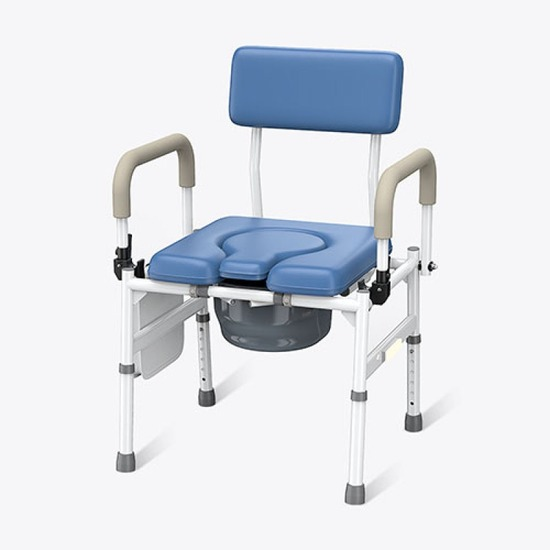
McKesson 3-in-1 Folding CommodeReaching the bathroom at nightNeeds a simple bedside toilet, raised seat or shower seat
VOCIC YR11 Toilet Chair CommodeA sturdier, more adjustable bedside toiletNeeds padding, flip-up arms and a night light
Stander Universal Bedside CommodeOne aid for several bathroom routinesCan stand and step; wants commode, shower chair and toilet rail in one
Lumex Drop Arm VersamodeTransferring sideways from a wheelchair or bedWheelchair user or caregiver-assisted; needs clear side access
Lumex Shower Transport ChairGetting to and into the shower while seatedCannot walk to the shower; has a caregiver and a roll-in shower
Key TakeawayBath aids for elderly adults split into two families: equipment that steadies a person who can still stand and step (poles, rails, 3-in-1 commodes), and equipment that moves or carries a person who cannot (bath lifts, drop-arm commodes, shower transport chairs). Knowing which family you are shopping in narrows the choice quickly.
Product Guide

Nine bathroom safety solutions, explained

Each entry below follows the same pattern: the difficulty it exists for, what it actually does, a few specifications worth knowing, who it tends to suit, and what it does not do. The last part matters as much as the first. Nobody enjoys returning a 26-pound bath lift because the tub was the wrong shape.

Stander Bathtub Security Pole with rotating ladder grab bar installed between the bathtub rim and ceiling
1. Stepping over the bathtub wall

Stander Bathtub Security Pole

A floor-to-ceiling pole that tension-mounts between the bathtub rim and the ceiling, with a curved ladder-style grab bar that rotates around the pole and locks every 45 degrees. It puts a solid handhold right at the tub edge, where a wall-mounted bar is often just out of reach, and it installs without drilling.

  • Supports up to 300 lb
  • Fits flat ceilings from 7 to 9 ft
  • Rotating ladder bar with several grip heights
  • No-drill tension mount; zinc-plated steel, powder-coated
Who it may suit: Someone who can still step over the tub wall and stand to bathe, but wants something steady to hold while doing it.
What it does not do: It does not lift or lower anyone. If the hard part is getting down to the bottom of the tub and back up, a pole alone will not solve that. It also needs a compatible tub rim and a flat ceiling in the 7 to 9 ft range; sloped or drop ceilings are not a fit.
View ProductSpecs & dimensions on the product page
VOCIC AX07 electric bath lift chair, lightweight powered bath lift with waterproof hand control
2. Lowering into the tub and rising back out

VOCIC AX07 Electric Bath Lift Chair

A powered seat that sits inside the bathtub on suction cups. The person sits at roughly chair height, and the seat lowers them to about 2.3 inches from the tub floor, then raises them back up at the end of the bath. It runs on a rechargeable waterproof hand control, so there is no cord running to the tub.

  • 300 lb capacity; the lift itself weighs about 23 lb
  • Seat travels from about 2.3 in. up to 18.9 in.
  • Listed seat width 13.4 in., seat length 17.7 in.
  • IP68 waterproof rating; rechargeable hand control
Who it may suit: Someone who can sit down on a seat and swing their legs over the tub wall (with or without a hand from a helper) but can no longer lower themselves to the bottom of the tub or push back up.
What it does not do: It is not a full-body patient lift and it does not carry anyone over the tub wall. The 13.4 in. seat is on the narrow side, so the user's hips, not just their weight, need to fit.
View ProductSpecs & dimensions on the product page
VOCIC AX08 bath lift chair and electric floor lift for rising from low seated positions
3. Getting up from the floor, or from a very low seat

VOCIC AX08 Bath Lift Chair & Floor Lift

The AX08 is the AX07's wider sibling. It does the same job in a compatible bathtub, but its wider seat and very low starting position make it especially useful as a floor lift: on a suitable smooth, hard floor, a person who has ended up sitting on the ground can be helped onto the seat and raised to a height they can stand from.

  • 300 lb capacity; weighs about 26 lb
  • Same 2.3 in. to 18.9 in. lift range as the AX07
  • Wider 15.4 in. seat (20.5 in. seat length)
  • Suction stabilization on compatible smooth tile or polished hard floors
Who it may suit: A household that wants one powered lift for both bathing and the occasional "I'm on the floor and can't get up" moment, or a user who needs the wider seat.
What it does not do: It is for someone who is uninjured after a fall. If there is any chance of injury, call for help first; never use a lift to get a hurt person off the floor. It also needs a smooth, hard surface for the suction cups; carpet and textured floors are out.
View ProductSpecs & dimensions on the product page
Wonder adjustable toilet safety rail with padded handles standing around a toilet
4. Standing up from the toilet

Wonder Toilet Safety Rail (Stander)

A frame with a padded handle on each side of the toilet, so the person has something to push down on when standing and something to hold while lowering themselves. The handles adjust in height and the frame folds, so it stays out of the way for everyone else who uses that bathroom.

  • Supports up to 300 lb
  • Handle height adjusts from 28 to 36 in.
  • Padded, ergonomic grips
  • Folding design
Who it may suit: Someone whose legs still work for the lift but who needs their arms to help, and who uses the regular toilet without trouble once they are on it.
What it does not do: It does not raise the seat and it does not help anyone get to the bathroom. If the toilet is simply too low, or the walk there is the problem, look at a commode instead.
View ProductSpecs & dimensions on the product page
McKesson 3-in-1 folding bedside commode with steel frame, fixed armrests and removable bucket
5. Reaching the bathroom at night

McKesson 3-in-1 Folding Bedside Commode

The straightforward bedside commode: a folding steel frame with fixed armrests, a removable 7.5-quart bucket with cover and splash shield, and a removable back bar. Set it up next to the bed and the nighttime trip down the hall disappears. It can also sit over the toilet as a raised seat with arms, or stand on its own.

  • 350 lb capacity
  • Seat height adjusts from about 16.6 to 22.5 in.
  • Listed seat 13.5 in. wide by 15 in. deep
  • Folding steel frame; non-skid tips
Who it may suit: Someone recovering from surgery or an illness, or anyone for whom the distance to the bathroom at night has become the real risk.
What it does not do: It is not a shower chair and should not be used in the shower. The fixed arms mean it is not a good match for a sideways transfer from a wheelchair, and the 13.5 in. seat width needs checking against the person, not just the weight limit.
View ProductSpecs & dimensions on the product page
VOCIC YR11 adjustable toilet chair commode with padded seat, flip-up armrests and night light
6. Needing a sturdier, more adjustable bedside toilet

VOCIC YR11 Toilet Chair Commode

A reinforced steel commode built for people who need more room, more capacity, and more adjustment than a basic model offers. The seat height and the overall width both adjust, the armrests flip up out of the way, the seat and backrest are padded, and there is a built-in night light for low-light use.

  • 400 lb capacity, reinforced steel frame
  • Seat height adjusts from about 17.7 to 22.6 in.
  • Three width settings: about 20.9, 22.8 and 24.8 in.
  • Flip-up armrests; padded 16.5 x 16.5 in. seat; night light
Who it may suit: A larger or taller user, someone who needs the arms to move aside for a transfer, or anyone who finds a thin plastic seat uncomfortable for more than a minute.
What it does not do: It is not a wheelchair or a transport chair; it is not meant to be moved with a person sitting in it. Check that the chosen width setting actually fits around your toilet if you plan to use it there.
View ProductSpecs & dimensions on the product page
Stander Universal Bedside Commode, a 3-in-1 aluminum commode, shower chair and toilet safety rail
7. Needing one aid for several bathroom routines

Stander Universal Bedside Commode

A lightweight aluminum frame that works three ways: as a bedside commode with a collapsible bucket, as a shower chair, and as a safety rail with padded arms placed over the existing toilet. The seat height adjusts with push buttons, no tools, and the whole thing weighs about 15 pounds.

  • 300 lb capacity
  • Seat height adjusts from about 16 to 22 in.
  • Aluminum frame, about 15 lb
  • Collapsible bucket (about 1.7 gal); padded armrests
Who it may suit: Someone who needs a little support in more than one place and would rather own one adjustable piece than three. Also a sensible choice when the equipment will move between rooms or homes.
What it does not do: It is not a drop-arm chair, so it is not designed for a sideways transfer from a wheelchair, and it has no wheels, so nobody should be pushed anywhere in it.
View ProductSpecs & dimensions on the product page
Lumex Drop Arm Versamode 3-in-1 commode chair with wheels, drop-down armrests and swing-away footrests
8. Transferring sideways from a wheelchair or bed

Lumex Drop Arm Versamode Commode Chair with Wheels (6810A)

A wheeled commode whose armrests drop down independently on each side, so a person can slide across from a wheelchair or the edge of a bed without an armrest in the way. It has 5-inch swivel casters with rear locks, swing-away footrests that can be removed, and a 7-quart pail. It can be positioned over a standard toilet or used at the bedside.

  • 300 lb capacity (evenly distributed)
  • Listed seat height 19.5 in.; seat 17.75 in. wide by 17.5 in. deep
  • About 18.25 in. between the armrests; 22 in. overall width
  • Two rear locking casters (the 6810B version has four)
Who it may suit: A wheelchair user, or someone who is helped by a caregiver, who needs clear side access to get onto the seat and may need to be moved short distances while seated.
What it does not do: It is not a shower chair. The manufacturer's listing does not establish it as suitable for use inside a shower or tub, so it should not be rolled into one. Check the 22 in. overall width against your bathroom door.
View ProductSpecs & dimensions on the product page
Lumex rust-resistant aluminum shower transport chair with wheels and rear wheel locks
9. Getting to and into the shower while seated

Lumex Shower Transport Chair with Wheels (7910A-1)

A rolling chair made for wet rooms: an anodized aluminum frame that resists rust, 5-inch swivel casters, rear wheel locks, and an open seat so it can double over a toilet. A caregiver wheels the person from the bedroom or hallway straight into a roll-in shower, locks the rear wheels, and the person bathes seated.

  • 250 lb capacity (evenly distributed)
  • Listed seat height 22 in.; seat 14 in. wide by 16.5 in. deep
  • 21.5 in. overall width, 24 in. deep, 39 in. high
  • Rust-resistant anodized aluminum; rear wheel locks
Who it may suit: Someone who cannot walk to the shower safely and has a caregiver to push and position the chair, with a shower they can roll into (no high lip or tub wall).
What it does not do: It is not a bedside commode replacement for every household, and it will not roll over a bathtub wall or a tall shower threshold. The 14 in. seat is narrow, and the 250 lb limit is lower than the other chairs here.
View ProductSpecs & dimensions on the product page

Browse the full range of bath safety equipment, including bath lifts, commodes and toilet chairs, safety bars and rails and shower wheelchairs.

Side by Side

What works for one person may not work for another

A list of nine products is only half the job. Several of these look alike in a photo and solve different problems, and the mistakes families make are almost always between two things that seem similar. Five comparisons that come up every week:

Bathtub security pole or electric bath lift: which one do we need?

Short answer: the pole is for balance, the lift is for strength. A bathtub security pole gives a person something solid to hold while they step over the tub wall, lower themselves and stand up; they still do the work.

A bath lift does the lowering and raising for them, but does nothing about the tub wall. Someone with weak knees but good balance may do fine with the pole. Someone who cannot push up from a low position needs the lift, and may still want a handhold for the step in. They are not substitutes for each other; some households end up with both.

VOCIC AX07 vs. AX08: what is actually different?

Short answer: the same lift range, a different seat. Both lower to about 2.3 inches and rise to about 18.9 inches, both carry 300 lb, and both run on a rechargeable waterproof hand control. The AX08's seat is two inches wider and almost three inches longer, which makes it the better floor lift and the better choice for a broader user; the AX07 is three pounds lighter and fits narrower tubs.

SpecificationAX07AX08
Weight capacity300 lb300 lb
Product weightabout 23 lbabout 26 lb
Lowest seat heightabout 2.3 in.about 2.3 in.
Highest seat heightabout 18.9 in.about 18.9 in.
Listed seat width13.4 in.15.4 in.
Listed seat length17.7 in.20.5 in.
Product pageAX07 specificationsAX08 specifications

If the tub is narrow or the lift will be carried in and out often, the AX07. If anyone in the house may need help up from the floor, or the user is broad through the hips, the AX08.

Toilet safety rail or bedside commode?

Short answer: if the toilet itself is fine and the person just needs arms, the rail; if distance, urgency or seat height is the problem, the commode. A toilet safety rail stays in the bathroom and leaves the toilet exactly as it was, which most people prefer.

A commode changes the equation in two ways a rail cannot: it can live beside the bed, and, set over the toilet, it raises the seat by several inches. The limitation runs the other way too: a rail cannot help someone who is not reaching the bathroom in time, and a commode over the toilet takes up floor space the other people in the house will notice.

Fixed-arm commode or drop-arm commode?

Short answer: it depends on how the person gets onto the seat. Fixed arms, like those on the McKesson 3-in-1, are rigid and reassuring for someone who stands, turns and sits; they also cost less. They are a wall for someone who transfers sideways from a wheelchair. A drop-arm model like the Lumex Versamode lowers one side so the person slides across; the VOCIC YR11's flip-up arms do a similar job for a standing-assisted transfer. Choose by the transfer, not by the price.

Shower transport chair or wheeled commode: aren't they the same thing?

Short answer: no, and this one causes the most expensive mistakes. The two Lumex chairs in this guide look alike: both have wheels, both have an open seat, both are meant to be pushed by a caregiver. The shower transport chair has an anodized aluminum frame built for water, rear wheel locks, and is meant to be rolled into a roll-in shower.

The Versamode is a transfer and transport commode with drop arms and a pail; its listing does not establish it as a shower chair, so it should not be used as one. Going the other way, a shower chair is not a full bedside commode replacement for every household: a narrower 14-inch seat, a 250 lb limit, and a 22-inch seat height that will not suit everyone. Many caregivers end up using both, each for its own job. Our guide to shower commode chairs goes deeper on the wet-room side.


Before You Order

What families should check before buying bathroom equipment

Most returns in this category are not defective products. They are good products that didn't fit the person or the room. Six things to check, with examples from the equipment above:

Transfer abilityCan the person stand and pivot? Slide sideways? Stay safely seated while being moved? Does a caregiver need to be there, and is a mechanical lift needed? This decides the category before anything else does.
Seat and body fitMeasure the person, not just the scale. Seat width, seat depth, the gap between the armrests, and seat height all matter. A 300 lb rating on a 13.4-inch seat does not mean it fits everyone under 300 lb.
Bathroom dimensionsDoorway width (a 22-inch chair and a 24-inch door is a tight squeeze), the space beside the toilet, the inside of the tub, the shower entrance and its threshold, and room for the caregiver to stand and turn.
Surface and installationSuction cups need a smooth, flat, hard surface, not textured tub bottoms or non-slip mats. A tension pole needs a flat ceiling in its height range and a tub rim it can sit on. Casters need a floor without thick bath mats in the way.
Caregiver involvementWho will set it up, move it, empty it, clean it, charge it and operate it, and can they do each of those safely? A 26 lb lift is light for the catalog and heavy for a 78-year-old spouse carrying it over a tub wall.
Changing needsIs this a six-week recovery or a direction things are heading? A folding commode is a sensible answer to the first. The second may justify equipment with more adjustment and a higher capacity from the start.

A few specifics from this collection. The AX07's 300 lb rating sits on a 13.4-inch seat; width is the measurement to confirm. The Stander pole needs a compatible tub rim and a flat 7-to-9-foot ceiling; it is not a universal installation.

The Lumex shower chair is 21.5 inches wide overall, but the shower entrance and the turning room in front of it decide whether it works, not the chair's own width. The Versamode's 19.5-inch seat height matters when planning a lateral transfer from a wheelchair, which should sit at roughly the same height. And a commode with fixed arms, however sturdy, is the wrong tool for anyone who needs clear side access.

Before you order: a nine-line checklist

  1. The specific task that is difficult, in one sentence ("can't push up from the toilet" beats "bathroom safety")
  2. How the person gets onto a seat: stand-and-turn, sideways slide, or lifted by someone
  3. Their weight, hip width, and comfortable seat height (measure a chair they get up from easily)
  4. Bathroom door width and the clear space beside the toilet
  5. Tub: inside width, rim shape, and whether the bottom is smooth or textured
  6. Shower: roll-in or stepped, and the height of the lip
  7. Ceiling height over the tub, and whether it is flat
  8. Who will help, and what they can comfortably lift and carry
  9. Whether a doctor, nurse or occupational therapist has looked at the transfer (recommended for new or repeated falls)

When to involve a professional

New or worsening difficulty with transfers, more than one fall in a year, dizziness on standing, or a transfer that now takes two people are all reasons to have a doctor, nurse or occupational therapist look at the situation before buying equipment, not after. A therapist can also tell you whether a sit-to-stand or floor lift is appropriate for a particular person. And on floor recovery specifically: a lift is for someone who has been checked and is unhurt. After a fall with pain, a hit to the head, or any uncertainty, the right equipment is a phone.

Living With It

Keeping bathroom routines manageable as needs change

The caregiver's side of it

Needing help in the bathroom is hard on dignity, and the person receiving the help feels that more than anyone. A few things make it easier. Keep as much of the routine private as you can: equipment that lets a person do the first and last part themselves (sitting, standing, drying) means a caregiver can step out for the middle. Make nighttime toileting short and obvious: a commode on the side of the bed the person gets out of, a night light, nothing on the floor between the two.

Cut the number of transfers where you can; a shower chair that rolls over the toilet saves one lift every morning. Reassess when something changes, whether that is a hospital stay, a new medication, or a fall; the equipment that was right in spring may be wrong by fall. And make sure everyone who helps, including the aide who comes on Thursdays, knows how the equipment works, where the locks are, and what it is not for.

None of this means the person has failed at anything. It means a task got harder and the family did something sensible about it.

Frequently asked questions about bathroom aids for seniors

What bathroom aids can help seniors remain independent at home?

It depends on which task has become hard. For getting into and out of the bathtub, a bathtub security pole or a transfer bench; for lowering into and rising from the tub, an electric bath lift; for standing up from the toilet, a toilet safety rail or a raised 3-in-1 commode; for nighttime trips, a bedside commode; for wheelchair users, a drop-arm commode and, with a roll-in shower, a shower transport chair. The most useful first step is to name the single hardest task, then choose for that.

What helps an elderly person stand up from the toilet?

Two things, in order of simplicity. A toilet safety rail adds a padded handle on each side of the existing toilet so the person can push down with their arms; it suits someone whose legs still do most of the work. If the seat itself is too low, a 3-in-1 commode set over the toilet raises the sitting height by several inches and adds armrests at the same time. A raised seat with no arms helps less than people expect, because the push comes from the hands.

Is a bedside commode better than a raised toilet seat?

They solve different problems. A raised toilet seat (or a commode over the toilet) helps someone who reaches the bathroom but struggles with a low seat. A bedside commode helps someone for whom the trip itself is the risk: nighttime, urgency, weakness after an illness, or a bathroom at the far end of the house. Many 3-in-1 commodes can do both jobs, which is why they are the usual recommendation when a family is not sure which problem they are solving.

Can an electric bath lift also help someone get up from the floor?

Some can. The VOCIC AX07 and AX08 lower to about 2.3 inches, so on a smooth, hard floor they can raise a seated person to a height they can stand from. The AX08, with its wider seat, is the one designed with floor lifting in mind. Two conditions: the floor has to suit the suction cups (smooth tile or polished hard flooring, not carpet), and the person must be uninjured. After a fall with any pain or a blow to the head, call for help instead of using a lift.

What's the difference between a shower chair with wheels and a transport commode?

A shower chair with wheels, such as the Lumex Shower Transport Chair, is built for water: a rust-resistant aluminum frame, wheel locks, and a design meant to be rolled into a roll-in shower so the person bathes seated. A transport commode, such as the Lumex Drop Arm Versamode, is a wheeled toileting chair with drop-down arms for sideways transfers and a pail; it is not established as a shower chair and should stay dry. They are not interchangeable, and households with a non-walking family member often need one of each.

How do I know when bathroom equipment is no longer enough?

When the person or the caregiver is doing something unsafe to make it work: two people needed for a transfer that used to take one, a caregiver lifting instead of guiding, falls that keep happening despite the equipment, or a person skipping bathing because the process has become frightening. Those are signs to involve an occupational therapist or the person's doctor, who may recommend a patient lift, a home modification, or home care support. Equipment is one part of a plan, not the whole plan.

The goal is not a bathroom full of equipment

It is to figure out which everyday task has become difficult and make that one task manageable again, for the person doing it and for the people helping. Sometimes that is a simple toilet rail. Sometimes it is a bath lift and a commode together. It is rarely all nine things on this page.

If you are not sure which difficulty you are looking at, or whether a particular chair will fit a particular doorway, contact our team with the measurements and we will tell you honestly what fits and what doesn't. MedCare Mobility is an authorized dealer and provider for the brands above, we are rated No. 1 in customer service, every order ships fast nationwide and is delivered to your door, and our products come with manufacturer warranties and cash-back rewards.

Browse the full bath safety collection, try our equipment assessment tools, or start with the home medical equipment buying guides if the difficulty reaches beyond the bathroom.

Not sure which bathroom aid fits your situation?

Call 585-505-6665 and describe the task that has become difficult. MedCare Mobility is an authorized dealer and provider with a huge selection of bath safety equipment, delivered to your door with fast nationwide shipping.

Rated No. 1 in customer serviceWarrantiesCash-back rewardsFast nationwide shippingAuthorized dealer & provider

Leave a Reply

Your email address will not be published. Required fields are marked *

RELATED

Posts