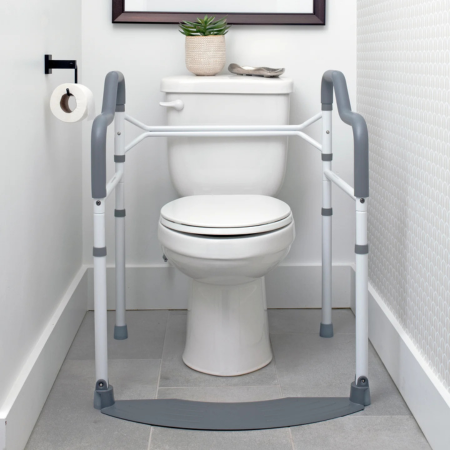
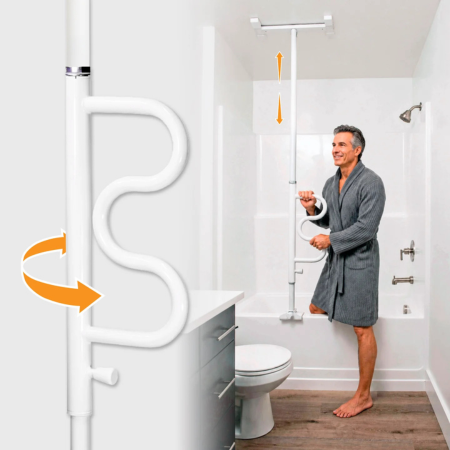
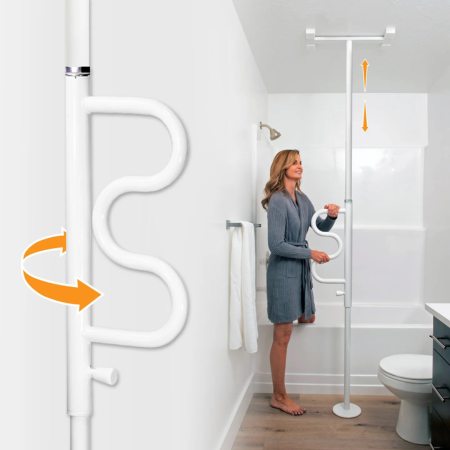
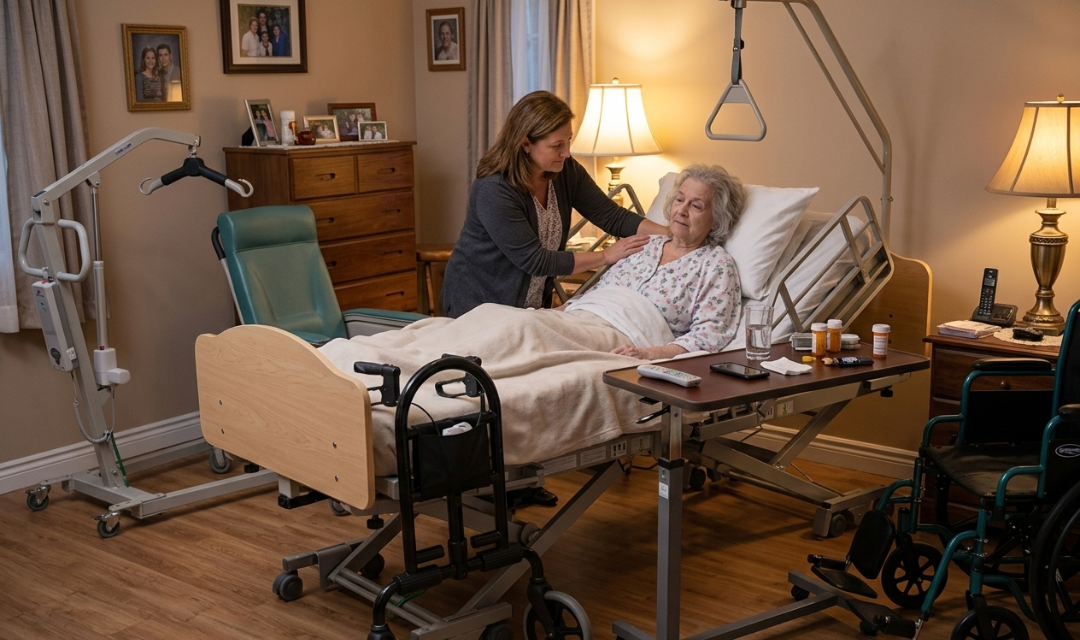
Home safety for seniors with bed assist rail and toilet safety rail

10

Aug

Home Safety for Seniors: Bed Rails, Grab Bars, Toilet Safety Rails & Support Poles Explained

Senior Home Safety

Changes in strength, balance, joint mobility, or confidence do not always begin with an obvious fall. Often, the first signs appear in the small ways an older adult adapts to everyday movements around the home. They may start pulling on a nightstand to get out of bed, pushing against a sink to rise from the toilet, reaching for a towel bar when stepping into the bathtub, or using furniture as an improvised handhold.

These behaviors can be easy to overlook because the person may still be walking, dressing, bathing, and completing much of their routine independently. But when someone repeatedly reaches for objects that were never designed to support body weight, it may be time to look more closely at where stable support is missing inside the home.

Sometimes the warning sign is what someone starts holding onto.

Everyday objects often become makeshift support points long before a family begins searching for home safety equipment.

Nightstand Pulling on bedroom furniture when trying to sit up or stand from bed.
Sink or Counter Pushing against nearby surfaces to lower onto or rise from the toilet.
Towel Bar Grabbing bathroom fixtures for balance while entering or leaving the bathtub.
Furniture Using chairs, dressers, or other household objects as support while standing or moving.
Another Person Reaching for a spouse, family member, or caregiver whenever extra stability is needed.
Key Takeaway The issue is not always that an older adult needs someone else to do more for them. Sometimes the home simply does not provide a stable, appropriately positioned support point where one is needed. Bed rails, bed assist handles, toilet safety rails, bathtub grab bars, and floor-to-ceiling safety poles are designed to address different support needs in different areas of the home.

The important question is therefore not simply, “What safety product should I buy for an elderly parent?” It is: Where does the person become unstable, what are they currently holding onto, what type of support would actually help in that location, and is that support compatible with the bed, bathroom, room layout, and individual using it?

Quick Answer

What types of home safety supports are available for seniors?

Bed assist handles, bed safety rails, toilet safety rails, bathtub grab bars, and floor-to-ceiling safety poles serve different purposes. A bed assist handle primarily provides a stable handhold for bedside movement and standing, while a bed safety rail can provide greater mattress-edge coverage and may also assist with repositioning or getting out of bed. Toilet safety rails provide hand support while sitting down and standing up. Bathtub grab bars and security poles create support around bathing, while a floor-to-ceiling safety pole can provide a handhold in locations where a conventional wall-mounted grab bar is unavailable or poorly positioned.

Explore This Article

Find the type of support you are looking for

Jump directly to support around the home, bed rails and assist handles, adjustable-bed compatibility, bathroom safety, floor-to-ceiling support poles, popular product solutions, buying guidance, or common questions.

Where Support Matters

Where Do Seniors Most Often Need Extra Support at Home?

Older adults may need extra support anywhere a routine movement requires them to shift their weight, rise, lower themselves, turn, or steady their balance. The bedroom and bathroom are common examples, but support may also be needed beside a favorite chair or in an area where there simply is not a secure handhold within reach. Identifying the difficult location and movement first makes it much easier to determine what type of home safety equipment for seniors may be appropriate.

Quick Answer

Seniors most often need extra support around beds, toilets, bathtubs, chairs, and other areas where standing, sitting, turning, or maintaining balance becomes difficult. A useful first step is to notice what the person currently reaches for. If they are pulling on furniture, pushing against a sink, grabbing a towel rack, or relying on another person simply to steady themselves, the environment may be missing a secure support point where one is actually needed.

Beside the Bed

Bedside difficulty can appear while sitting upright, moving toward the mattress edge, repositioning, standing, or lowering back onto the bed. Some people primarily need a secure handhold, while others may also have concerns about remaining safely positioned near the mattress edge.

Sitting upright Repositioning Standing Edge concerns

Around the Toilet

A low toilet or reduced leg strength can make controlled sitting and standing more difficult. Without a purpose-built support point, a person may begin pushing on a sink, countertop, toilet-paper holder, or other nearby fixture that was not intended to bear their weight.

Lowering safely Standing Balance Stable hand support

At the Bathtub

Bathtub entry and exit combine several challenges at once: stepping over the tub wall, changing direction, balancing on a wet surface, and reaching for support. The safest handhold is not always where a standard bathroom fixture happens to be located.

Tub threshold Wet surfaces Turning Entry & exit

Beside Chairs & Recliners

A favorite chair may be comfortable once seated but still difficult to stand from, especially if it is low, soft, or positioned away from a wall. People often compensate by pulling on furniture or reaching for another person. In some layouts, a properly selected support pole can create a more intentionally positioned handhold.

Sit-to-stand Low seating No nearby wall

Where There Is No Secure Handhold

Sometimes the problem is simply that nothing sturdy is available where support is needed. A wall may be too far away, furniture may move, or permanent wall installation may not be practical. Depending on the environment, a floor-to-ceiling safety pole or other purpose-built support may provide an alternative.

Open areas Bedside Near seating Bathroom
Key Decision Point

The best type of senior safety support depends primarily on where support is needed and what the person is trying to do. Start with the difficult activity and location—not with a product name. A person who needs a handhold to rise from bed may need something very different from someone who needs greater mattress-edge coverage, bilateral support around a toilet, or a secure handhold beside a bathtub.

Quick Support Finder

What Type of Support Might Help?

Use the concern first to narrow the type of safety equipment worth investigating. Compatibility and individual suitability still need to be checked before choosing a specific product.

If the concern is... Type of support to investigate
Difficulty getting out of bed Bed assist handle
Mattress-edge fall concerns Bed safety or guard rail
Both bedside support and edge concerns Combination assist/safety rail
Adjustable bed needs bedside support Compatible adjustable-bed rail
Difficulty standing from the toilet Toilet safety rail
Support needed at the bathtub Bathtub grab bar or safety pole
No suitable wall or secure handhold nearby Floor-to-ceiling safety pole
Difficulty getting out of bed
Consider: Bed assist handle
Mattress-edge fall concerns
Consider: Bed safety or guard rail
Both bedside support and edge concerns
Consider: Combination assist/safety rail
Adjustable bed needs bedside support
Consider: Compatible adjustable-bed rail
Difficulty standing from the toilet
Consider: Toilet safety rail
Support needed at the bathtub
Consider: Bathtub grab bar or safety pole
No suitable wall or secure handhold nearby
Consider: Floor-to-ceiling safety pole
Bedroom Safety

Bed Rails and Bed Assist Handles for Seniors: What's the Difference?

People often use the terms bed rail, bed safety rail, bed guard rail, bed assist rail, and bed assist handle as though they all mean the same thing. They do not. Some bedside supports are designed mainly to provide a secure handhold while sitting up or standing, while others provide substantially more coverage along the mattress edge and may combine both fall-protection and standing-assistance functions.

Understanding that distinction is important when choosing bed rails for seniors. A person who primarily needs something sturdy to hold while getting out of bed may benefit from a very different design than someone whose main concern is moving too close to the mattress edge during sleep.

Key Distinction A bed assist handle is generally more compact and primarily provides hand support for bedside movement, while a bed safety or guard rail generally extends farther along the mattress edge and may provide both protective coverage and a handhold. Neither design is automatically better—the appropriate choice depends on the actual problem being addressed.
Bed Assist Handle

What Is a Bed Assist Handle?

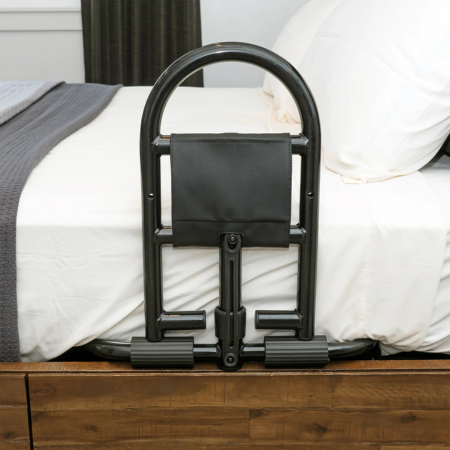
A bed assist handle is a compact bedside support designed primarily to give a person a stable handhold while sitting up, repositioning, getting into bed, or getting out of bed.

For an older adult who reaches for a mattress, nightstand, dresser, or caregiver when trying to stand, a properly selected bed handle for elderly users can provide a purpose-built gripping surface directly beside the mattress.

Because the support area is usually shorter than a full guard-style rail, a bed assist handle can also preserve more open bedside space for entering the bed, caregiver assistance, linen changes, or other equipment.

Real-World Example Stander Prime Bed Handle

The Prime Bed Handle uses a compact 10.5-inch support rail and is rated for up to 400 pounds. It is a useful example of a bedside product designed primarily around standing assistance and bed mobility rather than wide mattress-edge coverage.


Bed Safety Rail

What Is a Bed Safety Rail?

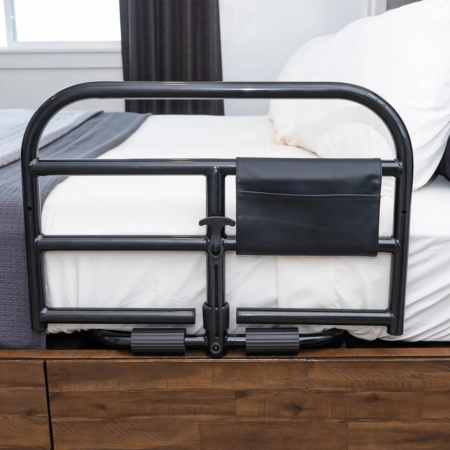
A bed safety rail or bed guard rail generally provides more coverage along the side of the mattress and may also function as a handhold for repositioning, sitting up, or standing.

Families searching for bed safety rails for elderly adults are often concerned about two issues at once: providing something stable to hold and creating a more substantial boundary along the mattress edge.

Wider rails can provide more edge coverage, but more coverage is not automatically the right choice for every user. Bed access, mattress compatibility, installation, rail gaps, caregiver needs, and individual safety considerations all matter.

Real-World Examples Prime Safety Bed Rail & 30-Inch Safety Bed Rail

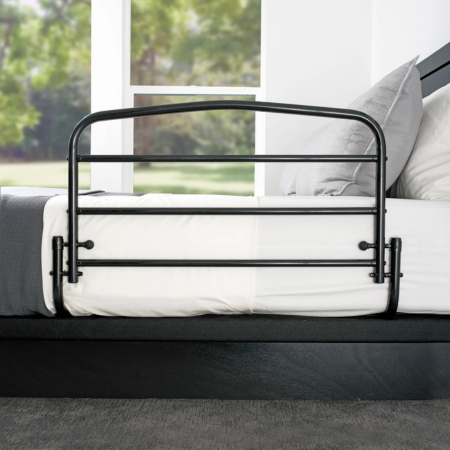
The Prime Safety Bed Rail provides approximately 27 inches of mattress-edge coverage and supports up to 400 pounds, while the Stander 30-Inch Safety Bed Rail provides a wider 30-inch guard area and also functions as a standing-assist support.

Bed Assist Handle vs. Bed Safety Rail

The biggest difference is usually whether the person mainly needs a handhold, greater mattress-edge coverage, or a combination of both.

Feature Bed Assist Handle Bed Safety / Guard Rail
Main purpose Stable hand support for bedside movement Mattress-edge coverage plus possible hand support
Typical width More compact Generally wider
Standing assistance Often a primary function Often available depending on design
Mattress-edge coverage Usually limited Greater coverage
Caregiver access Usually more open bedside space Depends on rail length and whether it folds or removes
Best choice depends on Standing, repositioning, and bedside support needs Edge concerns combined with bedside support needs
Main Purpose
Bed Assist Handle

Stable hand support for bedside movement.

Bed Safety Rail

Mattress-edge coverage plus possible hand support.

Typical Width
Bed Assist Handle

More compact.

Bed Safety Rail

Generally wider.

Standing Assistance
Bed Assist Handle

Often a primary function.

Bed Safety Rail

Often available depending on the design.

Mattress-Edge Coverage
Bed Assist Handle

Usually limited.

Bed Safety Rail

Provides greater coverage.

Caregiver Access
Bed Assist Handle

Usually leaves more open bedside space.

Bed Safety Rail

Depends on rail length and whether it folds or removes.

Best Choice Depends On
Bed Assist Handle

Standing, repositioning, and bedside support needs.

Bed Safety Rail

Mattress-edge concerns combined with bedside support needs.

Quick Answer

Bed Rail vs. Bed Assist Handle: Which One Do You Need?

A bed assist handle is usually the more focused option when the main need is something stable to hold while sitting up, repositioning, standing, or lowering onto the bed. Its shorter profile generally leaves more of the bedside open.

A bed safety or guard rail generally makes more sense when greater mattress-edge coverage is also needed. Some wider rails combine that coverage with a support surface for getting into and out of bed. The correct choice depends on the user's abilities, bed and mattress compatibility, desired amount of coverage, caregiver access, and the specific safety concern being addressed.

How Much Bed Rail Coverage Is Needed?

Bedside support ranges from compact handles to wider and extendable rails. More rail length does not automatically mean greater safety.

Compact Bed Assist Handle

Best understood as a focused handhold. It provides more open access to the mattress and is often chosen when standing assistance is the main concern.

Wider Bed Safety / Guard Rail

Provides more mattress-edge coverage while often doubling as a support surface for repositioning and bedside movement.

Flexible Extendable Bed Rail

Allows the amount of mattress-edge coverage to change within the product's approved range, which may be useful when both access and wider coverage matter.

What About Heavy-Duty Bed Rails for Elderly Adults?

Shoppers searching for a heavy-duty bed rail for elderly adults, a bed rail for a heavier person, or a bariatric bed assist handle should pay close attention to the manufacturer's stated weight capacity—but capacity is only one part of compatibility.

A higher weight rating does not automatically make a rail safer for every person or every bed. The bed frame, mattress thickness, mounting method, rail design, installation, and user's actual mobility needs still need to match the product.

For example, the Stander Prime Bed Handle and Prime Safety Bed Rail are both rated for up to 400 pounds, but they solve different problems: one is a compact bedside handle, while the other provides a much wider guard area.

Weight Capacity Confirm that the product's stated limit is appropriate for the intended user.
Bed Compatibility A high-capacity rail still needs to fit the actual bed frame and mattress.
Purpose Determine whether the user needs a handhold, mattress-edge coverage, or both.
Installation Correct attachment and regular inspection remain essential regardless of capacity.
When comparing the best bed rails for seniors, begin with the problem rather than the rail length. A compact bed assist handle may be appropriate when standing support and open bedside access matter most. A wider bed safety rail may be more relevant when mattress-edge coverage is also a concern. Bed type, mattress dimensions, user weight, installation requirements, caregiver access, and individual safety needs should all be evaluated before choosing a specific rail.
Bed Compatibility

Can You Put a Bed Rail on an Adjustable Bed?

Not every bed rail can be used on an adjustable bed. Bed-frame construction, mattress thickness, mounting method, moving components, and the manufacturer's compatibility requirements all matter. A rail that works properly on a stationary bed may not be designed to move safely with an adjustable base.

This is one of the most important issues to check before buying a bed rail for an adjustable bed. Adjustable bases raise, lower, bend, and articulate in ways traditional bed frames do not. If a rail attaches in the wrong location or is not designed for the movement of the base, the rail may fit poorly, interfere with adjustment, or fail to remain positioned as intended.

Quick Answer

What kind of bed rail works with an adjustable bed?

A bed rail should only be used with an adjustable bed when the rail manufacturer specifically identifies the relevant adjustable-base construction as compatible. Check the frame material, mattress thickness, mounting location, moving parts, and installation instructions before purchase. Some rails work with certain wooden adjustable bases, while standard under-mattress rails may be intended only for stationary traditional beds.

Compatibility Comes First

Do not assume that a rail labeled for a queen, king, or twin mattress automatically fits an adjustable bed of the same size. Mattress size and adjustable-base compatibility are separate questions. The frame construction and way the bed moves can be just as important as mattress dimensions.

Traditional Bed vs. Adjustable Bed: Why Rail Compatibility Changes

The mattress may look similar from above, but the structure underneath it can be very different.

Traditional Bed

Stationary Frame & Mattress Support

A traditional bed frame generally remains in a fixed position. Many under-mattress bed rails are designed around this stationary setup and use a support structure that extends beneath the mattress.

Frame does not articulate during normal use.
Many conventional bed handles are designed for this setup.
Mattress thickness and frame style still need to meet product requirements.
Adjustable Base

Moving Sections Require Specific Compatibility

An adjustable base changes position as the head, foot, or other sections move. A bed rail therefore needs to attach in a way that is compatible with the specific base construction and does not interfere with normal articulation.

Moving components change the rail-installation environment.
Wood and metal adjustable-base construction may require different solutions.
Manufacturer approval should be confirmed before installation.
Compatibility Example

Stander Click Extendable Bed Rail

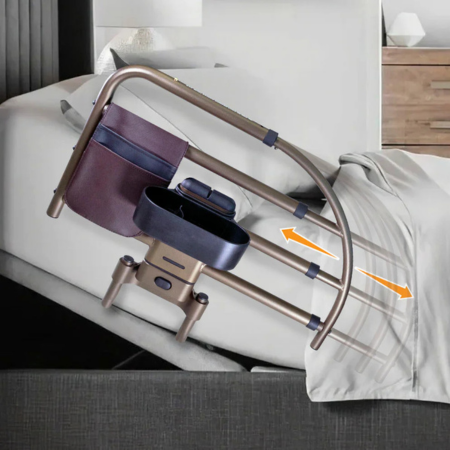
The Stander Click Extendable Bed Rail is a useful example of why individual product specifications matter. Unlike several traditional-bed rails, this model is designed for compatible traditional beds and certain wooden adjustable-base beds. Its rail extends from approximately 23 to 30 inches, providing adjustable mattress-edge coverage while retaining a removable EZ Click design for easier bed access.

Rail Length Extends from 23–30 inches
Weight Capacity Up to 300 lb
Adjustable Base Compatible wooden bases only
Mattress Thickness Designed for 10–12 inch mattresses
Metal Bed Frames Not compatible
Access Feature Removable EZ Click rail system
Before You Buy

Before Buying a Bed Rail, Check These 5 Things

These five checks can prevent many of the most common bed-rail compatibility mistakes.

01
Bed Type

Determine whether the bed is traditional, adjustable, hospital-style, platform, or another design.

02
Frame Construction

Confirm whether the rail is approved for the actual wood, metal, or platform structure underneath the mattress.

03
Mattress Thickness

Measure the mattress rather than estimating. Many rails specify an approved mattress-thickness range.

04
Installation Method

Understand where the rail attaches and whether straps, brackets, bolts, or under-mattress supports are required.

05
Manufacturer Compatibility

Verify that the manufacturer specifically allows the rail to be used with the intended bed configuration.

The safest way to choose a bed rail for an adjustable bed is to treat compatibility as a product-specific requirement, not an assumption. Confirm the adjustable-base construction, mattress thickness, installation method, moving components, weight capacity, and manufacturer guidance before purchasing. A rail that fits the mattress dimensions may still be inappropriate for the underlying bed frame.
Explore Related Equipment

Browse Bed & Bathroom Safety Supports

Explore additional support options when you already know which area of the home needs attention.

Bathroom Support & Safety

How Do You Make a Bathroom Safer for an Elderly Person?

Bathroom safety often comes down to one practical question: does the person have a stable, purpose-built support point exactly where balance becomes difficult? Toilets and bathtubs create different challenges, but both can become risky when an older adult begins relying on sinks, towel bars, countertops, walls, or another person for support.

The right solution depends on the activity. Around the toilet, some people need bilateral hand support for controlled sitting and standing. At the bathtub, the bigger challenge may be stepping across the tub wall, turning, or maintaining balance on a wet surface. In both situations, placement and fit matter just as much as the type of equipment being used.

Quick Answer

What types of bathroom safety equipment can help seniors?

Bathroom safety equipment for seniors may include toilet safety rails, appropriately installed grab bars, raised toilet solutions, bathtub safety bars, bathtub support poles, transfer benches, bath lifts, commodes, and shower mobility equipment. The best option depends on whether the main difficulty is sitting, standing, stepping over the tub wall, bathing independently, reaching the bathroom safely, or maintaining balance during movement.

Toilet Safety

How Do You Make a Toilet Safer for an Elderly Person?

A toilet can become difficult to use safely when reduced leg strength, joint stiffness, pain, poor balance, or fatigue makes it harder to lower the body in a controlled way and stand back up again.

A toilet safety rail provides hand support beside the toilet so the user has something intentionally positioned to hold during sitting and standing. Depending on the person's needs, alternatives or additions may include wall-mounted grab bars, raised toilet seats, commodes, or other bathroom support equipment.

What can an elderly person hold onto to get off the toilet?

A purpose-built toilet safety rail or properly positioned grab bar can provide a more appropriate support point than a sink, towel holder, toilet-paper fixture, or movable furniture. The best option depends on bathroom layout, user strength, toilet configuration, and whether permanent installation is practical.

Bathtub Safety

What Can Seniors Hold Onto When Getting In and Out of a Bathtub?

Bathtub entry and exit can be especially challenging because the person may need to step over a raised tub wall, turn, shift weight, and manage a wet surface at the same time.

Depending on the bathroom and user, appropriate support may include wall-mounted grab bars, bathtub safety bars, bathtub security poles, transfer benches, or bath lifts. The most useful support is the one that can be safely reached at the exact moment stability is needed.

What if you cannot drill a grab bar into the bathroom wall?

Some tension-mounted bathtub support poles can provide a non-wall-mounted option when the room and ceiling meet the product's installation requirements. These products still require careful compatibility checks and proper installation.

Toilet Safety Rail vs. Wall-Mounted Grab Bar

Both can provide support, but they solve the problem in different ways.

Toilet Safety Rail

A toilet rail places support directly beside the toilet and often provides handholds on both sides.

Support is positioned close to the toilet.
Many models provide bilateral hand support.
Some designs avoid permanent wall modification.
Height and width adjustability may help fit different users.

Wall-Mounted Grab Bar

A fixed grab bar creates support from the wall and can be useful when the wall structure and placement allow secure installation.

Permanent installation is typically required.
Placement depends on available wall structure.
Support may be on one side rather than both.
Professional installation may be appropriate.

What Should You Look for in a Toilet Safety Rail?

A good fit depends on the user, toilet, bathroom layout, and how the rail will actually be used.

Height Hand support should be reachable without awkward leaning.
Toilet Compatibility Confirm fit around the actual toilet shape and surrounding space.
Stability The rail should remain secure during sitting and standing.
Grip Handles should be easy to reach and hold.
Weight Capacity Check the manufacturer's stated user-weight limit.
Footprint Make sure the frame does not create a new bathroom obstacle.
Installation Determine whether wall drilling or toilet attachment is required.
Storage & Folding Useful when equipment needs to move or store between uses.
Real-World Product Examples

How Different Bathroom Support Designs Solve Different Problems

These examples show why product type, placement, and installation method matter.

Wonder Toilet Safety Rail

The Wonder Toilet Safety Rail is an example of an adjustable toilet safety rail that provides bilateral hand support without requiring permanent wall installation. It adjusts from approximately 28 to 36 inches, supports up to 300 pounds, fits a variety of toilet configurations, and folds for easier storage or transport.

Adjustable 28–36" 300 lb capacity Bilateral support Folding design

Stander Bathtub Security Pole

The Stander Bathtub Security Pole illustrates a different approach: a tension-mounted bathtub support positioned near the tub edge rather than attached to a wall. It includes a rotating ladder-style grip, works with compatible 7–9 foot ceilings, requires no wall drilling, and supports up to 300 pounds.

Tension mounted No wall drilling Rotating ladder grip 300 lb capacity
Bathtub Safety: Quick Takeaway

The best bathtub support is not necessarily the largest grab bar. Placement, reach, installation method, bathroom configuration, ceiling or wall compatibility, and the person's actual movement pattern all matter. The support must be accessible during the difficult part of entering, turning, standing, or exiting—not simply somewhere else in the bathroom.

Support Without a Wall

What If There's No Wall for a Grab Bar?

One of the most common problems in senior home safety is surprisingly simple: the person needs something sturdy to hold onto, but there is no useful wall where the support is actually needed. This can happen beside a bed, near a recliner, around a toilet, next to a bathtub, or in another open area of the home.

In these situations, people often improvise by pulling on furniture, pushing against countertops, grabbing door frames, or relying on another person for balance. A purpose-built floor-to-ceiling grab bar or safety pole can sometimes create a more intentional support point without depending on a nearby wall.

Quick Answer

What can you use when there is no wall for a grab bar?

A floor-to-ceiling safety pole can create a stable handhold in some locations where wall-mounted support is unavailable or poorly positioned, provided the floor, ceiling, and installation environment meet the product's requirements. These poles are commonly considered beside beds, chairs, toilets, and other areas where an older adult needs something secure to hold while standing, sitting, turning, or steadying balance.

Common Problems

When Seniors Need Support but the Room Doesn't Provide It

These are the kinds of everyday situations that often lead families to search for a safety pole or floor-to-ceiling grab bar.

“My parent pulls on the nightstand to get out of bed.”

Furniture may move or tip. A properly positioned support pole can sometimes provide a dedicated handhold beside the bed.

“There is nothing to grab beside the recliner.”

Soft or low seating can make standing difficult when there is no wall or fixed support nearby.

“The wall is too far from the toilet.”

A bathroom layout may place wall-mounted support too far away to be useful during sitting or standing.

“We don't want to drill into the wall.”

Some tension-mounted support poles provide an alternative when permanent wall modification is not practical.

“They grab furniture when they stand.”

Reaching for dressers, chairs, and movable objects can signal that a stable support point is missing.

“They need something to hold while turning.”

Some users need support during weight shifting or turning rather than only during straight standing.

What Is a Floor-to-Ceiling Safety Pole?

A floor-to-ceiling safety pole is a vertical support installed between the floor and ceiling to provide a stable handhold without relying on a nearby wall. Depending on the design, it may also include a rotating or multi-position grab bar that helps the user reach support from different directions.

These products may also be described as a floor to ceiling grab bar, floor to ceiling safety pole, security pole grab bar, home safety pole, support pole for elderly adults, or grab pole for seniors. The exact terminology varies, but the underlying purpose is similar: create a support point where conventional wall-mounted support is unavailable or poorly positioned.

Where Can a Safety Pole Be Used?

The best location is where the person actually becomes unstable—not simply wherever installation is easiest.

Beside the Bed

A support pole may provide a handhold for standing, sitting, turning, or stabilizing near the bedside when furniture is currently being used for support.

Beside a Recliner or Chair

Useful when a favorite chair sits away from a wall and the person needs something secure to hold during sit-to-stand movement.

Near the Toilet

A pole may be considered when wall placement is poor or when a vertical handhold is more practical for the available bathroom layout.

At the Bathtub

A bathtub-specific security pole can position support near the tub edge when entering, exiting, or turning around the bathing area.

Hallway or Open Area

Some layouts lack a wall or stable surface exactly where a person pauses, turns, or transitions between spaces.

Near a Stair Lift or Transition Point

A properly installed pole may provide a nearby handhold where the user needs extra stability before or after changing position.

Safety Pole vs. Wall-Mounted Grab Bar

Both can provide support, but placement and installation are very different.

Floor-to-Ceiling Safety Pole

Can create support where no useful wall exists.
Often uses tension mounting rather than permanent wall drilling.
Placement may be more flexible within compatible floor and ceiling areas.
Some models provide rotating or multi-position handholds.

Wall-Mounted Grab Bar

Requires an appropriate wall and secure installation point.
Creates fixed support in one specific location.
Often requires drilling and structural anchoring.
May be preferable when permanent fixed support is appropriate.
Real-World Product Examples

Two Different Safety Pole Solutions for Two Different Problems

The right pole depends on where the support is needed and how the person will use it.

Wonder Pole Plus

The Wonder Pole Plus is a floor-to-ceiling support pole designed for areas where a secure handhold is needed but a wall-mounted grab bar is unavailable or poorly positioned. Its tension-mounted installation and rotating ladder-style grab bar allow the user to reach support from multiple directions around the pole.

Floor-to-ceiling support Tension mounted Rotating grab bar Multi-room use

Stander Bathtub Security Pole

The Stander Bathtub Security Pole is built specifically around bathtub access. It positions a tension-mounted vertical support near the tub edge and uses a rotating ladder-style handhold so the user can reach support while entering, turning, standing, or exiting. It is designed for compatible 7–9 foot ceilings and supports up to 300 pounds.

Bathtub support No wall drilling Rotating ladder grip 300 lb capacity

What can an elderly person hold onto when standing up?

A purpose-built support such as a bed assist handle, toilet safety rail, grab bar, or floor-to-ceiling safety pole may provide a more appropriate handhold than movable furniture or another person's arm. The right option depends on where the person is standing and what support is available in that location.

Can a safety pole help someone get out of a recliner?

In some compatible room setups, a floor-to-ceiling safety pole positioned beside a recliner can provide a stable handhold during standing or sitting. Placement should allow the person to reach the pole without excessive twisting, leaning, or pulling.

Can you install a grab bar without drilling into the wall?

Some floor-to-ceiling and bathtub safety poles use tension-mounted installation rather than wall drilling. They are not interchangeable with every grab bar, however, and the ceiling, floor, height range, placement, and manufacturer's installation requirements must all be compatible.

Is a safety pole useful beside a bed?

It can be in some situations, particularly when someone needs a vertical handhold beside the bed and a conventional wall or bedside rail is not positioned appropriately. Bed rails and support poles solve different problems, so the person's actual movement and bed setup should guide the choice.

Key Takeaway

A safety pole is most useful when the person needs support at a specific point but the room does not provide a secure wall, fixture, or handhold there. The goal is not simply to add more grab bars—it is to place stable support where standing, sitting, turning, or balancing actually becomes difficult. Floor-to-ceiling poles and bathtub security poles solve different placement problems, so installation environment and intended use should guide the decision.

Buying Guidance

How Do You Choose the Right Safety Rail, Grab Bar or Support Pole?

Choosing home safety equipment should begin with the specific problem the person is trying to solve, not with whichever rail or grab bar happens to look strongest. A bedside handle, wider bed guard rail, toilet safety rail, bathtub pole, and floor-to-ceiling support pole can all provide stability—but they are designed for very different locations, movements, and installation environments.

Quick Answer

What should you consider before buying senior safety equipment?

Start by identifying where support is needed and what the person needs the equipment to do. Then check whether the product provides a handhold, mattress-edge protection, bilateral toilet support, bathtub support, or open-room support; confirm weight capacity, bed or bathroom compatibility, installation method, caregiver access, and whether the person's mobility or cognitive needs require professional assessment.

8 Questions to Ask Before Choosing a Rail, Handle or Safety Pole

These questions help narrow the equipment type before comparing individual products.

01
What problem needs solving?

Standing, repositioning, mattress-edge protection, toilet use, bathing, or general balance support?

02
Where is support needed?

Beside the bed, around the toilet, at the bathtub, near a chair, or in an open area?

03
Handle, rail or barrier?

A compact handhold solves a different problem than a wider mattress-edge guard.

04
Can it be permanently installed?

Determine whether wall mounting is appropriate or a tension-mounted/no-drill option is needed.

05
What capacity is required?

Confirm the manufacturer's user-weight limit and never treat capacity as interchangeable with suitability.

06
Is the environment compatible?

Check mattress thickness, bed-frame type, toilet layout, tub dimensions, ceiling height, and mounting surfaces.

07
Does a caregiver need access?

Removable, folding, pivoting, or compact designs may make daily care and bed access easier.

08
Is professional input appropriate?

Complex balance, cognition, positioning, or transfer needs may require individualized assessment.

Choosing Senior Safety Equipment: Bottom Line

The right safety support should match the person's difficult movement, the exact location where support is needed, and the physical environment where the equipment will be installed. A higher weight capacity, longer rail, or larger grab bar is not automatically better. Compatibility, placement, access, and intended use are what turn a product specification into a useful solution.

Popular Solutions

Popular Bed Rails, Toilet Safety Rails & Support Poles for Common Home Safety Needs

There is no single best safety rail for every older adult. The products below address different needs: compact bedside standing assistance, wider bed-edge protection, adjustable-bed compatibility, toilet support, bathtub support, and floor-to-ceiling stability. Use the “Best For” guidance to match the product to the actual problem before checking full compatibility.

Need a compact bed handle? Prime Bed Handle
Need wider bed-edge coverage? Prime or 30-Inch Safety Rail
Have an adjustable bed? Click Extendable Bed Rail
Need support beyond the bed? Toilet rails & safety poles

Popular Bed Rails & Bed Assist Handles

These options differ primarily in rail coverage, weight capacity, bed compatibility, and caregiver access.

Stander Prime Bed Handle heavy-duty bed assist handle for elderly adults
Best Compact Bed Handle

Stander Prime Bed Handle

Best for: Seniors who mainly need a sturdy handhold for sitting up, standing, repositioning, or getting in and out of a traditional bed while keeping more of the bedside open.

A heavy-duty bed assist handle for elderly adults that focuses on standing and bedside mobility rather than extended mattress-edge protection.

400 lb heavy-duty support capacity
Compact 10.5-inch support rail
Fits 6–15 inch mattresses
Removable handle improves bed access
View Product Traditional beds
Stander Prime Safety Bed Rail 27 inch bed guard rail for elderly adults
Best Heavy-Duty Guard Rail

Stander Prime Safety Bed Rail

Best for: Older adults who need both stronger bedside support and greater mattress-edge coverage on a traditional non-adjustable bed.

A 27-inch bed guard rail for elderly adults combining mattress-edge protection with a sturdy standing-assist surface.

27-inch wide bedside guard rail
400 lb heavy-duty weight capacity
Fits 6–15 inch mattresses
Removable rail improves caregiver access
View Product Traditional beds
Stander 30 inch safety bed assist rail for elderly fall prevention
Best Folding 30-Inch Rail

Stander 30-Inch Safety Bed Rail

Best for: Seniors who want wider nighttime mattress-edge coverage but also need the rail to fold down for easier bed access and caregiving.

A 30-inch bed rail for seniors to help prevent falls that also functions as a standing-assist handle and pivots down 180 degrees.

30-inch mattress-edge coverage
180° fold-down rail design
300 lb support capacity
Fits 6–16 inch mattresses
View Product Traditional beds
Stander Click Extendable Bed Rail for seniors and compatible adjustable beds
Best for Compatible Adjustable Beds

Stander Click Extendable Bed Rail

Best for: Users who need both adjustable mattress-edge coverage and standing assistance, including certain compatible wooden adjustable-base beds.

An adjustable bed rail for seniors that extends from 23 to 30 inches and combines nighttime coverage, transfer support, and removable caregiver access.

Extends from 23 to 30 inches
300 lb support capacity
Compatible wooden adjustable bases
EZ Click removable rail system
View Product 10–12" mattresses

Popular Bathroom & Whole-Home Safety Supports

These products provide support around the toilet, bathtub, and other locations where a wall-mounted grab bar may not be practical.

Wonder adjustable toilet safety rail for elderly sitting and standing support
Best Toilet Support

Wonder Toilet Safety Rail

Best for: Seniors who need stable support on both sides of the toilet without permanently drilling grab bars into bathroom walls.

An adjustable toilet safety rail for elderly adults designed to support controlled sitting and standing around most residential toilet configurations.

Height adjusts from 28–36 inches
Fits most toilet shapes
300 lb weight capacity
Folds for compact storage
View Product No wall drilling
Stander Bathtub Security Pole rotating bathtub safety bar for elderly adults
Best Tub-Edge Support

Stander Bathtub Security Pole

Best for: Seniors who need a reachable support point directly at a compatible bathtub edge and prefer a no-drill installation.

A tension-mounted bathtub safety bar with a rotating ladder-style grab bar for entering, turning, standing, and exiting around standard alcove tubs.

360° rotating ladder grab bar
Locks every 45 degrees
Fits 7–9 foot flat ceilings
300 lb support capacity
View Product Standard alcove tubs
Stander Wonder Pole Plus floor to ceiling grab bar and safety pole for seniors
Best Whole-Home Safety Pole

Stander Wonder Pole Plus

Best for: Older adults who need a secure handhold beside a bed, recliner, toilet, or other location where no useful wall-mounted grab bar is available.

A versatile floor-to-ceiling grab bar and security pole that creates support in compatible rooms without permanent wall installation.

Fits 7–10 foot flat ceilings
No-drill tension installation
Rotating grab bar locks every 45°
300 lb support capacity
View Product Bedroom • Bath • Living room
Popular Solutions: Quick Answer

For compact bedside standing support, the Prime Bed Handle provides a 10.5-inch handhold with a 400 lb capacity. For greater mattress-edge coverage, the Prime Safety Bed Rail or 30-Inch Safety Bed Rail provide wider guard-style support. For certain compatible wooden adjustable bases, the Click Extendable Bed Rail provides adjustable 23–30 inch coverage. Around the bathroom, the Wonder Toilet Safety Rail provides bilateral toilet support, the Bathtub Security Pole places support at the tub edge, and the Wonder Pole Plus provides floor-to-ceiling support in multiple areas of the home.

For Professional Buyers

Safety Rails, Grab Bars & Support Equipment for Senior Living and Care Facilities

Purchasing senior safety equipment for assisted living, rehabilitation, healthcare, home-health programs, or other care organizations involves more than selecting a product for one individual. Facility buyers often need to evaluate equipment across multiple rooms or residents while considering standardization, compatibility, caregiver workflow, installation requirements, replacement availability, and long-term purchasing needs.

Resident & Patient Needs

Match support equipment to mobility levels, room environments, user weights, and common care scenarios.

Standardized Room Setups

Consider whether bed rails, grab bars, or support poles can be consistently used across similar room configurations.

Caregiver Access

Folding, removable, adjustable, or repositionable designs may improve routine care and equipment access.

Purchasing & Reordering

Availability, replacement parts, manufacturer support, warranties, and quantity requirements matter for ongoing procurement.

What Should Facility Purchasing Teams Consider?

A practical procurement review should look beyond price and evaluate fit, safety, workflow, and long-term support.

User Population Mobility level, weight ranges, cognition, and common assistance needs.
Bed & Room Compatibility Frame types, mattress dimensions, bathroom layouts, ceiling heights, and available mounting locations.
Installation Requirements Wall-mounted, under-mattress, tension-mounted, folding, or removable designs.
Cleaning & Daily Care Consider surfaces, accessibility, caregiver workflow, and facility cleaning procedures.
Manufacturer Support Warranty coverage, replacement availability, documentation, and product support.
Facility Review Confirm equipment meets organizational policy and appropriate clinical or safety requirements.
Facility & Organizational Purchasing

Purchasing Safety Equipment for a Facility or Care Organization?

MedCare Mobility can assist senior living communities, rehabilitation providers, home-health organizations, healthcare facilities, DME purchasers, and purchasing departments with product selection, quantity pricing, sourcing, manufacturer coordination, and multi-unit equipment requirements.

Request Purchasing Assistance
Important Safety Considerations

Are Bed Rails, Grab Bars and Safety Poles Safe for Every Senior?

Safety equipment can provide valuable support, but no bed rail, grab bar, toilet rail, or safety pole is automatically appropriate for every older adult. The right choice depends on the person's physical abilities, cognition, balance, how the equipment will be used, and whether the product is correctly matched to the bed, bathroom, floor, ceiling, or other installation environment.

Quick Answer

Bed rails, grab bars, toilet safety rails, and support poles are not one-size-fits-all safety solutions. Before use, confirm that the product is appropriate for the person's abilities and intended movement, installed according to the manufacturer's instructions, within its stated weight and compatibility limits, and positioned where it can be reached without unsafe leaning, twisting, climbing, or pulling.

Correct Installation

Rails and poles should be secured exactly as the manufacturer specifies and checked periodically for movement or loosening.

Bed & Room Compatibility

Mattress thickness, frame type, ceiling height, mounting surfaces, and surrounding clearances can affect whether a product is suitable.

Weight Capacity

Stay within the manufacturer's stated capacity and remember that a higher rating alone does not make a product appropriate.

User Ability & Cognition

Consider whether the person can recognize, reach, grip, and use the support as intended without trying to climb over or misuse it.

Placement & Access

Support should be positioned where it is actually needed while preserving safe access for the user and caregiver.

Changing Mobility Needs

Equipment that works well today may need to be reconsidered after a fall, surgery, hospitalization, or change in strength or balance.

Especially Important With Bed Rails

A bed rail should never be selected only because it is longer, stronger, or advertised for fall prevention. Rail design, mattress fit, gaps, bed-frame compatibility, the user's behavior, and the intended purpose all matter. A person who mainly needs a handhold for standing may require a different solution from someone needing mattress-edge support, and some individuals may require another approach entirely.

When Should Safety Equipment Be Reassessed?

Reevaluate the setup if the person begins falling more often, has difficulty using the equipment as intended, experiences a major change in mobility or cognition, returns home after hospitalization, or begins needing substantially more assistance with everyday movement. A qualified healthcare professional can help when safety or mobility needs are complex.

Reassess as Needs Change
Common Questions

Frequently Asked Questions About Bed Rails, Toilet Safety Rails, Grab Bars & Safety Poles

These questions reflect the practical problems families, caregivers, older adults, and professional buyers often face when comparing bed rails for seniors, bed assist handles, toilet safety rails, bathtub grab bars, and floor-to-ceiling support poles. Each answer begins with the most important point, then explains the factors that should guide a safe buying decision.

Bed Safety

Bed Rails & Bed Assist Handles

What is the best type of bed rail for an elderly person?

The best bed rail for an elderly person depends on whether the main need is standing assistance, mattress-edge protection, or both. A compact bed assist handle may be better when the person mainly needs something sturdy to hold while getting out of bed, while a wider safety rail may be more appropriate when greater mattress-edge coverage is also needed. Bed type, mattress thickness, weight capacity, caregiver access, and the person's mobility should all be checked before choosing.

What is the difference between a bed rail and a bed assist handle?

A bed assist handle is generally a compact handhold for sitting up, repositioning, standing, and getting into or out of bed, while a bed safety rail usually provides greater coverage along the mattress edge. Some wider rails perform both functions. The important distinction is whether the person primarily needs a handhold, a protective bedside boundary, or a combination of the two.

How can I help an elderly person get out of bed more safely?

Start by identifying what makes getting out of bed difficult. Bed height, strength, balance, mattress firmness, foot placement, lighting, and the absence of a stable handhold can all contribute. A properly selected bed assist handle or safety rail may provide a more reliable support point than a nightstand, mattress edge, or caregiver's arm, but the bed and product must be compatible.

What can an elderly person hold onto when getting out of bed?

A purpose-built bed assist handle or compatible bed safety rail can provide a stable handhold beside the mattress. Pulling on a nightstand, dresser, mattress, or movable furniture is less predictable because those objects are not designed to support body weight. The support should be positioned where the person can reach it without excessive twisting or leaning.

Are bed rails good for preventing elderly people from falling out of bed?

A bed safety rail can provide greater mattress-edge coverage, but it is not automatically the correct fall-prevention solution for every older adult. Rail length, gaps, mattress fit, bed compatibility, cognition, mobility, and the person's behavior all matter. Some people need a wider guard rail, some mainly need an assist handle, and others may require a different safety strategy.

Can you put a bed rail on an adjustable bed?

Only bed rails specifically compatible with the adjustable-base construction should be used on an adjustable bed. Adjustable bases move and articulate, so a rail designed only for a traditional stationary bed may interfere with the base or fail to remain positioned correctly. Confirm frame material, mattress thickness, mounting method, and manufacturer compatibility before buying.

What bed rail works with an adjustable bed?

Look for a rail whose manufacturer specifically approves it for the type of adjustable base you have. For example, some rails are designed for compatible wooden adjustable bases but not metal frames. Mattress thickness and mounting requirements can also be restricted, so “adjustable-bed compatible” should never be assumed from mattress size alone.

How much weight can a heavy-duty bed rail hold?

Weight capacity varies by product and should always be confirmed from the manufacturer's specifications. Some heavy-duty bedside supports are rated around 400 pounds, while other rails may be rated around 300 pounds. A higher capacity does not automatically make a product safer—the bed frame, mattress, installation method, intended use, and user's movement must also be compatible.

Bathroom Safety

Toilet Rails, Grab Bars & Bathtub Support

How do you make a toilet safer for an elderly person?

Provide stable support where the person needs it while sitting down and standing up. Depending on the user's abilities and bathroom layout, this may include a toilet safety rail, appropriately installed grab bar, raised toilet solution, bedside commode, or another bathroom mobility aid. The goal is to avoid relying on sinks, towel racks, toilet-paper holders, or other fixtures that were not designed as support surfaces.

What does a toilet safety rail do?

A toilet safety rail provides hand support beside the toilet to help with controlled sitting, standing, and balance. Many designs provide support on both sides of the toilet, which can be useful for someone who needs bilateral assistance rather than a single grab point on one wall.

What can an elderly person hold onto to get off the toilet?

A toilet safety rail or correctly positioned grab bar can provide a purpose-built handhold for standing from the toilet. The best option depends on whether the person needs support on one side or both, whether wall installation is possible, and whether the toilet rail fits the user's height, toilet configuration, and available bathroom space.

Are toilet safety rails better than wall-mounted grab bars?

Neither is universally better. Toilet rails place support directly beside the toilet and often provide two handholds, while wall-mounted grab bars provide fixed support from an appropriate wall. Toilet rails may be useful where permanent wall modification is undesirable, while fixed grab bars may be preferable when suitable wall structure and placement are available.

What should I look for when buying toilet safety rails for elderly adults?

Check height, toilet fit, stability, grip location, weight capacity, overall footprint, installation method, and whether folding or storage matters. The rail should provide support without forcing excessive leaning or creating a new obstacle around the toilet.

What can seniors hold onto when getting in and out of a bathtub?

Purpose-built options include properly installed wall grab bars, bathtub safety bars, bathtub support poles, and other bathing equipment suited to the person's mobility. The support must be reachable during the difficult part of stepping over the tub edge, turning, standing, or exiting—not simply installed somewhere convenient in the bathroom.

What if I cannot drill a grab bar into the bathroom wall?

A compatible tension-mounted safety pole may provide an alternative when wall drilling is not practical. Floor-to-ceiling and bathtub-specific poles still have installation requirements, including ceiling height, surface compatibility, placement, and weight limits, so they should not be treated as universal substitutes for permanently mounted grab bars.

When is a transfer bench or bath lift better than a grab bar?

A grab bar primarily provides hand support, while a transfer bench or bath lift addresses a larger mobility problem. Someone who cannot safely step over a tub wall may benefit from seated transfer equipment, while someone who struggles to lower into and rise from the bathtub may require a bath lift. The equipment should match the movement the person can no longer perform safely.

Support Poles

Floor-to-Ceiling Grab Bars & Safety Poles

What is a floor-to-ceiling safety pole used for?

A floor-to-ceiling safety pole creates a stable handhold in locations where a useful wall-mounted grab bar is unavailable or poorly positioned. Depending on the room and product, it may be used beside a bed, recliner, toilet, in a bathroom, or at another point where a person needs help standing, sitting, turning, or steadying balance.

Can a safety pole help an elderly person stand up from a recliner?

In an appropriate room setup, a floor-to-ceiling safety pole can provide a stable handhold beside a recliner or chair. It should be positioned so the user can reach it without excessive twisting, leaning, or pulling, and the floor and ceiling must meet the product's installation requirements.

Can you put a safety pole beside a bed?

Yes, some floor-to-ceiling safety poles can be positioned beside a bed when the room and installation surfaces are compatible. A pole may be useful when the person needs a vertical handhold but a bedside rail or nearby wall is not appropriate. Bed rails and poles perform different functions, so the user's actual difficulty should guide the choice.

Is a floor-to-ceiling safety pole the same as a grab bar?

Both provide hand support, but a floor-to-ceiling pole and a wall-mounted grab bar use different installation methods and placement strategies. A pole may create support in an open area or away from a wall, while a conventional grab bar is fixed to an appropriate wall structure.

How do I know where to place a safety pole for an elderly person?

Place support where the person actually becomes unstable and where they can reach it without unsafe leaning or twisting. Common locations include beside a bed or recliner, near a toilet, or at another transition point. The installation location must also satisfy the manufacturer's floor, ceiling, height, and clearance requirements.

Buying Decisions

Choosing the Right Senior Safety Equipment

What home safety equipment can help an elderly person live more independently?

Helpful equipment depends on which daily activities have become difficult. Bed assist handles and safety rails can support bedside mobility, toilet rails can help with sitting and standing, grab bars and bathtub poles can support bathing, floor-to-ceiling poles can add handholds in open areas, and walkers or other mobility aids may help when walking itself is the primary concern.

How do I know if my elderly parent needs a grab bar, safety rail, or support pole?

Watch what they currently reach for when standing, sitting, turning, bathing, or getting out of bed. Pulling on furniture, pushing against sinks, grabbing towel bars, or repeatedly reaching for another person can signal that a stable support point is missing. The location and movement tell you more about the right equipment than the product name does.

Are no-drill safety rails and poles safe for seniors?

No-drill equipment can be appropriate when it is designed for the intended environment and installed exactly according to the manufacturer. Tension-mounted poles still depend on compatible floors, ceilings, height ranges, clearances, and correct installation. “No drill” should not be interpreted as “no compatibility checks required.”

FAQ Bottom Line

The most useful home safety equipment is the equipment that solves the person's actual problem in the location where it occurs. Start with the difficult movement, then determine whether the user needs a handhold, mattress-edge coverage, bilateral toilet support, bathtub support, or a stable support point where no wall is available. After that, verify installation requirements, compatibility, capacity, and individual suitability.

Home Safety Starts With the Right Support

Make the Home Easier to Navigate Without Adding Equipment Everywhere

The goal is not to fill a home with rails and grab bars. It is to identify the few places where an older adult genuinely needs a stable support point, then choose equipment that matches the person, movement, room, and installation environment.


Leave a Reply

RELATED

Posts