

Mobility Scooter Knowledge Base
The Mobility Scooter Knowledge Base: Lifespan, Batteries, Upkeep and Travel
What to know before you buy a scooter: how long it lasts, which battery is easier to live with, what the features do, tires, upkeep, storage, car and air travel, and how to measure your home. For riders, families and facilities.
General information only. The rider's doctor or therapist and the scooter's manual come first for anything specific to the rider.
What do you want to understand?
What Should You Understand About a Mobility Scooter Before You Buy One?
Owning a scooter comes down to four things: how it gets into the car, the battery and how you'll charge it, where you'll ride, and where it lives at home. Folding and take-apart scooters travel easily but go shorter distances. Full-size scooters ride farther and smoother but stay home or need a lift.
Travel decides the type
Folding scooters weigh about 50 to 70 lbs. Take-apart scooters split into pieces of about 23 to 45 lbs. Full-size scooters weigh 130 lbs and up and need a lift or carrier.
The battery sets the routine
Lithium packs are light and easy to top up. Sealed lead-acid batteries are heavier and like a full charge after each ride.
Where you'll ride
Store aisles and smooth sidewalks suit small scooters. Long trips, grass, hills and rough paths call for bigger tires, suspension and a bigger battery.
A place to park and charge
A scooter needs a dry indoor spot near an outlet. Measure it before you buy, especially for full-size models.
What wears out
Batteries and tires are the usual replacements. Frames, motors and tillers last much longer with simple care.
Home or facility
A scooter for one rider is chosen differently from scooters shared at a senior community, campus or loaner program.
Settle how the scooter will travel and where it will be stored and charged first. Those answers narrow the choice faster than any spec, and they decide what daily ownership feels like.
Comparing models side by side?
This page explains how scooters last, what the features do, upkeep, storage and travel. The buying guide is where we compare models and scooter types.
How Long Do Mobility Scooters Last?
With regular care, a scooter's frame, motor and tiller commonly last many years. Batteries and tires wear first. Sealed lead-acid batteries often need replacing every year or two of regular use; lithium packs usually last several years. Charging after rides, storing it indoors and keeping it dry make the biggest difference.
| Part | What to expect | What makes it last longer |
|---|---|---|
| Batteries | The first big replacement on most scooters. Range slowly shrinks as they age. | Charging after each ride, never storing them flat, keeping them out of freezing garages |
| Tires | Air-filled tires wear and can go flat. Solid tires wear slowly and never go flat. | Correct pressure on air tires, avoiding sharp curbs and broken pavement |
| Seat and armrests | Covers and foam wear with daily use and count as normal wear. | A seat cover outdoors, wiping it down, not sitting on the armrests to get on |
| Tiller and controls | Throttle lever, key switch and speed dial get handled every ride. | Keeping them dry with a tiller cover, never forcing the tiller adjustment |
| Frame and connections | The longest-lasting part. Take-apart joints and folding hinges see the most wear. | Clean, dry connections; separating and folding gently |
| Motor and brakes | Built for years within the weight rating and incline limit. | Staying under the weight capacity and rated incline |
Daily rider vs occasional rider
A scooter used for every errand goes through batteries and tires faster than one used for vacations. A scooter that sits for months needs its battery topped up so it doesn't go flat.
Warranty as a clue
Warranty terms vary by maker. The Merits Silverado Extreme, for example, lists 5 years on the frame and 18 months on electronics and motors. See the warranty section below.
When you budget for a scooter, plan on replacing the batteries at some point. On a scooter with two batteries, replace both together.
Lithium or Sealed Lead-Acid: Which Scooter Battery Is Easier to Live With?
Lithium batteries are lighter, easy to top up and the practical choice for flying, so most folding scooters use them. Sealed lead-acid batteries are heavier and want a full charge after every ride, but they power most full-size scooters and give long range. A full charge takes about 4 to 8 hours on the scooters we sell.
| Lithium-ion | Sealed lead-acid (SLA / AGM / gel) | |
|---|---|---|
| Weight | Light; a big reason folding scooters can weigh about 50 lbs | Heavy; usually two batteries in a removable pack or box |
| Charging habit | Fine to top up any time | Recharge fully after each ride; avoid leaving it low |
| Typical lifespan | Usually several years of regular use | Commonly a year or two of regular use |
| Flying | Allowed within FAA watt-hour limits | Generally not practical for flying |
| Examples we sell | EV Rider Transport 4AF, EV Rider Transport 4M (25.2V or 24V, 10.05Ah lithium-ion) | EV Rider Transport Plus (dual 12V 12Ah, lithium optional), Shoprider Flagship Enclosed (dual 12V 75Ah) |
How often will I need to charge it?
After any day you ride. Sealed lead-acid batteries last longest when they're charged fully after each use. Lithium can be topped up whenever it's handy.
How long does a full charge take?
The EV Rider Transport Plus lists about 4 to 6 hours and the CityCruzer up to about 8 hours. Overnight is the easy habit.
Can I charge it off the scooter?
Many portable scooters have a battery pack that lifts out so you can charge it indoors. Check the product page before you buy if the scooter will be parked in a garage or car.
Does cold weather matter?
Yes. Batteries give less range in the cold, and charging a very cold battery is hard on it. Bring the battery or the scooter inside.
How Far Will a Mobility Scooter Really Go?
Expect real-world range to land below the listed number. Listed range is measured with a lighter rider on flat ground in mild weather. Hills, cold, soft ground, a heavier load, stop-and-go riding and an older battery all cut into it. Plan your outings around half to two-thirds of the spec.
Hills and ramps
Climbing pulls far more power than flat ground.
Rider and cargo weight
A full basket and a rider near the limit mean more work for the motor.
Cold weather
Winter range is often well below summer range.
Soft ground
Grass, gravel and thick carpet are harder to roll on.
Low tire pressure
Soft air tires drag. Check them monthly.
Stop-and-go
Store aisles and crowded sidewalks use more than cruising.
Battery age
An older battery holds less.
Top speed
Riding flat out drains the battery faster.
Pick a scooter whose listed range is well beyond your longest normal outing. Our longest listed ranges: Merits Silverado Extreme up to 55 miles, FreeRider FR1 Terrain up to 40 with its largest battery, and Shoprider Excursion up to about 37 depending on battery. Small folding scooters list about 8 to 10 miles.
What Do Mobility Scooter Features Actually Do?
Scooter features fall into three groups: how it travels (auto-fold, manual fold, tool-free take-apart), how it rides (suspension, tire type, turning radius, top speed) and how it carries the rider (captain seat, swivel seat, heavy-duty frame, lights). The table explains each one and which of our scooters have it.
| Feature | What it does | Worth it if | Scooters we sell with it |
|---|---|---|---|
| Remote auto-fold | Folds and unfolds itself with a remote | Bending to fold a frame is hard for the rider | EV Rider Transport 4AF |
| Manual fold | Folds into one compact piece | It rides in a trunk or a closet | EV Rider Transport 4M, EV Rider Transport Plus, FreeRider Luggie Classic |
| Rolls when folded | Stands up and rolls like luggage once folded | You want to wheel it rather than carry it | EV Rider Transport Plus |
| Tool-free take-apart | Splits into a few lighter pieces | No one can lift the whole scooter | EV Rider Nomad, Shoprider Dasher 4, Merits Roadster S3, FreeRider ASCOT 4, EV Rider MiniRider Lite, Shoprider Echo 3, EV Rider CityCruzer |
| Suspension | Softens bumps, cracks and curb cuts | You ride outside often or on rougher sidewalks | EV Rider CityCruzer, Shoprider Excursion, Merits Silverado Extreme, Shoprider Flagship Enclosed |
| Air-filled tires | Softer ride and better grip outside | Outdoor riding matters more than zero upkeep | Shoprider Explorer, Shoprider Expedition XL4, Shoprider Excursion, Shoprider Flagship Enclosed |
| Solid flat-free tires | Never go flat, no pressure checks | You want the least upkeep | Shoprider Dasher 4, Shoprider Echo 3, EV Rider Transport Plus, EV Rider CityCruzer, EV Rider MiniRider Lite |
| Swivel seat | Turns sideways so getting on and off is easier | The rider transfers from the side | Shoprider Dasher 4, Shoprider Echo 3, Shoprider Excursion |
| Captain seat | Padded seat with backrest and armrests | Long rides and all-day comfort | Shoprider Explorer, Shoprider Expedition XL4, Shoprider Excursion |
| Headlights (turn signals on some) | Help you see and be seen | You ride at dusk or near traffic | Shoprider Explorer, Shoprider Expedition XL4, Shoprider Excursion, Merits Pioneer 4, Shoprider Flagship Enclosed |
| Heavy-duty frame (400 lbs and up) | Stronger frame, motor and seat | The rider is near or above 350 lbs | FreeRider FR1 City, Merits Pioneer 4, FreeRider FR1 Terrain, Merits Silverado Extreme, Shoprider Excursion, Merits Pioneer 10 |
| Enclosed cabin | Doors, windshield and wiper for weather | You ride year-round in rain or cold | Shoprider Flagship Enclosed |
Match features to the hardest part of the rider's day. If that's lifting it into the car, look at auto-fold, fold weight or the heaviest piece. If it's rough sidewalks, look at suspension and air tires. If it's long rides, look at the seat and the battery.
Three-wheel scooters turn tighter and give more legroom. Four-wheel scooters are steadier on slopes and uneven ground. The buying guide compares them in detail.
Air-Filled or Solid Tires: Which Is Easier to Own?
Solid tires never go flat and need no pressure checks, which is why most portable scooters use them. Air-filled tires give a softer ride and better grip outside but need a monthly pressure check and can puncture. Foam-filled tires sit between the two. Pick by where you ride and how much upkeep you want.
| Tire type | Ride | Upkeep |
|---|---|---|
| Air-filled (pneumatic) | Softest ride, best grip outdoors | Check pressure monthly; can go flat |
| Solid | Firmer, more bumps felt | No flats, no pressure checks |
| Foam-filled | Between the two | No flats; heavier than air tires |
Which of your scooters have air-filled tires?
Mostly full-size models, like the Shoprider Explorer, Shoprider Expedition XL4, Shoprider Excursion and the Shoprider Flagship Enclosed.
Which have solid tires?
Most portable and folding models, like the Shoprider Dasher 4, Shoprider Echo 3, EV Rider Transport Plus and the EV Rider CityCruzer.
How long do scooter tires last?
It depends on miles and surfaces. Replace them when the tread is worn smooth, the rubber cracks, or a solid tire starts chunking.
What Maintenance Does a Mobility Scooter Need?
Mobility scooter maintenance is light. Charge after rides, wipe it down and look at the tires weekly, check pressure on air tires and tighten loose parts monthly, and have it looked over once a year. Portable scooters with solid tires need the least. Full-size scooters with air tires and lights need a little more attention.
Every day it's used
- Charge after use.
- Glance at the tires.
- Make sure the throttle lever springs back.
Once a week
- Wipe down the seat, tiller and body.
- Check the lights and horn.
- Listen for new noises.
Once a month
- Check pressure on air tires.
- Make sure the seat, tiller and basket are tight.
- Look over cables and battery connections.
Once a year
- Have a dealer or technician look it over.
- Check brakes, motor and battery health.
- Replace worn tires.
| Folding scooters | Take-apart scooters | Full-size scooters | |
|---|---|---|---|
| Battery care | Lithium on most; top up any time | Battery pack lifts out for charging | Larger batteries; charge after every ride |
| Tires | Solid; nothing to inflate | Mostly solid | Often air-filled; check pressure monthly |
| Connections | Keep hinges clean; fold gently | Keep connectors clean and dry when apart | Fewer moving joints |
| Who can do it | The owner | The owner | The owner, plus a yearly service visit |
How Do You Keep a Mobility Scooter in Good Shape for Years?
A scooter lasts longest when it's charged after rides, parked indoors, kept out of heavy rain and ridden within its weight rating and slope limit. Scooters left outside under a tarp, run flat every day or stored in a freezing garage wear out much sooner.
Ten habits that make a scooter last
- Charge after every day of use, and never store the battery flat.
- Park it indoors, or in a covered, dry spot with the battery brought inside.
- Use a tiller and seat cover in light rain; stay out of downpours and puddles.
- Stay under the weight capacity, counting what's in the basket.
- Go straight up and down slopes within the rated incline.
- Take curb cuts head-on instead of bumping up curbs.
- Turn the key off before getting on or off.
- Fold or take it apart gently, without forcing latches.
- Wipe it down weekly and dry it after it gets wet.
- Keep the manual, invoice and serial number together.
Can you ride a mobility scooter in the rain?
A light shower on the way home is usually OK, but most scooters are water-resistant at best. Cover the tiller, avoid puddles, and dry it off when you get in. The Shoprider Flagship Enclosed is built with a cabin for bad weather.
Is it OK to store a scooter in the garage?
Only if it stays dry and above freezing. Otherwise bring the battery inside, since cold storage shortens its life.
What about salt and sand?
Wipe off road salt and beach sand after rides. Both work their way into bearings and connections.
How Do You Keep a Mobility Scooter Clean?
Wipe the seat, tiller, armrests and body with a damp cloth and mild soap, then dry them. Never hose a scooter down or spray water at the tiller, motor or battery. For scooters shared between riders, choose wipeable seats and add a wipe-down between users, using a cleaner the manual allows.
Everyday cleaning
Damp cloth, mild soap, then dry. Hands touch the tiller grips, throttle lever and armrests most, so give them extra attention.
Shared scooters
Senior communities, campuses and loaner programs should pick vinyl seats, add tiller covers that come off for washing, and wipe down between riders.
What Should You Know About Flying With a Mobility Scooter?
Folding scooters with small lithium batteries are the easiest to fly with. FAA rules allow a lithium battery up to 300 watt-hours on a mobility device, with spares in the cabin. If the rider travels often, choose a folding lithium scooter and keep the battery details ready for the airline or cruise line.
FAA rules allow a lithium-ion battery up to 300 watt-hours on a mobility device, plus one spare up to 300 Wh or two spares up to 160 Wh each, carried in the cabin. Airlines can be stricter, so call them before booking.
When you book
- Tell the airline you're bringing a scooter.
- Have the model, weight, battery type, volts, amp-hours and Wh ready.
- Ask if the battery stays on or comes off.
Before you go
- Charge fully.
- Print a sheet with battery Wh and how to fold it.
- Photograph the scooter from all sides.
At the airport
- Ride to the gate if allowed.
- Remove the basket and loose items.
- Carry the battery on board if asked.
On a cruise
- Ask the cruise line about scooter size limits and cabin door width.
- Request an accessible cabin if you need one.
- Plan where it will charge in the cabin.
Which of our scooters fly best?
The EV Rider Transport 4AF (25.2V 10.05Ah, about 253 Wh) and the EV Rider Transport 4M (24V 10.05Ah, about 241 Wh) are both under the 300 Wh limit. Always confirm with your airline.
Can I rent instead?
Many cruise ports and theme parks rent scooters. If you travel a lot, owning a folding scooter you know is often easier.
How Do You Store and Transport a Mobility Scooter?
Store it indoors, charged and switched off, near an outlet, and top up the battery about once a month if it sits. How to transport a mobility scooter depends on its type: folding scooters go in the trunk whole, take-apart scooters go in as a few pieces, and full-size scooters need a vehicle lift, a van ramp or a hitch carrier.
| Type | Weight to lift | How it travels | Examples |
|---|---|---|---|
| Folding | About 50 to 70 lbs whole | Folds into one piece; auto-fold on the 4AF | EV Rider Transport 4AF, EV Rider Transport 4M, EV Rider Transport Plus, FreeRider Luggie Classic |
| Take-apart | Heaviest piece about 23 to 45 lbs | Comes apart with no tools | EV Rider Nomad, Shoprider Dasher 4, Merits Roadster S3, FreeRider ASCOT 4, EV Rider MiniRider Lite, Shoprider Echo 3, EV Rider CityCruzer |
| Full-size | About 130 to 330 lbs | Vehicle lift, ramp into a van, or hitch carrier | FreeRider FR1 City, Shoprider Explorer, Shoprider Expedition XL4, Shoprider Excursion, Shoprider Flagship Enclosed |
Take-apart scooters
A common order: seat off, battery out, then separate the front and rear sections. Load the heaviest piece first. On a Shoprider Dasher 4 the heaviest piece is about 26 lbs; on an EV Rider Nomad, about 23.5 lbs.
Folding scooters
Take the battery out if it's removable, fold, then lift. The Transport 4AF folds itself with a remote and folds to about 30 x 18.3 x 17.7 inches. The Transport Plus rolls on its own wheels once folded.
Hitch carriers
A platform on the car's trailer hitch carries a scooter outside the vehicle. Cover the scooter and strap it down tightly; road spray and rain are hard on electronics.
Interior lifts and ramps
For full-size scooters, a lift in an SUV or van, or a ramp into a van, means nobody lifts anything.
Storing it between uses
Charge it fully, turn the key off and keep it indoors where it stays dry and above freezing. Top up the battery about once a month. A battery left flat for months may not recover.
Who's lifting?
If the person loading it can't lift the heaviest piece to trunk height comfortably, the scooter ends up staying home. Check the heaviest piece, not just the total weight.
How Do You Measure Your Home and Car for a Mobility Scooter?
Measure where the scooter will park and charge, every doorway on the way out, hallway turns, steps and thresholds, and the trunk or hitch. Then compare those numbers with the scooter's length, width, turning radius, folded size and heaviest piece. A few minutes with a tape measure prevents most returns.
Pick the storage and charging spot
- Choose a dry indoor spot near an outlet and measure its width and depth. Full-size scooters are often around 4 feet long or more.
Measure doorways on the way in
- Open each door fully and measure the clear opening between the scooter's spot and the outside.
Check turning space
- Measure hallway corners and the room where it parks. Compare with the scooter's turning radius; the Transport Plus lists 32 inches and the Flagship 70.
Check steps and thresholds
- Measure the height of each door lip and step. Small lips may need a threshold ramp; steps need a ramp or lift.
Measure the vehicle
- Measure the trunk opening height and width and the floor depth, or note the hitch class if you'll use a carrier.
Decide who lifts and how much
- Write down how much the person loading it can comfortably lift to trunk height.
Compare with the product page
- Check overall length and width, turning radius, folded size, weight and heaviest piece against your numbers. Call 585-505-6665 if it's close.
Need to get over a step or into a van?
We carry threshold ramps for door lips and folding ramps for steps and vehicles.
Where Can You Ride a Mobility Scooter?
In most of the U.S., scooter riders are treated like pedestrians, so sidewalks, crosswalks, stores and paved paths are fine at walking speed. Roads generally aren't, except to cross. Local rules vary. Think about where you'll actually ride before you buy, since it decides the tires, range and size you need.
Sidewalks
Yes, at walking speed around people. Turn the speed dial down in crowds.
Crosswalks
Cross where pedestrians cross, with the signal. Take the curb cut straight on.
Roads
Generally not, except to cross or where there's no sidewalk. Check your local and state rules.
Stores and malls
Most welcome scooters. Go slow in aisles and watch for people stepping out.
Buses and trains
Many transit systems with lifts or ramps carry scooters that fit their lift. Call your local agency about size and weight limits.
Parks and trails
Paved paths are fine for most scooters. Grass, gravel and dirt need bigger wheels and more clearance.
Use lights and a safety flag if you ride near traffic or at dusk. Many full-size scooters have built-in lights.
Which Safety Features Should a Mobility Scooter Have?
Look for a brake that holds the scooter when you let go of the throttle, anti-tip wheels, a speed dial you can turn down, a weight capacity with room to spare, and lights if you'll ride near traffic or at dusk. Four wheels are steadier than three on slopes and uneven ground.
Automatic brake
Most scooters brake on their own when you release the throttle lever. Ask how it holds on a slope.
Speed dial
Turn it down indoors, in crowds and while learning.
Anti-tip wheels
Small rear wheels that help stop the scooter tipping back on ramps.
Weight capacity with room
Count the rider plus the basket. Staying under it protects the frame and motor.
Lights and mirrors
Headlights, turn signals and mirrors matter near traffic. Many full-size models have them.
Stable base
Four wheels for slopes and rough paths; three wheels turn tighter indoors.
Do
- Take curb cuts and ramps straight on.
- Slow down before turning.
- Lean forward slightly going uphill.
- Keep the speed low going downhill.
- Stay on the flattest part of the path.
Don't
- Cross a slope sideways.
- Turn sharply at speed, especially on a 3-wheeler.
- Try to climb a curb without a ramp or cut.
- Stop and turn on a steep slope.
- Hang heavy bags off the seat back.
Which Accessories Go With a Mobility Scooter, and Will They Fit?
The usual add-ons are a spare or larger battery, a cover, a bag or basket liner, a cane or oxygen holder, and a ramp or vehicle lift. Batteries and chargers have to match the exact model and be maker-approved. Covers must match the scooter's size. Bags and holders are mostly universal.
| Accessory | Why people add it | What to check |
|---|---|---|
| Larger or spare battery | More range for long days | Maker-approved for that model; some scooters offer a bigger optional battery, like the Dasher 4 (12Ah or 14Ah) and MiniRider Lite (18Ah option) |
| Charger | A second charger for another home or the car | Must match the battery type and the maker's spec |
| Scooter cover | Keeps rain and dust off when parked | Fits the scooter's length and height |
| Tiller and seat covers | Protect controls and the seat in light rain | Fit the tiller shape and seat size |
| Bags, cane and oxygen holders | Carry things without overloading the basket | Mounting point and weight; keep weight low and centered |
| Ramp, lift or hitch carrier | Gets a full-size scooter into a vehicle | Scooter weight with batteries, vehicle hitch class or cargo space |
Scooter accessories
Covers, bags, holders and other add-ons for mobility scooters.
What Does a Mobility Scooter Warranty Usually Cover?
Every scooter we sell comes with the manufacturer's warranty. The frame usually has the longest coverage, with shorter terms on the motor, electronics and batteries. Tires, seats and covers count as normal wear. Unapproved batteries or chargers, water damage and overloading can void it. Terms vary by model.
| Scooter | Frame | Motor and electronics | Batteries |
|---|---|---|---|
| Merits Silverado Extreme | 5 years | 18 months | See product page |
Frame
Usually the longest coverage, for cracks and breaks under normal use.
Motor and electronics
Their own, shorter term.
Batteries
Usually the shortest coverage, since batteries wear with use.
Wear items
Tires, seat covers and baskets are usually normal wear.
What can void it
Unapproved batteries or chargers, water damage, overloading or modifications.
Keep your paperwork
Save the invoice, note the serial number and register it if the maker asks.
Shoprider, EV Rider, FreeRider and Merits each set their own terms by model. Call 585-505-6665 and we'll tell you the coverage on the scooter you're looking at.
What Should a Facility Know Before Buying Mobility Scooters?
A scooter for one rider at home is matched to that person's size, routes and car. Senior communities, campuses, resorts and loaner programs need scooters that suit many riders, are easy to clean and charge, and share batteries and chargers. Standardizing on one or two models keeps parts and training simple.
| One rider at home | Facility, loaner or shared use | |
|---|---|---|
| Fit | Matched to one rider's weight, routes and car | Capacity and seat that suit most riders; four wheels for stability |
| Charging | One charger, overnight | A charging area and schedule; spare batteries in rotation |
| Travel | Folding or take-apart for the car | Full-size scooters stay on site; folding ones for outings |
| Cleaning | Weekly wipe-down | Wipeable seats and a wipe-down between riders |
| Records | Invoice and serial number | A log per scooter: serial number, purchase date, warranty end dates, battery changes |
What to settle before ordering scooters for a facility
- Standardize on one or two models so batteries, chargers, keys and parts are interchangeable.
- Choose four-wheel models and speed settings that suit new riders.
- Pick capacities that cover your heaviest likely riders, plus a heavy-duty scooter if needed.
- Plan a dry charging area with enough outlets, and keep a spare battery and charger on hand.
- Set up a service log per scooter with serial number and warranty end dates.
- Walk the routes riders will use: doors, ramps, elevators and paths.
- Confirm lead times and delivery for the whole order.
Ordering in volume
Volume pricing is available on request, we accept tax-exempt orders, and net terms can be set up after a few orders; just ask us. Call 585-505-6665 or send us your list.
Bids and quotes
MedCare Mobility is registered on SAM.gov (UEI ZW1FPMTY2WK8, CAGE 23P44). For bids, RFQs and formal quotes, use our bids and quotes page.
Does Medicare Cover Mobility Scooters?
Sometimes. Medicare Part B can cover a scooter (Medicare calls it a power-operated vehicle) when it's medically necessary for use in the home, the rider can safely operate it, and the steps are followed with a Medicare-enrolled supplier. Rules and costs are set by Medicare, so read Medicare.gov first. Many travel scooters are bought outright.
Which Mobility Scooters Does This Knowledge Base Reference?
Every scooter named on this page is one we have in stock: 20 models from folding travel scooters around 50 lbs to full-size scooters rated up to 500 lbs. Specs come from each product page. Tap a feature to narrow the list.
We sell every model shown here. Specs come from each product page; check the page for current details before ordering, and call 585-505-6665 if you're unsure a model fits.

EV Rider Transport 4AF
Folds and unfolds with a remote, so there are no latches to fight. Battery is about 253 Wh.
See this scooter
EV Rider Transport 4M
A simple folding scooter for travel with a lithium battery of about 241 Wh.
See this scooter
EV Rider Transport Plus
Turns in a 32" radius, so it gets around inside the house and in tight aisles.
See this scooter
FreeRider Luggie Classic
Folds small enough for cramped trunks and closets. Turns in a 40" radius.
See this scooter
EV Rider Nomad
Lightest pieces to lift of any take-apart scooter here, plus front and rear springs.
See this scooter
Shoprider Dasher 4
Holds 300 lbs but the heaviest piece is only about 26 lbs.
See this scooter
FreeRider ASCOT 4
The highest weight capacity of our take-apart scooters, at 325 lbs.
See this scooter
EV Rider MiniRider Lite
Only 19" wide, so it slips through narrow doors and store aisles.
See this scooter
Shoprider Echo 3
One front wheel means tighter turns and more room for your legs.
See this scooter
Merits Roadster S3
A nimble 3-wheeler with better range than most portables.
See this scooter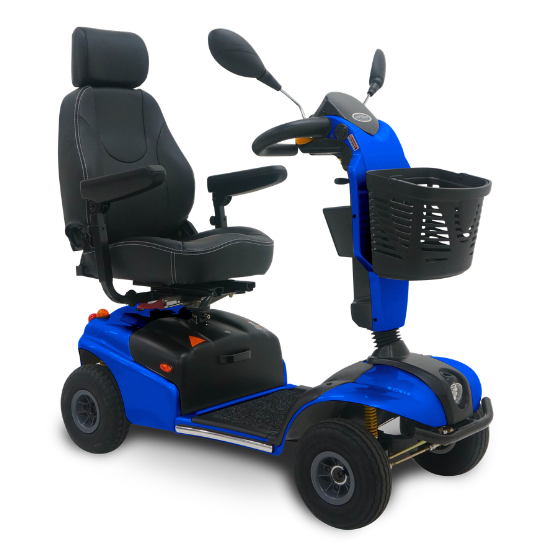
Shoprider Explorer
Goes up to 6.2 mph and 24 miles, made for the neighborhood and longer outings.
See this scooter
EV Rider CityCruzer
Rear suspension smooths out cracked sidewalks, and it still comes apart for the car.
See this scooter

Shoprider Expedition XL4
12.5" air-filled drive wheels and up to 7.5 mph.
See this scooter
Merits Pioneer 4
Long range and up to 4" of ground clearance.
See this scooter
Shoprider Excursion
Rated to 500 lbs with full suspension and 4" of ground clearance.
See this scooter
Merits Pioneer 10
500 lb capacity with the steadiness of four wheels, up to 8 mph.
See this scooter
Merits Silverado Extreme
Built for rough ground, with the longest listed range of any scooter we carry.
See this scooter
FreeRider FR1 Terrain
Made for covering long distances outdoors.
See this scooter
Shoprider Flagship Enclosed
A fully enclosed cabin keeps you out of the rain, wind and cold. Rated for 350 lbs on level ground.
See this scooterWhere Can You Learn More About Mobility Scooters?
For comparing models, use the buying guide or the ten-question assessment. To shop, browse 3-wheel, 4-wheel, heavy-duty or all scooters. For parts, see accessories, batteries and ramps. If a power chair might suit the rider better, the electric wheelchair knowledge base covers the same topics.
Help choosing a scooter
Shop mobility scooters
Parts and add-ons
Thinking about a power chair instead?
What Do Common Mobility Scooter Terms Mean?
Spec sheets and manuals use shorthand. The tiller is the steering column, the wig-wag is the thumb throttle, turning radius is the space needed to turn, and weight capacity is the most the scooter is rated to carry. Here's each common term in plain words.
Tiller
The steering column with the handlebars and controls.
Wig-wag / thumb throttle
The lever you push with your thumbs to go forward or back.
Speed dial
Sets the scooter's top speed.
Freewheel lever
Releases the drive so the scooter can be pushed. The brake is off when it's released.
Seat swivel
Lets the seat turn sideways for easier on and off.
Delta tiller
A wraparound handlebar some scooters use, easier for weak hands to grip.
Ground clearance
How high the lowest part of the scooter sits. More clearance clears bumps and curb cuts better.
Turning radius
How much room the scooter needs to turn around.
Anti-tip wheels
Small wheels at the back that keep the scooter from tipping backward.
Pneumatic tire
An air-filled tire. Softer ride, can go flat.
U1 battery
A common size of sealed lead-acid battery used in full-size scooters.
Watt-hour (Wh)
Battery energy: volts x amp-hours. Airlines use it for battery limits.
POV
Power-operated vehicle, Medicare's term for a mobility scooter.
Take-apart
A scooter that separates into pieces for loading into a car.
Weight capacity
The most the scooter is rated to carry, rider plus cargo.
Hitch carrier
A platform on the car's trailer hitch that carries a scooter outside the vehicle.
Auto-fold
A scooter that folds and unfolds itself, usually with a remote.
Heaviest piece
On a take-apart scooter, the weight of the biggest section you\'ll lift.
Mobility Scooter Questions and Answers
Short answers to what shoppers and facility buyers ask us most. Type a word to filter.
How long do mobility scooters last?
With regular care, the frame, motor and tiller commonly last many years. Batteries and tires get replaced along the way.
How long do mobility scooter batteries last?
Sealed lead-acid batteries often last about a year or two of regular use, and lithium batteries usually several years. Charging after rides and never storing them flat helps both.
How much maintenance does a mobility scooter need?
Very little: charge it, wipe it down and look at the tires weekly. Have it looked over once a year.
Are solid or air-filled scooter tires better?
Solid tires never go flat and need no upkeep. Air-filled tires ride softer outside but need pressure checks.
How far can a mobility scooter go on one charge?
Small folding scooters list about 8 to 10 miles and big full-size models 20 miles or more. Plan on half to two-thirds of the listed range in real riding.
Can I fly with a mobility scooter?
Yes. FAA rules allow a lithium battery up to 300 watt-hours on the scooter, with spares in the cabin. Call the airline before you book.
Which scooter is easiest to put in a car?
A folding scooter like the EV Rider Transport 4AF folds itself with a remote. Take-apart scooters like the EV Rider Nomad split into pieces of about 23.5 lbs or less.
How should I store a mobility scooter?
Indoors, dry, charged and switched off, near an outlet. Top up the battery about once a month if it sits.
Can you ride a mobility scooter in the rain?
Light rain for a short ride is usually OK, but most scooters aren't waterproof. Cover the tiller and avoid puddles.
Where can I ride a mobility scooter?
In most of the U.S., sidewalks, crosswalks, stores and paved paths at walking speed. Check local rules for roads.
What does a mobility scooter warranty cover?
The frame usually gets the longest coverage, with shorter terms on the motor, electronics and batteries. Ask us for any model's exact terms.
Does Medicare pay for mobility scooters?
Medicare Part B can help when a scooter is medically necessary at home and the steps are followed. See Medicare.gov for current rules.
Do you offer volume pricing for senior communities and facilities?
Yes. Volume pricing is available on request and we accept tax-exempt orders; call 585-505-6665 or send us your list.
Can agencies buy scooters through bids or RFQs?
Yes. We're registered on SAM.gov (UEI ZW1FPMTY2WK8, CAGE 23P44), and our bids and quotes page takes formal quote requests.
Where Does the Information on This Page Come From?
The MedCare Mobility team wrote this page from the questions shoppers and facility buyers ask us, the specs and warranty terms on our product pages, and official guidance from the FAA and Medicare. If anything here differs from your scooter's manual, follow the manual.
Customer questions
Topics come from what people ask us before they buy a scooter.
Maker specs
Specs and warranty terms come from each product page. Check the page before ordering.
Official rules
Battery and coverage rules link to the FAA and Medicare.
Your manual wins
If anything here differs from your scooter's manual, follow the manual.
Find the Right Scooter
Take the assessment, compare scooters in the buying guide, or browse our other knowledge bases.