

8
Jul
Medical Walkers: The 8 Types of Walkers and Who Each One Is For (2026)
Updated October 22, 2026
A medical walker is a frame you hold with both hands (or one, in some designs) that takes weight off the legs and widens your base of support while you walk. Hospitals send people home with one after surgery, a fall or a stroke, and many older adults use one every day. There are more types than most people expect, and the differences matter: a walker that suits someone recovering from a hip replacement can be the wrong choice for someone with Parkinson's.
Quick answer: the 8 main types of medical walkers are
- Standard walker (no wheels, lifted with each step): most stable
- Two-wheel walker (front wheels, back glides): the common hospital walker
- Four-wheel rollator (hand brakes and a seat): smoothest walk, place to rest
- Three-wheel rollator: narrow and nimble, light support
- Upright walker (forearm rests): stand tall instead of hunching
- Hemi walker: for one-hand use after a stroke
- Knee walker (knee scooter): for foot and ankle injuries
- Bariatric walker: heavy duty, 400 to 500 lb capacity
Another name for a medical walker is a walking frame (in the UK it's often called a Zimmer frame). A rollator is also called a rolling walker or wheeled walker.
Medical walker types compared
| Type | Wheels | Seat | Best for | Example we carry |
|---|---|---|---|---|
| Standard walker | None | No | Poor balance, leaning heavily, early recovery after surgery | Drive Deluxe Two-Button (5.5 lb) |
| Two-wheel walker | 2 front | No | Steady walking without lifting the frame | Drive Deluxe with 5" wheels |
| Four-wheel rollator | 4 | Yes | Good balance, longer walks, needs rest stops | Lumex Walkabout Lite |
| Three-wheel rollator | 3 | No | Tight spaces, light support | Drive Deluxe Three Wheel |
| Upright walker | 4 | Yes | Hunching, back pain, standing taller | Lumex Gaitster |
| Hemi walker | None | No | One usable hand or arm | Drive Side Step |
| Knee walker | 4 | Knee pad | Non-weight-bearing foot or ankle | Drive Economy Knee Walker |
| Bariatric walker | 0 to 4 | Some | Users up to 400 to 500 lb | Protekt Bariatric Rollator (500 lb) |
1. Standard walker (pick-up walker)
The original medical walker: a four-legged aluminum frame with rubber tips and no wheels. You lift it, set it down a step ahead, and step into it. Because it never rolls, it's the most stable type, which is why it's often the first walker after a hip or knee surgery, or for someone who puts a lot of weight through their arms.
The trade-off is a slower, stop-and-go walk, and lifting the frame every step can tire the arms. Most fold flat with push buttons. The Drive Medical Deluxe Two-Button Folding Walker weighs only 5.5 lb, holds 350 lb, and each side folds on its own. Some standard walkers are also reciprocal walkers: the sides hinge so you can advance one side at a time, and a "fixed mode" locks them into a regular rigid walker.

2. Two-wheel walker (front-wheeled walker)
This is the walker most people picture as a "hospital walker." It's a standard frame with two wheels on the front legs and glides or tips on the back legs. You push it forward instead of lifting it, so walking is smoother and less tiring, while the back legs still keep it from rolling away.
It's a good middle ground for people who need real support but have the balance to walk at a steady pace. The Drive Deluxe Two-Button Folding Walker with 5" wheels adjusts from 32" to 39" with a 350 lb capacity, and the Drive Deluxe Trigger Release Folding Walker folds without letting go of the frame and weighs 6 lb. Shorter users can choose a junior frame like the McKesson Junior Folding Walker (25" to 32").
3. Four-wheel rollator
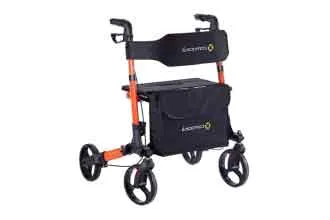
A rollator has four wheels, hand brakes and almost always a seat and backrest. It gives the most natural walking pace and a built-in place to rest, so it suits people with fair balance who walk longer distances, shop or go outside. The user has to manage the brakes, and the brakes must be locked before sitting.
Wheel size decides where it works best: 6" wheels for indoors and smooth sidewalks, 8" and up for rougher ground. The Lumex Walkabout Lite is a 14.5 lb aluminum rollator with 6" wheels and a 300 lb capacity. The Protekt Aluminum Rollator weighs 13 lb with a 20" seat height. For outdoor use, the Drive Nitro Sprint has large 10" front wheels and slow-down brakes. See all rollators.

4. Three-wheel rollator
A three-wheel rollator has one front wheel and two back wheels, which makes it narrower and easier to steer around furniture and through doorways. Most have no seat, and the three-point base is less stable than four wheels, so it's best for someone who needs light support and good maneuverability. The Drive Medical Deluxe Three Wheel Walker is 11 lb with 7.5" casters and a 300 lb capacity, and the Karman R-3600 has three 8" solid wheels. Browse 3 wheel walkers.
5. Upright walker (stand-up walker)
An upright walker puts padded forearm rests at chest height, so the user stands tall inside the frame and leans on their forearms instead of pushing down through bent wrists. It helps people who hunch over a standard walker or get back and shoulder pain from it. Most have four wheels, brakes and a seat.
The Lumex Gaitster upright rollator has adjustable forearm rests, an 18" padded seat and 9.25" front wheels. The VOCIC Z22 Stand Up Walker offers 5 forearm rest heights and a 300 lb capacity. More in upright and specialty walkers.

6. Hemi walker (one-hand walker)
A hemi walker is made to be held with one hand, for people who have use of only one arm, most often after a stroke. It's wider at the base and more stable than a quad cane, but lighter and narrower than a full walker. The Drive Medical Side Step folding walker adjusts from 29.5" to 37" and folds flat with one hand. If a seat is needed, the Lumex Walkabout Four-Wheel Hemi Rollator is a 14 lb hemi rollator with a 20" seat.
7. Knee walker (knee scooter)
A knee walker isn't a walker in the usual sense. The user rests the injured leg's knee on a padded platform and pushes with the other foot, steering with handlebars. It's used after foot or ankle surgery, fractures and wounds when the person can't put weight on that foot, and it's much easier than crutches for most people. The Drive Medical Economy Folding Knee Walker is 19.5 lb, steerable, with dual rear brakes and a 350 lb capacity. The Karman KW-200 weighs 23.5 lb with 8" flat-free casters. See all knee walkers.
8. Bariatric (heavy duty) walker
Bariatric walkers have heavier frames, wider spacing between the handles and higher weight ratings. Standard walkers are commonly rated around 300 to 350 lb, and many rollators lower than that. The McKesson Bariatric Dual Release Folding Walker holds 500 lb with no wheels, the Protekt Bariatric Rollator holds 500 lb with an 18" seat, and the Karman R-4800 holds 400 lb with a 23" handle opening. Browse heavy duty walkers.
Specialty walkers worth knowing
- Gait trainers for Parkinson's: the U-Step II has reverse brakes that stop it when you let go, plus laser and sound cueing for freezing.
- Rollator and transport chair in one: the Triumph Prestige and Karman R-4602-T convert so a caregiver can push the user when they get tired.
- Electric walkers: the VOCIC Z73 has an assist mode with 3 power levels and a resist mode with 3 control levels.
- Petite and narrow walkers: frames like the Karman R-4100N (23" wide) fit shorter users and tight homes. See petite walkers.
Which type of walker is right?
As a rule of thumb: the more weight someone puts through their arms and the poorer their balance, the fewer wheels they should have. A therapist will often start someone on a standard or two-wheel walker and move them to a rollator as they get stronger. For a step-by-step way to choose, use our complete walker buying guide. If the walker you have isn't working, our guide to common problems with walkers for the elderly covers the fixes.
Medical walker FAQ
What is another name for a medical walker?
A medical walker is also called a walking frame, a walking aid or, in the UK, a Zimmer frame. Walkers with wheels are called rollators, rolling walkers or wheeled walkers.
What type of walker do hospitals use?
Hospitals most often use a standard folding walker or a two-wheel walker, because both are stable and easy to adjust. Rollators are usually introduced later, once balance improves.
What is the most stable type of walker?
A standard walker with no wheels is the most stable, because it can't roll. A two-wheel walker is close behind, since its back legs still grip the floor.
What is a reciprocal walker?
A reciprocal walker is a walker without wheels whose sides hinge, so you move one side forward at a time in a walking pattern. Most can be locked into a fixed mode to work as a regular rigid walker.
What is the difference between a walker and a rollator?
A walker has no wheels or two front wheels and gives more stability. A rollator has three or four wheels, hand brakes and usually a seat, and gives a smoother walk for people with better balance.
Is a knee walker better than crutches?
For most people with a foot or ankle injury, yes. A knee walker takes no upper body strength to balance and leaves the hands on the handlebars, while crutches take strength and coordination.
Questions about a specific walker? Contact our team and we'll help you match the type to the person.




Comment (1)
This guide on medical walkers is exceptional! It provides detailed descriptions and benefits of each type, making it easier to select the right walker for improved mobility. Highly recommended!