Patient Transfer Solutions for Difficult Transfers: Real-World Hoyer Lift, Sling & Sit-to-Stand Answers
26
Aug
Patient Transfer Solutions for Difficult Transfers: Real-World Hoyer Lift, Sling & Sit-to-Stand Answers
Real-World Patient Transfer Problems
Start With the Transfer Problem — Not the Name of the Equipment
The right patient transfer solution depends less on what a product is called and more on what is actually happening during the transfer. Someone sitting on the floor and unable to get back up has a different problem from someone who can stand once assisted but cannot rise from a chair. A patient whose legs buckle unpredictably is different again from someone who cannot bear weight at all.
Start with what the patient can still do. A full-body Hoyer lift becomes relevant when the patient's body must be supported by a sling through the transfer. Sit-to-stand and standing assist devices are different: they depend on the patient being able to participate in standing to an appropriate degree.
Then look at what is making the transfer difficult. It may be repeated lifting, poor head control, a sling that is hard to position, toileting access, a bed the lift cannot fit beneath, or a bathroom where the base cannot maneuver. In some situations, a seated patient transfer chair may make more sense than repeatedly suspending the patient in a sling.
Core PrincipleMatch the equipment to the transfer that is actually failing. Patient ability, starting position, destination, sling support, room geometry and transfer frequency help determine whether to investigate a Hoyer lift for home use, electric or hydraulic patient lift, sit-to-stand device, standing aid, transfer chair, or specialized patient sling.
Real Transfer Situations
The same patient lift is not the answer to every transfer problem.
Small details in the patient's ability, position and environment can completely change the equipment worth investigating.
Floor
Cannot get up from the floor
Starting position, weight-bearing, lift range and sling placement all matter.
Standing
Can stand but cannot rise
Rising strength and active participation may point toward standing assistance.
Stability
Legs buckle unexpectedly
Occasional standing does not necessarily mean standing transfers are reliable.
Full Support
Cannot bear weight
A sling-supported full-body lift may become the category to investigate.
Frequency
Transfers happen all day
Repeated lifting makes caregiver effort and powered operation more important.
Positioning
Poor head or trunk control
The sling's support profile may matter as much as the lift itself.
Bathroom
Toileting is the hardest transfer
Support, clothing access and bathroom clearance can change the setup.
Home Layout
The lift does not fit the room
Under-bed clearance, base width and turning space can decide whether a lift works at home.
?
Quick Answer
How do you know which type of patient transfer equipment to investigate?
Begin with the movement the patient can no longer perform safely. Can they bear weight? Can they remain stable once upright? Are they starting on the floor, bed, toilet or chair? Then consider head and trunk control, destination, room space, sling requirements and how often the transfer happens. Those answers narrow the equipment category far more effectively than starting with a product name.
Explore This ArticleJump to a transfer situation
Quick Situation Finder
Start With What's Actually Making the Transfer Difficult
Use the problem to narrow the equipment category first. Patient fit, measurements, sling compatibility and manufacturer requirements still need to be confirmed.
What's Happening?
Equipment Category to Investigate
Cannot bear weight
Full-body patient lift + appropriate sling
Can bear some weight but cannot rise
Powered sit-to-stand
Can actively pull up and remain supported
Manual standing transfer aid
Sitting on floor and cannot rise
Floor-capable full-body lift + appropriate sling
Lying on floor
Floor-capable lift + appropriate full-body sling
Several full-body transfers daily
Electric patient lift
Limited predictable transfers
Hydraulic lift may be practical
Repeated seated transfers
Patient transfer lift chair may be relevant
Toileting access is difficult
Compatible toileting / commode-access sling
Bathing or wet transfer
Compatible mesh sling
Poor head or trunk control
Higher-support sling
Higher patient weight
Properly rated heavy-duty lift + sling
Small home or difficult room layout
Compact/folding lift or another space-appropriate solution
Cannot bear weight
Full-body patient lift + appropriate sling.
Can bear some weight but cannot rise
Powered sit-to-stand may be relevant.
Can actively pull up and remain supported
Manual standing transfer aid may be relevant.
Sitting or lying on the floor
Investigate true floor-capable lifting range and an appropriate sling.
Several full-body transfers every day
Electric lifting may reduce repeated manual pumping.
Only a few predictable transfers
A hydraulic lift may remain practical.
Repeated seated transfers
A patient transfer lift chair may be worth investigating.
Toileting or bathing is difficult
The sling material, opening, support and compatibility become critical.
Poor head or trunk control
Look for a sling providing the required body and head support.
Small or difficult room
Compare base width, under-bed clearance and turning space.
Before Narrowing the Equipment
Five Details That Can Completely Change the Answer
Two people needing the same basic transfer can still require different equipment.
01
Can the patient bear weight?The key distinction between many standing and full-body lifting solutions.
02
Can they remain stable upright?Standing ability must be reliable enough for the transfer method.
03
Where are they starting and going?Floor, bed, wheelchair, recliner and toilet transfers create different demands.
04
How much head and trunk control?This can completely change the sling support required.
05
How often does it happen?Frequency changes the practical value of powered versus manual equipment.
Getting Up & Floor Transfers
Getting Up & Floor Transfers: When the Starting Position Changes the Solution
“They cannot get up” can describe very different problems. Someone sitting on the floor without reliable weight-bearing needs a different transfer approach from a person who can stand once assisted but lacks the strength to rise from a chair. If the legs sometimes give way, the question changes again. Starting position, reliable weight-bearing, sling support and where the patient needs to go next are what narrow the solution.
Before a Floor Transfer
If the person is on the floor because of a fall, first consider whether an injury may have occurred. New pain, suspected fracture, head impact, loss of consciousness or a sudden change in movement may require medical evaluation before attempting a lift.
Scenario A · Sitting on the Floor
What Lift Works If the Patient Is Sitting on the Floor and Cannot Get Up?
Quick Answer
If the patient cannot reliably bear weight or participate in standing, investigate a full-body patient lift that can reach the required floor position with the appropriate sling. Sitting upright on the floor does not automatically make a sit-to-stand lift appropriate.
The first question is not “Can they sit?” It is “Can their legs safely support the transfer?” Sit-to-stand equipment is built around patient participation. If the legs cannot be relied upon, a sling-supported full-body lift is usually the more relevant category to investigate.
No Reliable Weight-BearingFull-body sling lift
The lift and sling support the patient instead of relying on the legs to complete the transfer.
Some Weight-BearingDo not ignore starting height
A standing lift may suit the patient's ability yet still be unsuitable for beginning directly from the floor.
Active & StableStanding assistance may fit
Manual standing aids require meaningful participation and enough stability to remain supported.
For floor pickup, lifting range matters almost as much as capacity.
A 500-lb rating tells you how much the lift can support; it does not tell you whether the spreader bar reaches the patient in the position they are actually in. For floor transfers, compare the lowest sling-hook position, base access, sling application and destination height.
Is the patient sitting, reclined or lying?
Can the lift reach the required attachment height?
Can the sling be applied without unsafe repositioning?
Does the patient require head or trunk support?
Can the base approach in the available room?
Is the destination a bed, wheelchair or commode?
Real Equipment Examples
Two different ways to solve a full-body floor-transfer problem
These products belong here because of specific transfer capabilities—not simply because they are patient lifts.
Powered · 500 lb Capacity
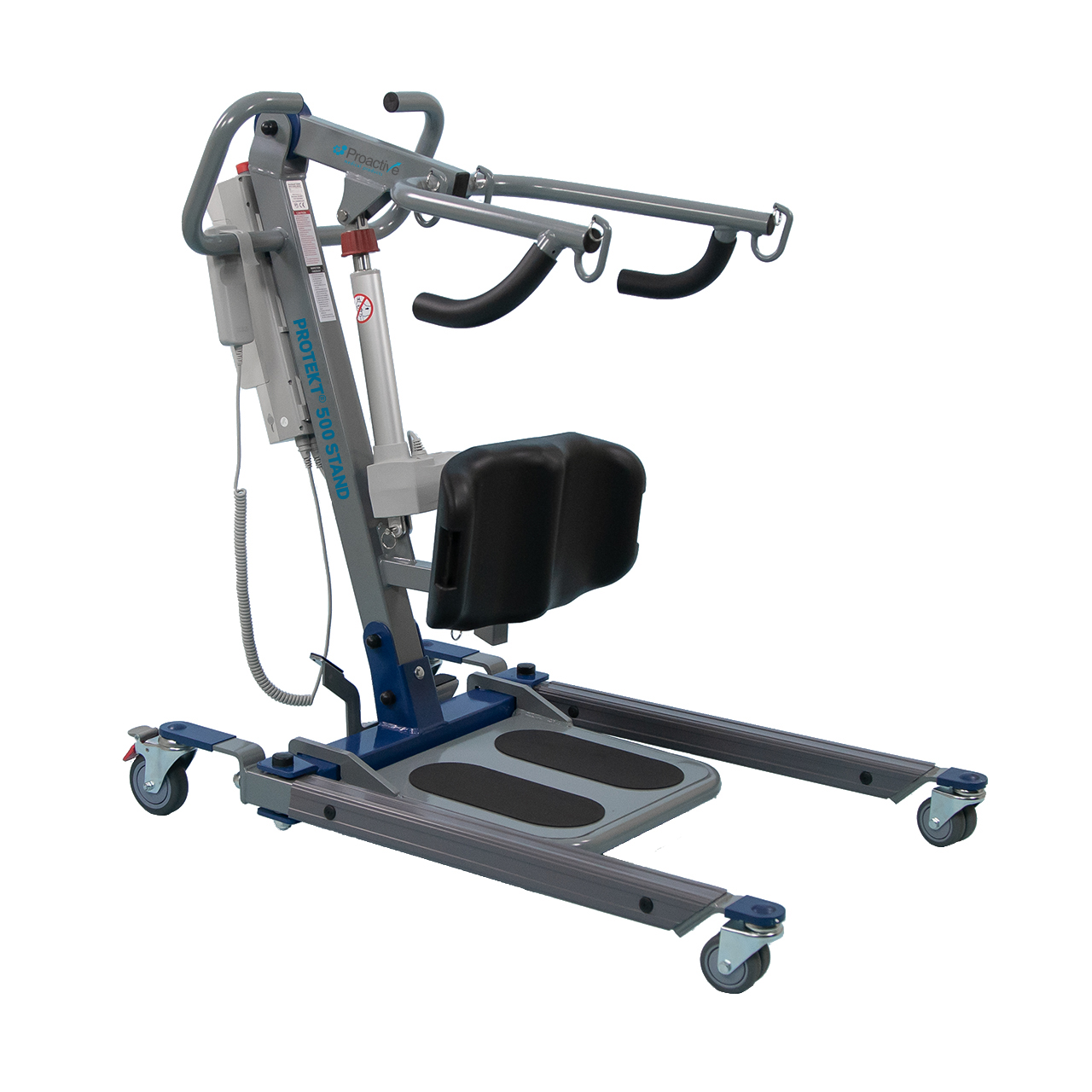
Protekt 500 Electric Hoyer Lift
A strong fit when full-body floor recovery is required and the caregiver also wants powered lifting for repeated transfers. Its 6-point spreader bar also expands the sling configurations that can be considered.
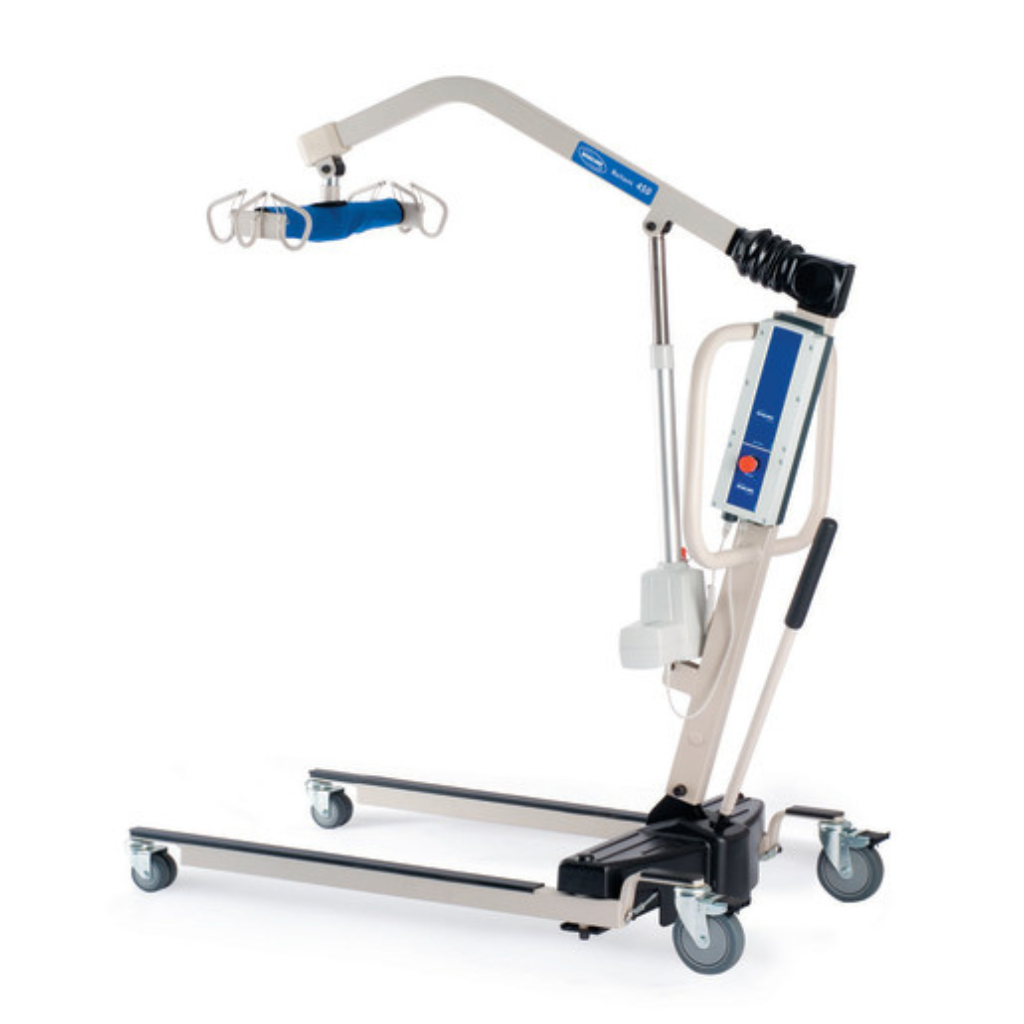
A manual alternative when floor pickup and sling versatility are needed without an electric lifting system. Its 6-point swivel bar works with several Invacare sling styles, including divided-leg options.
Other situations may point elsewhere:
the Birdie Evo XPLUS provides a documented 24–74" sling-hook range and folding electric design, while the Hoyer Advance becomes especially interesting when floor-level lifting must be combined with portability, folding storage and tighter home spaces.
Scenario B · Sling Application & Support
What Kind of Hoyer Sling Works When the Patient Is Sitting on the Floor?
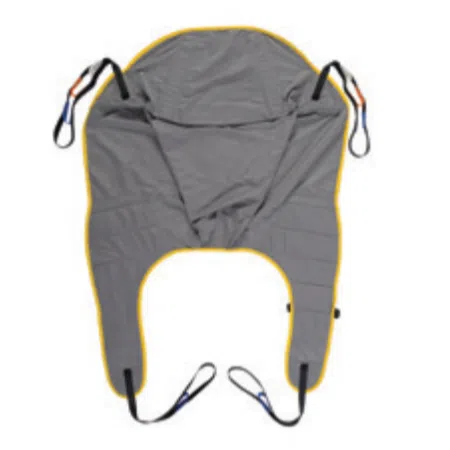
Quick AnswerThere is no universal “floor sling.” A divided-leg sling can sometimes be easier to work around the thighs of an already-seated patient, while another patient may need a full-back or head-support sling even if it takes more repositioning to apply. The best choice balances how the sling goes on with how much support the patient needs once lifted.
This is why choosing a Hoyer lift sling from weight capacity alone can lead families in the wrong direction. Starting posture, head and trunk control, leg position, destination and the lift's attachment system all matter.
When Support Is the ProblemJoerns Hoyer Full Back Sling
Integrated head and neck support makes this the type of sling to investigate when the patient cannot reliably maintain upper-body position during a full-body lift.
When Wet Care Comes NextProactive Full Body Mesh Sling
Full-body support combined with breathable mesh makes this more relevant when the transfer continues into bathing, showering or another wet-care routine.
Often worth investigating for an already-seated patient because each leg section can be positioned separately around the thighs. The patient's support needs still come first.
Full-back / head-support sling
More relevant when head or trunk control is poor and the patient needs greater support through the lift.
Commode-access sling
Useful when toileting access is the destination problem, provided the more open design still supplies enough support for that patient.
Specialized / amputee sling
Amputation, contractures or unusual leg positioning can change both sling shape and leg configuration requirements.
For example, the Invacare 9805P can be configured with several sling styles, including divided-leg slings. That makes the sling discussion part of the lift decision itself—not an accessory decision that should be left until after the lift is purchased.
Sling capacity is not the same as sling suitability. Correct size, body fit, support profile and attachment compatibility with the specific spreader bar all need to be verified before use.
Scenario C · Lying Flat on the Floor
What Changes If the Patient Is Lying Flat Instead of Sitting?
A supine patient creates a different sling-placement problem. With an approved application method, some full-body slings can be positioned while the patient is lying down, but the lift still has to reach low enough for the sling attachments without pulling the patient upward before everything is correctly seated.
Sitting on FloorApplication and postural control matter more.
The caregiver has to work the sling around a body that is already upright or partly reclined.
Lying on FloorLow pickup geometry and full support dominate.
Sling placement may be different, while head support and true low-level attachment reach remain critical.
Destination matters too. Floor-to-bed recovery asks the lift to finish at a different height and patient position than floor-to-wheelchair seating. This is one reason published lifting range should be checked at both ends of the transfer.
Scenario D · Can Stand, But Cannot Rise
What If the Patient Can Stand Once Up but Cannot Get Up From the Chair?
Quick Answer
When the patient can safely bear weight but lacks enough strength to rise independently, a standing assist device or powered sit-to-stand lift may match the problem better than a full-body Hoyer lift.
Actively Pulls & StandsManual standing transfer aid
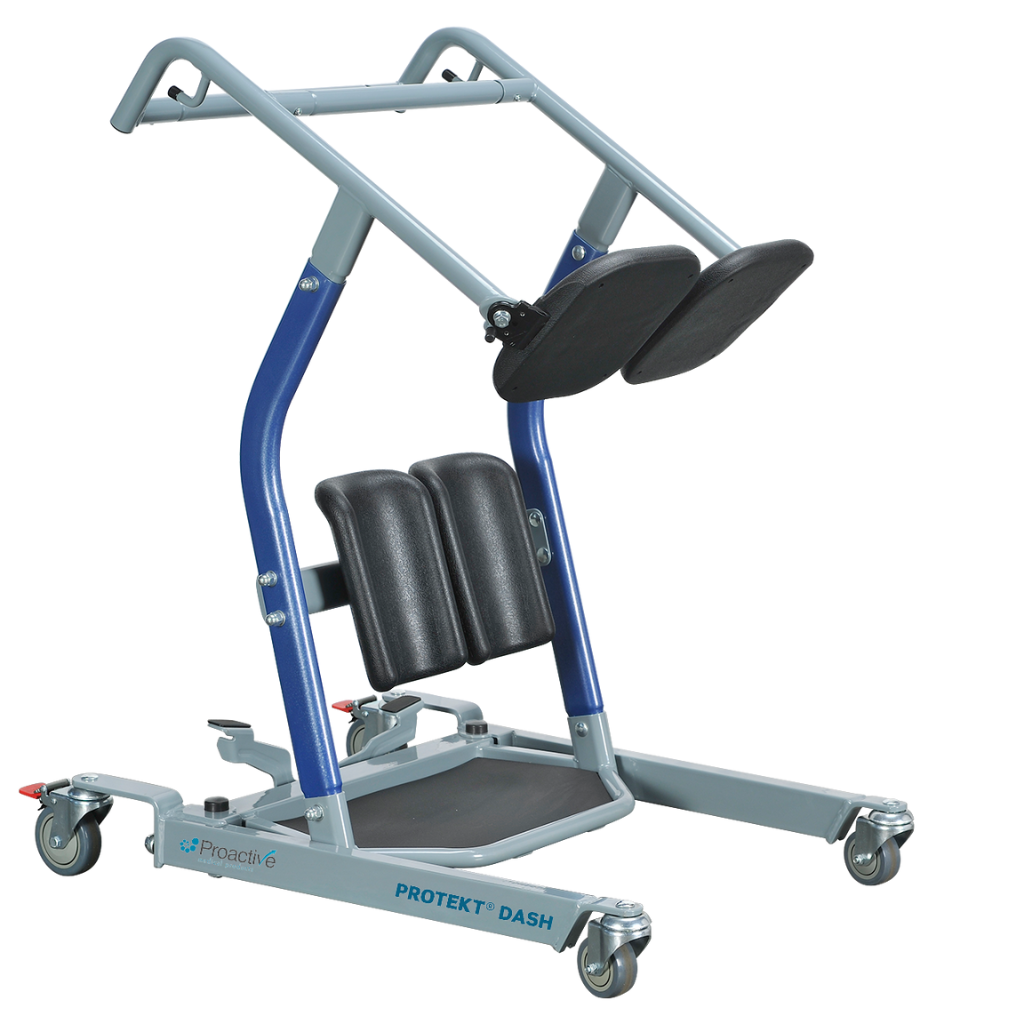
A product such as the Protekt Dash depends on meaningful patient participation: pulling into standing, bearing weight and remaining supported.
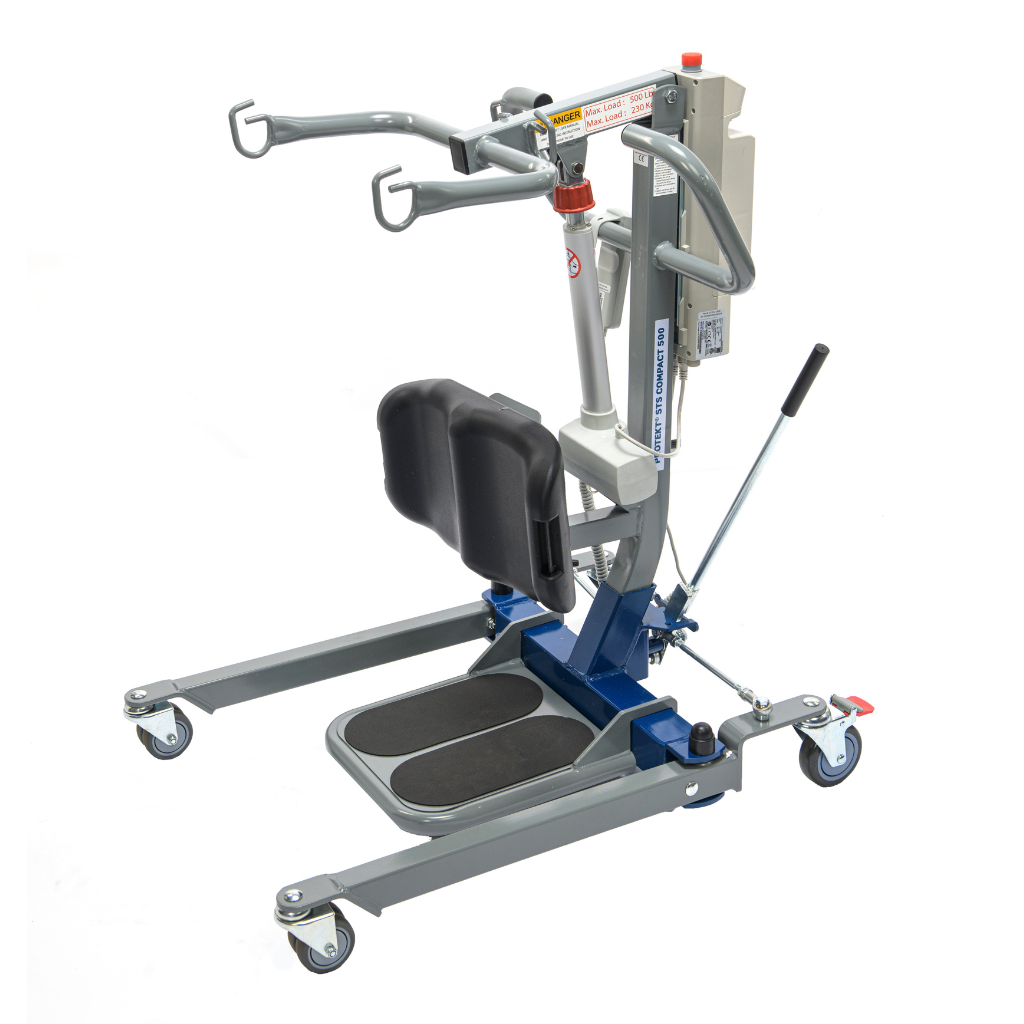
Models such as the Protekt STS Compact 500 or Invacare ISA Compact mechanically assist the rise while still requiring the patient to be an appropriate standing-transfer candidate.
This is a useful place to separate “cannot get up” from “cannot stand.” They are not the same problem. A patient who lacks rising strength but can participate safely once upright may need a completely different solution from someone whose legs cannot support the transfer.
Scenario E · Legs Give Out
What If the Patient's Legs Suddenly Buckle During a Transfer?
Important DistinctionBeing able to stand sometimes is not necessarily the same as being able to participate reliably in a standing transfer.
A person may complete one transfer successfully and lose strength midway through the next. If weight-bearing is unpredictable, a manual standing aid may no longer match the amount of support the transfer actually requires.
A powered sit-to-stand can assist the rising movement, but it still relies on appropriate patient participation. If the legs can no longer be relied upon to support a standing transfer, the question may shift back toward a full-body patient lift and an appropriately supportive sling.
A new or unexplained change in leg strength deserves attention beyond equipment selection. If someone who previously stood reliably begins buckling or functioning differently, appropriate clinical evaluation should be considered.
Trusted reference:
OSHA's safe patient-handling guidance distinguishes sling-type full-body lifts from sit-to-stand equipment based in part on the patient's ability to bear weight and participate in standing, and also discusses full-body sling lifts for transfers from the floor.
Review OSHA Safe Patient Handling Guidance
Continue by SituationWhat transfer problem are you trying to solve next?
Full-Body Patient Lifting
When Full-Body Patient Lifting Becomes the Practical Solution
There is a point where helping someone “a little more” is no longer what the transfer requires. If the patient cannot reliably support their weight, cannot complete a stand-and-pivot transfer, or has to be physically held up between the bed and wheelchair, the problem has changed. The patient's body now needs dependable support throughout the transfer. That is where a sling-supported full-body patient lift becomes relevant.
For families looking at Hoyer lifts for home use, this distinction matters more than whether a particular model is electric, hydraulic, lightweight or heavy-duty. First establish that full-body lifting is the right transfer method. Then look at the details that determine whether the lift will actually work around the patient's bed, wheelchair, recliner and daily care routine.
The Practical Threshold
If the caregiver has to hold up a meaningful portion of the patient's body weight to complete the transfer, simply adding more physical assistance may not solve the underlying problem. A properly selected full-body lift transfers that lifting demand to the equipment while an appropriate sling supports the patient.
Scenario A · No Reliable Weight-Bearing
What Kind of Patient Lift Is Used When Someone Cannot Bear Weight?
Quick Answer
A patient who cannot safely bear weight through the legs will generally require a full-body sling lift rather than equipment that depends on standing participation. The sling supports the patient's body while the lift raises and positions them between surfaces.
This is one of the clearest dividing lines in patient transfer equipment. A sit-to-stand device can provide substantial mechanical assistance, but it still assumes that standing is an appropriate part of the transfer. A full-body lift does not ask the patient's legs to carry the transfer in the same way.
“They can stand for a second.”Is that enough?
Not necessarily. Weight-bearing needs to be reliable enough for the transfer, not merely possible for a moment on a good attempt.
“We can still lift them ourselves.”Does that mean a lift is unnecessary?
The more relevant question is how much of the patient's weight the caregiver is physically supporting and whether that can be done consistently and safely.
“They are awake and cooperative.”Can they use a standing lift instead?
Cooperation helps, but it does not replace the physical ability required for a standing transfer.
Once full-body support is needed, the decision becomes more practical: How much does the patient weigh? How much sling support is required? How low and high must the lift reach? Can its base approach the furniture? And how often will the caregiver perform the transfer?
Two Different Full-Body Lift Pathways
Same basic transfer need — very different homecare priorities
The useful difference between these lifts becomes clearer when we connect their design to an actual caregiving situation.
Electric · Lightweight · Folding
Hoyer Advance
Especially relevant when a fully dependent patient needs sling-supported transfers but the home also creates a storage, transport or furniture-access problem. Its lightweight aluminum frame, tool-free folding design and tapered legs distinguish it from a conventional full-size floor lift.
Worth investigating when the transfer involves different surface heights or a heavier patient while still requiring a mobile electric lift. Its published sling-hook range extends from approximately 24 to 74 inches, with a 463 lb safe working load.
When capacity and repeated powered lifting matter more:
the Protekt 500 Electric Hoyer Lift provides a 500 lb capacity, electric operation and 6-point spreader bar. The point is not that one of these lifts is universally “best”; each solves a different version of the same full-body transfer problem.
Scenario B · Bed to Wheelchair
What If Bed-to-Wheelchair Transfers Can No Longer Be Managed Safely by Hand?
Quick Answer
If the patient can no longer complete a safe stand-and-pivot transfer and the caregiver is increasingly lifting, catching or holding the patient's body weight, a full-body patient lift may provide the support the transfer now requires.
The difficult part is often not simply getting someone out of bed. A caregiver may be able to help the patient sit at the edge, only to discover that the patient cannot rise, cannot turn toward the wheelchair, or begins collapsing before reaching the seat.
A full-body lift changes that workflow because the patient can remain supported in the patient sling while being moved between surfaces. But a lift that can raise the patient is not automatically a lift that will work well in that particular bedroom.
For a bed-to-wheelchair transfer, check the entire path—not just lifting capacity.
Can the lift base travel beneath or around the bed?
Does the boom provide enough usable lifting range?
Can the wheelchair be approached closely enough for positioning?
Can footrests or armrests be moved when needed?
Does the sling provide the patient's required head and trunk support?
Can the caregiver maneuver the loaded lift in the available floor space?
A common homecare surprise: families sometimes focus on the lift's weight capacity and only later discover that the bed frame, wheelchair position or room layout is the harder part of the transfer. Capacity answers “can it support the patient?” Geometry answers “can it actually perform this transfer here?”
Transfer frequency matters as well. If bed-to-wheelchair happens every morning and wheelchair-to-bed every evening, the caregiver is performing at least two full lifting cycles every day. Add toileting, repositioning or another chair transfer and the practical value of an electric Hoyer lift can become much more noticeable.
Scenario C · Recliners & Low Chairs
What If the Hardest Transfer Is From a Recliner or Low Chair?
Recliners create a problem that a normal bed often does not: there may be almost nowhere for the lift base to go. The seat may be low, the chair base may extend close to the floor, and the patient may be positioned farther back than they would be in a wheelchair.
Seat HeightHow low is the patient?
A low seat changes sling attachment height and the amount of vertical range needed before movement.
Furniture BaseCan the legs get close?
Solid or bulky chair bases can prevent conventional lift legs from approaching the patient.
Patient AbilityDo they actually need full-body support?
If reliable standing is still possible, a standing solution may fit better than suspending the patient in a sling.
Transfer PatternIs this always seat-to-seat?
Repeated seated transfers may eventually make a patient transfer chair worth investigating instead.
Why the Hoyer Advance becomes interesting around bulky furniture
This is a good example of why specifications need context. The Hoyer Advance uses tapered, swan-neck-style legs specifically designed to help the lift approach wide obstacles such as bulky chairs, commodes and wheelchairs. That design feature can matter more around a difficult recliner than simply choosing the lift with the highest capacity.
It still does not mean every recliner is accessible. Furniture construction, clearance and the patient's position have to be checked. When the chair cannot be approached appropriately, the solution may involve changing the furniture arrangement, using another lift geometry, or reconsidering whether a patient transfer lift chair better matches a repeated seated-transfer routine.
Scenario D · Daily Workflow
Does This Situation Call for an Electric or Hydraulic Hoyer Lift?
Quick Answer
The useful question is not whether electric Hoyer lifts are universally better than hydraulic Hoyer lifts. Ask instead: how often will this patient be lifted, who will operate the lift, and how much repeated pumping is realistic for that caregiver?
Occasional / Predictable Transfers
Hydraulic can remain very practical.
A manual lift can make sense when transfers are limited, the caregiver can comfortably operate the hydraulic pump, and avoiding batteries or charging is valuable.
The Protekt Onyx, for example, supports 450 lbs, has a 22-inch closed base and works with both 4- and 6-point sling arrangements.
Repeated Daily Full-Body Lifting
Electric operation becomes more meaningful.
When the same caregiver performs bed, wheelchair, commode and return transfers throughout the day, powered lifting removes the repeated hydraulic pumping portion of every lift cycle.
The Protekt 500 is a useful example when 500 lb capacity and powered daily operation are priorities.
“I don't want to worry about charging.”A hydraulic model such as the Protekt Onyx or Invacare 9805P may fit that priority.
“My arms can't keep pumping a lift several times a day.”That is a strong practical reason to investigate an electric patient lift rather than treating powered operation as merely a convenience feature.
“I need something easier to store or move between locations.”The lightweight folding Hoyer Advance addresses a different problem than a conventional heavy-duty electric floor lift.
“I want manual now, but our care needs may increase.”The Protekt Transformer is unusual because the hydraulic configuration can later accept an electric upgrade kit.
Do not let “electric vs hydraulic” hide the more important questions. A powered lift can reduce pumping effort, but it still needs the correct capacity, sling, lifting range and base geometry. Likewise, a hydraulic lift can be completely appropriate when its manual workflow is realistic for the caregiver and the transfer environment.
If you are still comparing the lift types themselves rather than solving a particular transfer problem, use our complete patient lift buying guide or browse current Hoyer lifts for sale. This resource stays focused on what changes when a real transfer stops working.
Trusted reference:
OSHA identifies sling-type full lifts as an assistive solution for non-weight-bearing patients and for transfers such as bed to wheelchair, toilet chair, bathtub and commode. NIOSH likewise emphasizes assistive lifting technology as part of safe patient handling and reducing the physical demands of manual patient handling.
OSHA Patient Handling Guidance
·
NIOSH Safe Patient Handling
Continue by SituationWhat transfer problem are you solving next?
Frequent & Everyday Transfers
When Patient Transfers Happen Several Times Every Day
A transfer that works reasonably well once in a while can become exhausting when it has to happen five or six times a day. Frequency changes what matters. Caregivers begin noticing the repeated pumping, sling setup, maneuvering, battery routine and time required to move between the places the patient actually uses throughout the day.
Bed
Wheelchair
Toilet
Chair
Back to Bed
Scenario A · Several Transfers a Day
What Changes When Someone Needs Several Transfers Every Day?
Quick Answer
When full-body transfers become part of the daily routine, the question shifts from “Can this lift complete the transfer?” to “Can this setup realistically support this routine every day?”
Consider a patient who moves from bed to wheelchair in the morning, needs toilet transfers during the day, spends time in a recliner, and returns to bed at night. The same lift may be used again and again, often by the same caregiver.
Operator effort
Small differences in lifting effort become much more noticeable after repeated cycles.
Sling routine
A sling that is difficult to apply for the actual transfer can slow every transfer that follows.
Maneuverability
The lift may need to work around several different pieces of furniture, not just the bed.
Power routine
With an electric Hoyer lift, charging and battery readiness become part of everyday care.
This is where electric Hoyer lifts often become particularly relevant. Powered lifting removes repeated hydraulic pumping from the routine. That does not automatically make electric the right answer—the lift still has to fit the patient, sling and home—but frequency gives powered operation a much more practical reason to matter.
Scenario B · Fewer Predictable Transfers
When Does a Hydraulic Hoyer Lift Still Make Sense at Home?
Quick Answer
A hydraulic Hoyer lift can remain a very practical home solution when full-body lifting is needed but transfers are relatively limited, the caregiver can comfortably operate the pump, and a battery-free lifting system is preferred.
Think of a predictable bed-to-wheelchair transfer in the morning and a return transfer later in the day rather than a constant cycle of lifting. In that situation, manual hydraulic operation may not create the same burden it would for someone transferring repeatedly between bed, wheelchair, toilet and chair.
Where current hydraulic options fit this conversation
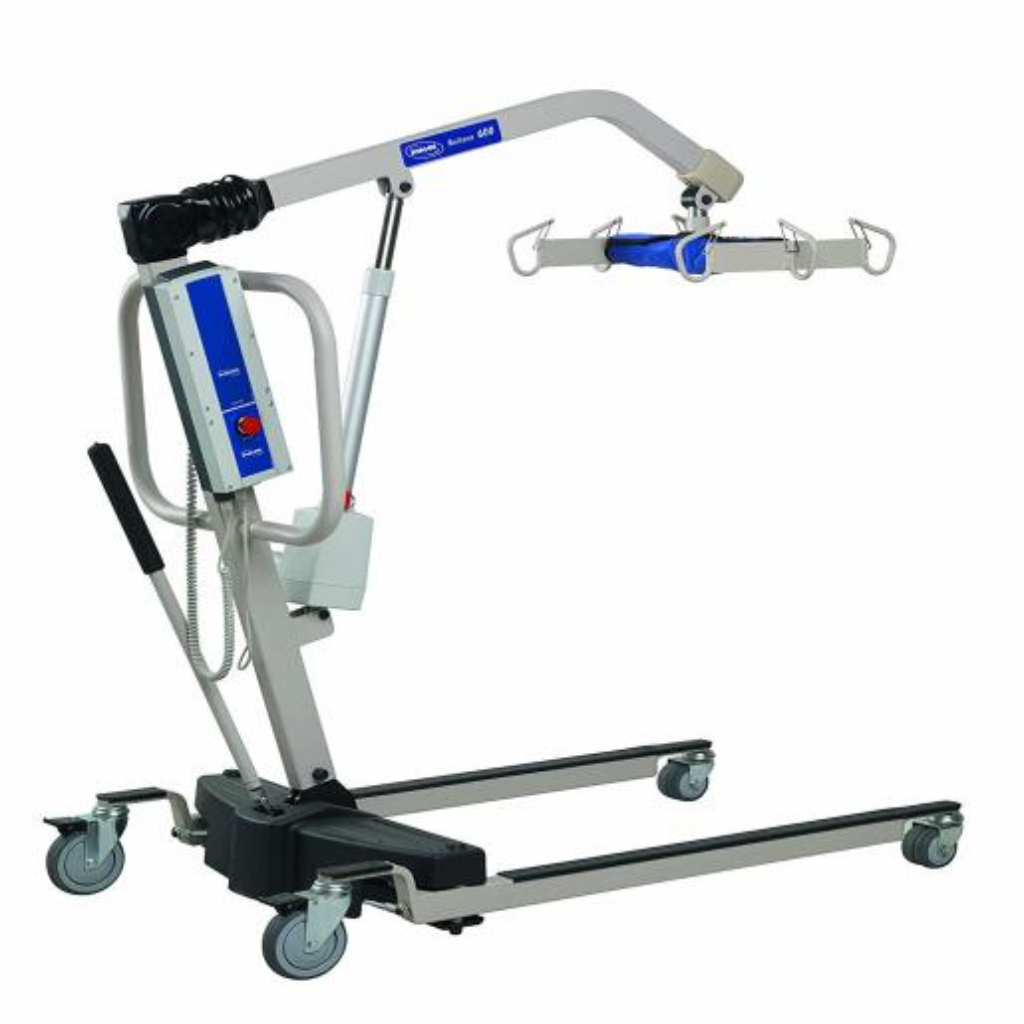
The Protekt Onyx,
Joerns Hoyer HML400, and
Invacare 9805P
are examples of manual full-body lift solutions for families who need sling-supported lifting without building charging or battery management into the routine.
The tradeoff is straightforward: the caregiver supplies the pumping effort. If that feels insignificant at the actual number of transfers being performed, hydraulic operation may be entirely reasonable. If it is already becoming tiring, the transfer frequency is telling you something important.
Scenario C · Caregiver Effort
What If the Caregiver Can Position the Patient but Cannot Manage Repeated Manual Lifting?
Sometimes the caregiver can manage sling placement, communicate with the patient and guide the transfer, but repeated hydraulic pumping is the part that has become difficult. That is a different problem from being unable to perform the entire transfer.
In that situation, look at which part of the workflow is actually causing the difficulty. An electric boom can remove manual pumping, but it does not automatically make sling application or maneuvering effortless. A powered base, where offered, may reduce another manual task. And if most transfers are repeated seated-to-seated moves, a patient transfer chair may eventually deserve consideration rather than assuming every workflow must revolve around a floor lift.
The number of caregivers required for a transfer should never be assumed from the word “electric.” Staffing and assistance requirements depend on the patient, equipment, sling, environment and manufacturer instructions—not simply on whether a hand control raises the boom.
Scenario D · Changing Ability
What If the Patient's Transfer Ability Is Gradually Changing?
Transfer needs do not always change overnight. A person may first need help rising, then begin relying more heavily on the caregiver, and eventually stop bearing weight reliably. The equipment that worked six months ago may no longer match what the patient is physically doing today.
Functional Ability
Equipment That May Become Relevant
Needs light assistance
Appropriate transfer assistance based on current mobility
The important signal is often not a diagnosis or a product name. It is a change in what happens during the transfer: the patient stops rising reliably, needs progressively more physical support, begins buckling, or can no longer maintain the position the current transfer method requires.
Continue by SituationJump directly to the transfer problem you need to solve.
Home & Space Challenges
Hoyer Lifts for Home Use: When the Room Itself Creates the Problem
A patient may clearly need lifting assistance, yet the home can determine which equipment is actually practical. A bedroom may have very little turning space. The bed frame may sit too low for certain lift bases. A recliner may have a wide footprint that makes patient positioning difficult, or a bathroom may have enough doorway width but almost no room around the toilet. These are geometry problems, not simply “small-space” problems.
A Better Home-Use Question
A lift being described as “compact” tells you very little by itself. For Hoyer lifts for home use, what matters is whether the lift can physically complete the path from the patient's starting surface to the destination inside the actual room.
Scenario A · Small Bedroom
What Makes a Patient Lift Easier to Use in a Small Bedroom?
Quick Answer
A narrow closed base helps a patient lift enter the room, but overall length and turning space often determine whether it can actually be positioned beside the bed. A lift that looks compact on paper may still need more working room than the bedroom provides.
DoorwayClosed base width
Determines whether the lift can pass the narrowest point.
Beside the BedOverall length
A long mast/base assembly may consume the remaining maneuvering room.
TurningActual floor area
Fitting through a door does not mean the lift can rotate once inside.
ApproachBed and furniture layout
Nightstands, walls and recliners often decide where the base can go.
Why actual measurements are more useful than the word “compact”These examples show how differently home-oriented lifts can occupy the same room.
Hoyer Advance
26.4" closed width
49.2–51.2" overall length
69.7 lb unit weight
Birdie Evo XPLUS
25.3" closed width
50.4" base length
4.5" clearance
Protekt Transformer
25.3" closed width
40.3" base length
49.5" closed turning diameter*
Real-world example: a 25-inch-wide lift may pass a 30-inch bedroom doorway without difficulty but still need more room than expected to turn beside the bed. This is why doorway width should be treated as only one part of the home-use measurement.
Scenario B · Under-Bed Clearance
How Much Under-Bed Clearance Does a Patient Lift Need?
Quick Answer
The lift needs enough clearance for its base or front casters to travel beneath the specific bed frame. Measure the lowest obstruction under the bed, not the mattress height alone.
Platform beds, storage beds, low decorative rails, motor housings and adjustable-bed components can all change whether a patient lift can approach closely enough for a transfer. Sometimes raising an adjustable bed creates additional clearance; in other cases, the frame or motor assembly remains the limiting point regardless of mattress height.
This is where published measurements become useful before purchasing. The Invacare Reliant 450 lists approximately 4.5 inches of under-bed clearance. The Birdie Evo XPLUS is also listed at approximately 4.5 inches. But clearance alone does not tell the whole story—the location and shape of the bed's obstruction can also determine whether the base can travel far enough underneath.
Measure the actual approach path. If a bed has a crossbar, storage drawer or motor housing near the floor, compare its height and location with the lift base—not simply the height from the floor to the mattress.
Scenario C · Recliner or Wheelchair Access
Why Do Some Patient Lifts Work Better Around Recliners and Wheelchairs?
Quick Answer
The important difference is often how the lift's legs approach and fit around the destination. Recliner bases, wheelchair wheels, footrests and anti-tippers can all affect how close the patient can be positioned.
This is easy to overlook when comparing Hoyer lifts for home use. Two lifts can have similar weight capacities and closed widths yet behave very differently around furniture because their base legs are shaped differently.
The Hoyer Advance is particularly relevant here because its tapered swan-neck leg design is intended to improve access around bulky chairs, commodes and wheelchairs. The Birdie Evo XPLUS uses a curved leg profile and smooth-rolling casters for a similar reason: maneuverability includes the final approach to the patient and destination, not simply moving through the doorway.
The destination matters before the lift is purchased. If most transfers involve a deep recliner, wheelchair or commode, look at the furniture footprint together with the lift's leg geometry. If the patient can still participate reliably in standing, some situations may instead be worth evaluating with sit-to-stand equipment or an appropriate patient transfer chair.
Scenario D · Bathroom & Doorway
What Makes a Patient Lift Practical in a Small Bathroom?
Quick Answer
A bathroom transfer requires more than enough width to pass through the door. The equipment also needs room to turn, approach the toilet, position its base and place the patient over the destination.
The patient needs full-body support
A compact full-body lift may reduce the required footprint, but the room still needs enough space for the base and suspended patient to approach the toilet safely.
The patient can participate in standing
A compact sit-to-stand device may change the space requirement considerably. The Invacare ISA Compact, for example, is only 21" wide closed and 36.4" long.
The doorway is the bottleneck
Sometimes the safer practical workflow is to position or transfer outside the bathroom rather than choosing equipment solely because it can squeeze through the doorway.
The patient remains safely seated
A patient transfer lift chair may create a different seated workflow, although its width, approach and surface-alignment requirements still have to fit the home.
This is why the narrowest device is not automatically the most appropriate one. The ISA Compact's 21-inch closed width is highly useful for tight spaces—but only for a patient who meets the functional requirements of a sit-to-stand device. A fully dependent, non-weight-bearing patient still needs the level of body support their transfer requires.
Scenario E · Storage, Two Homes & Travel
What Matters When a Patient Lift Needs to Fold, Store or Travel?
Quick Answer
For a lift that cannot remain assembled in one room, portability is about more than total weight. Folding method, storage footprint, component weight, setup and whether tools are required can all affect how practical the lift is from one transfer to the next.
This becomes especially relevant when a patient lift needs to be stored between uses, transported in a vehicle, moved between family homes, or used during temporary recovery. A lift can perform very well during the transfer itself and still be impractical for a household if storing or transporting it becomes a major task.
Lightweight Folding PathwayHoyer Advance
69.7 lb total weight, tool-free folding and upright storage make it especially relevant when the lift cannot permanently occupy the room.
Travel-Oriented Electric PathwayProtekt Take-A-Long
A 400 lb electric lift with a 41" base length, 26.3" closed width and tool-free assembly/disassembly, built around storage and transport as part of everyday care.
Full electric lifting with folding and travel-focused construction.
Lower Carry WeightHoyer Advance
Its aluminum construction brings total unit weight down to roughly 69.7 lb.
Changing Care NeedsProtekt Transformer
A compact 400 lb hydraulic lift that can later accept the compatible electric upgrade system.
The Protekt Transformer provides another kind of flexibility: its 25.3-inch closed base and 40.3-inch length create a relatively compact footprint, while the hydraulic model can later be converted to electric operation. That can matter when the home's available space is unlikely to change, but the patient's transfer routine may.
Continue by SituationJump to the transfer need that most closely matches your situation.
Hoyer Lift Sling Solutions
Hoyer Lift Sling Solutions: When Support, Positioning, Toileting or Bathing Changes the Transfer
Sometimes the lift itself is not the difficult part of the transfer. The patient feels unstable once suspended. Their head falls backward. The sling is difficult to remove after wheelchair positioning. A standard full-body sling blocks clothing access during toileting, or a bathing routine leaves the fabric wet long after the transfer is over. Those are sling problems, and different sling designs solve very different versions of them.
The Important Distinction
A patient sling should not be treated as a generic accessory attached after the Hoyer lift has already been selected. The sling determines how the patient's head, trunk, hips and legs are supported, how the body is positioned during lifting, how easily the sling can be applied or removed, and whether toileting or bathing access remains practical.
Which Sling Characteristics Matter When the Patient Starts Seated on the Floor?
Quick Answer
From a seated floor position, how the sling can be applied may matter almost as much as how much support it provides. A divided-leg design can sometimes be worked around the thighs more easily, while poor head or trunk control may make a higher-support full-back sling the better fit despite requiring more repositioning.
We covered the actual floor-transfer setup earlier, so this section does not repeat it. The sling-specific point is that an easy-to-apply sling is useful only if it still supports the patient correctly once lifting begins.
What Changes in a Hoyer Lift Sling When the Patient Starts Lying Down?
Quick Answer
A patient starting supine may benefit from a sling that can be positioned from a lying posture and provide enough body support as the patient moves toward sitting. Head support, leg support and the final seated position become more important than simply finding a “full-body sling.”
Needs head and neck support
A high-back or full-back sling can maintain upper-body support while the patient moves from lying toward seated positioning.
Needs extended lower-body support
A long-seat or hammock-style sling can offer more continuous support beneath the legs and lower body.
Amputation changes balance
Missing limbs or unusual weight distribution can make a specialized amputee or long-seat sling more appropriate than a standard divided-leg design.
Destination is seated
The sling should support the transition into the wheelchair or chair posture the patient actually needs afterward.
This is where products such as the Joerns Hoyer Long Seat Sling become meaningful. Its hammock-style long-seat construction is designed for recumbent positioning, amputee transfers and situations where extended leg support is needed.
Scenario C · Bed to Wheelchair Positioning
Why Can Two Full-Body Hoyer Slings Position the Same Patient Differently in a Wheelchair?
A sling does more than hold the patient off the bed. Its shape, leg sections and attachment configuration influence how upright or reclined the patient finishes, how the thighs are supported, and how easily the caregiver can settle the patient back into the wheelchair.
Good head control
A full-body sling without head support may be appropriate when the patient can maintain the head and neck independently.
Poor head or trunk control
A higher-back design with integrated head support may provide a much more stable transition into seated positioning.
Need easier thigh positioning
Divided-leg or contoured-leg designs can allow each leg section to be positioned individually around the thighs.
Need greater containment
One-piece, hammock or long-seat designs provide a more enveloping support profile but can be less convenient to remove afterward.
Attachment style matters too. The Joerns Quickfit Deluxe Sling, for example, uses loop attachments and can work with compatible 4- or 6-point spreader bars. That gives caregivers more positioning flexibility than assuming every sling attaches and hangs the patient the same way.
Scenario D · Sling Removal After Seating
What If the Sling Needs to Be Removed After the Patient Is Seated?
Quick Answer
If the patient will spend hours in the wheelchair or recliner, ease of sling removal can become a major practical consideration. A sling that is very supportive during lifting may also be harder to remove from beneath a patient who cannot lean, shift or lift a leg independently.
Divided-leg slings can sometimes be easier to remove because the leg sections can be withdrawn individually. A hammock-style or long-seat sling provides more continuous support beneath the body, but that same coverage can make removal more involved once the patient is seated.
Do not assume a sling should simply remain under the patient indefinitely. Whether that is appropriate depends on the sling design, manufacturer guidance, seating system, skin condition and the patient's pressure-management needs. A caregiver who expects to remove the sling after every transfer should consider that workflow before purchase.
Scenario E · Poor Head & Upper-Body Control
Which Hoyer Sling Provides More Support When the Patient Cannot Hold Their Head Up?
Quick Answer
Look for a full-body Hoyer sling with integrated head and neck support. A patient who cannot maintain head position needs more than extra fabric behind the back—the sling has to support the upper body throughout the lifting movement.
Full Back · Head SupportJoerns Hoyer Full Back Sling
Integrated head and neck support, 500 lb safe working load, and mesh or padded material options make this especially relevant for fully dependent patients needing stronger upper-body stability.
Universal High · Seated or SupineInvacare Universal High Sling
Built around full head, neck, trunk and hip support, this sling is especially useful when the patient needs high support from either a seated or lying starting position.
When Hygiene Access Changes What the Sling Needs to Do
Toileting and bathing introduce a competing requirement: the sling still has to support the patient, but caregivers may also need clothing access, a commode opening, drainage or quick-drying material.
Toileting Scenario · Access
Which Hoyer Sling Works When Toileting Access Is the Main Problem?
Quick Answer
A toileting or commode-access sling creates more room for clothing and hygiene care, but the most open sling is not automatically the right sling. The patient still needs enough trunk, head and lower-body support for the transfer.
This is the practical difference between a basic open toileting sling and a full-body sling with a commode opening. The open design may provide easier access for a patient who can remain stable upright. A more dependent patient may need substantially more body coverage while still requiring a toileting opening.
Toileting Scenario · Support vs Access
What If the Patient Needs Toileting Access but Also Needs Significant Upper-Body Support?
Important Distinction
This is exactly where “just buy a toileting sling” can become poor advice. Some toileting slings are intentionally open and assume stronger head and trunk control. Others are designed to preserve toileting access while providing much more upper-body support.
High Support + Toileting AccessInvacare Dress Toileting High Sling
A strong example when toileting access is necessary but the patient also needs full head and neck support, a secure positioning belt and a more supportive design than a basic open toileting sling.
Full Body + Commode OpeningProactive Full Body Mesh Sling with Commode Opening
Provides full-body support, breathable mesh and an integrated commode opening for patients who need more containment while still requiring hygiene access.
By contrast, the Invacare Toileting Sling is designed for a more upright patient and specifically requires full head and neck control. That is a very different patient profile even though both products may appear under the general label “toileting sling.”
Bathing Scenario · Mesh Material
When Is a Mesh Hoyer Lift Sling Actually the Better Choice?
Quick Answer
A Hoyer lift sling mesh design becomes particularly useful when water, moisture and drying are part of the care routine. Mesh allows drainage and faster drying, which is why it is commonly used for bathing, showering and hygiene transfers.
Mesh is not automatically “better” for every transfer. In a dry bedroom transfer, a padded or solid sling may provide a different comfort and positioning feel. The value of mesh becomes much clearer when the sling itself will routinely get wet.
The Proactive Full Body Mesh Sling is a strong example: it provides full-body support up to 600 lbs while using breathable, quick-drying mesh for wet or dry environments. The Invacare Full Body Mesh Sling adds head and neck support plus padded under-thigh sections, which can matter when bathing and high-support needs occur together.
Destination Scenario · Bedside Commode
What Changes When the Destination Is a Bedside Commode Instead of a Wheelchair?
A wheelchair transfer is mostly about controlled seating and positioning. A commode transfer adds another requirement: the sling has to support the patient while preserving enough access for clothing and hygiene.
That is why a sling that works perfectly well for bed-to-wheelchair use may become frustrating for toileting. Full-body commode slings such as the Invacare Full Body Toileting Mesh Sling or the McKesson Full Body Commode Sling preserve much more support while incorporating an opening specifically for the hygiene routine.
Bathroom Scenario · Space
What If the Sling Is Appropriate but the Bathroom Is Too Tight for the Lift?
At that point, changing the sling will not solve the geometry problem. The transfer method may be correct, but the lift still needs enough room to pass the doorway, maneuver around the toilet and position the patient safely.
Rather than repeating those measurements here, see our small-bathroom patient lift section for the space side of the problem. This is also where patient function may open the door to a compact sit-to-stand device or a seated patient transfer chair when those transfer methods are appropriate.
Continue by SituationJump to the next transfer need that matches the patient's situation.
Standing & Sit-to-Stand Solutions
Standing Assist & Sit-to-Stand Solutions: When the Patient Can Still Participate
One of the most important questions in patient transfers is not simply “Can they stand?” It is how much of the movement can they still perform themselves? Someone who can pull themselves upright may need only a manual standing assist device. Someone who can bear weight but cannot rise without substantial help may need a powered sit-to-stand lift. And someone who can no longer participate reliably may have moved beyond the sit-to-stand category altogether.
The Difference That Matters
A sit to stand aid is not automatically appropriate because the patient's feet can touch the floor or because they can stand for a few seconds after someone lifts them. The patient's ability to initiate, participate in and maintain the supported standing transfer is what separates a manual stand aid, a powered sit-to-stand lift and a full-body patient lift.
Quick Answer
A manual standing transfer aid can be enough when the patient can actively pull or push themselves into standing, bear the necessary weight through their legs and remain supported upright. The device organizes and supports the transfer—it does not mechanically lift the patient's body weight.
This distinction answers one of the most common questions families have: “They can stand once we get them up, so do we really need an electric lift?” Maybe not. If the patient can perform the rising movement with appropriate assistance, a non-powered stand assist can provide the foot placement, knee support, handholds and supported transport position that make the transfer much more manageable.
Can actively rise
The patient performs meaningful work during the sit-to-stand movement instead of being mechanically lifted.
Can bear weight through the legs
Weight-bearing must be sufficient and reliable for the standing transfer method being used.
Can remain supported upright
The patient needs enough stability to stay appropriately positioned while the device is moved.
Can follow the transfer
Manual standing aids depend on active participation and appropriate response to caregiver instructions.
Manual · 500 lb CapacityProtekt Dash Standing Transfer Aid
A strong option when the patient can actively rise but needs a structured transfer platform. Rotating molded seat pads, dual shin supports, a non-slip footplate and an opening base support transfers between beds, chairs, recliners and compatible toileting surfaces.
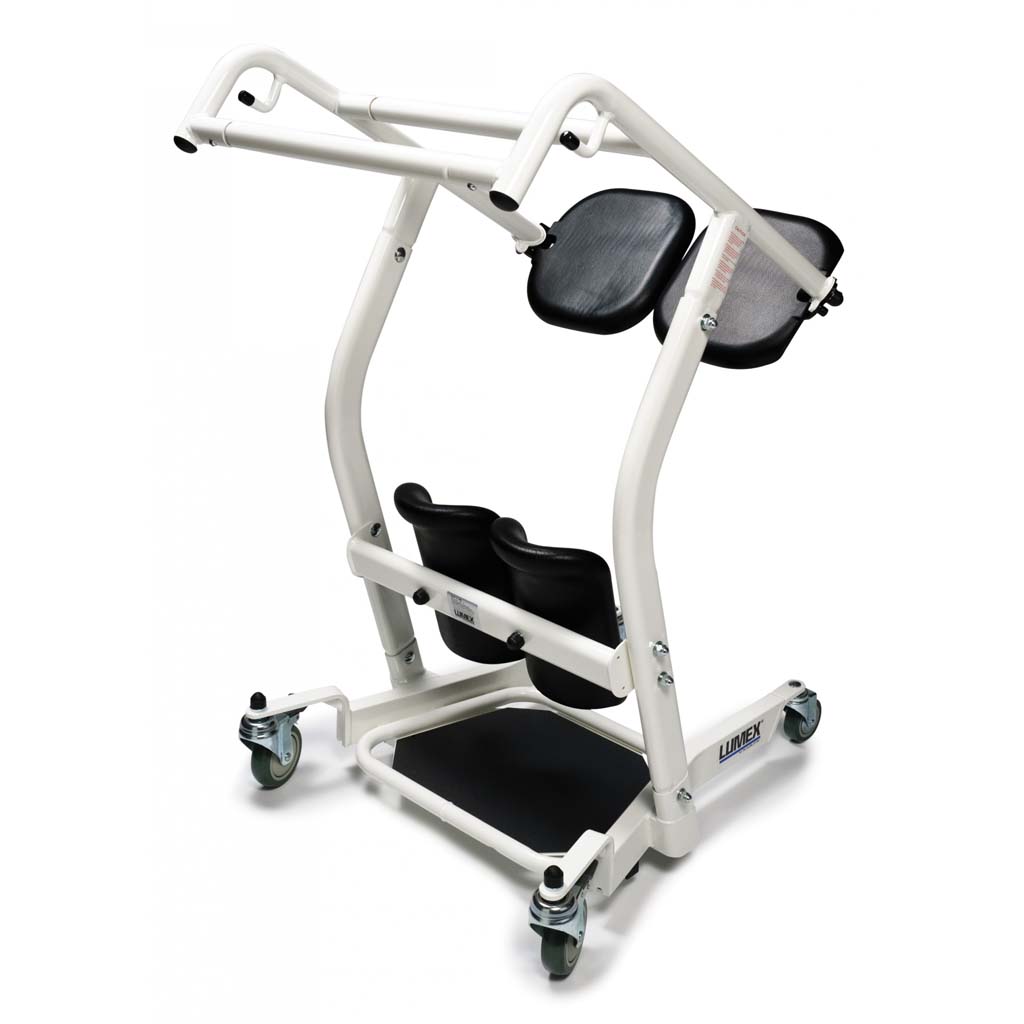
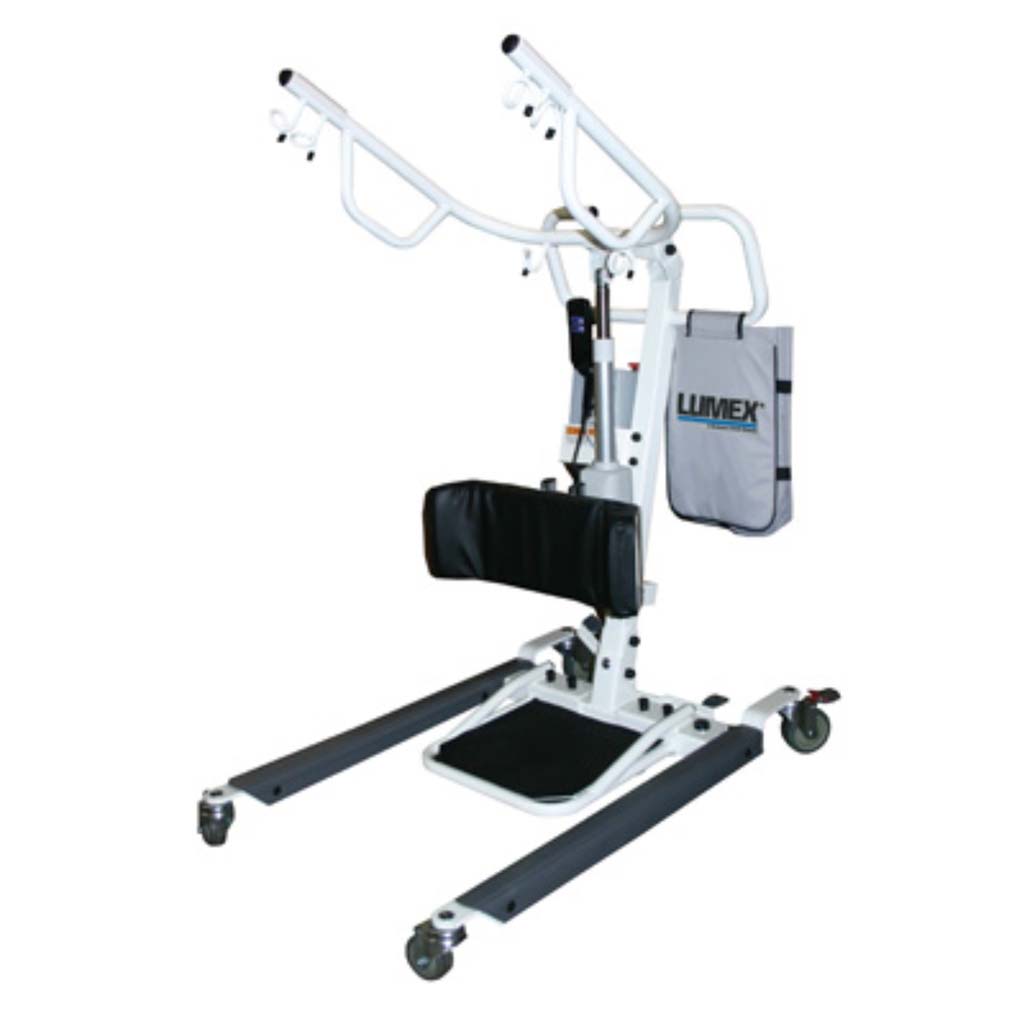
Manual · Compact Transport AidLumex LF1600 Stand Assist
Designed for users who can pull themselves upright using the support bar. Its padded split seat then swings behind the patient for short transport, while the narrow approximately 25-inch overall width is useful in tighter home and facility spaces.
No lifting sling is required for its basic standing-transfer function. The Dash instead uses its footplate, shin supports, crossbar and rotating seat. An optional support strap can provide additional support when appropriate.
Lumex LF1600
No patient lifting sling is used. The patient pulls themselves upright and the padded split seat is positioned behind them for support and transport.
That absence of a lifting sling is not a minor feature—it tells you what these devices actually are. They support a standing patient; they are not substitutes for a lift when the patient cannot perform the standing movement.
Scenario B · Patient Can Participate but Needs Mechanical Help
When Is a Powered Sit-to-Stand Lift More Appropriate?
Quick Answer
A powered sit-to-stand lift becomes more relevant when the patient can still participate and tolerate supported standing, but does not have enough strength to complete the rising movement safely with a manual standing aid. The electric actuator supplies lifting assistance while the patient remains involved in the transfer.
This is the patient families often describe as: “She can put weight on her legs, but I have to do almost all the work getting her out of the chair.” That is very different from someone who cannot bear weight at all.
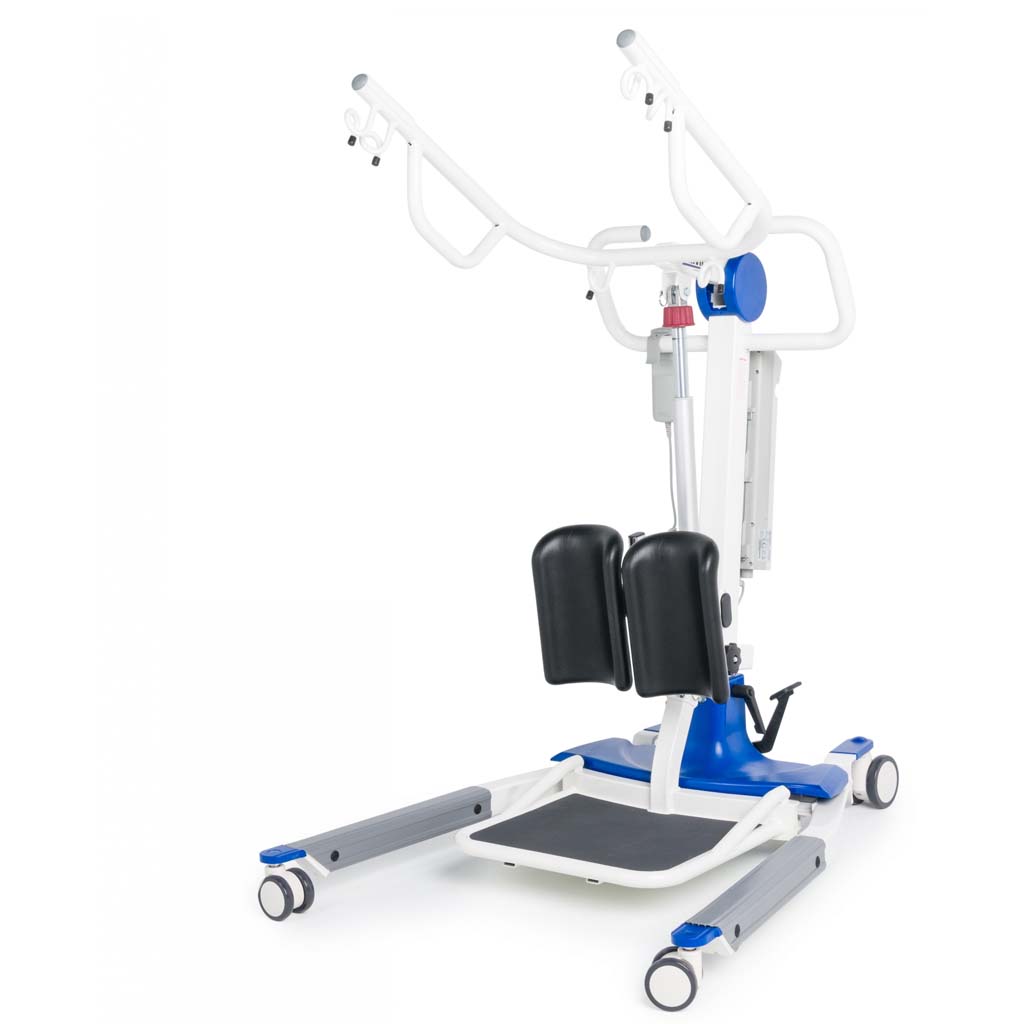
Powered · Compact · 500 lbProtekt STS Compact 500
A particularly useful homecare option when powered standing assistance is needed but maneuverability matters. Its compact footprint, 4.9-inch low base, standing platform and cushioned knee support are designed around routine seated-surface transfers.
Powered · 500 lb · Frequent TransfersProtekt 500 Sit Stand Lift
Adds a fast powered actuator, four sling hooks, adjustable molded knee support, long-runtime battery and caregiver controls for situations where stand-assist transfers are frequent and greater mechanical assistance is needed.
Powered · Highly Adjustable · CompactInvacare ISA Compact
Especially relevant when fit and room size matter. Its lifting arm adjusts through nine lengths, the lower-leg support has multiple settings, and the base closes to approximately 21 inches while supporting appropriate users up to 350 lbs.
Powered · 500 lb · Adjustable SupportLumex STS500 Sit and Stand Lift
A robust 500 lb stand-assist platform with adjustable knee support, removable foot platform and sling attachment points. Depending on configuration, base operation can also be powered or manually controlled.
Other needs can shift the model choice further. The Invacare Reliant 350 offers battery-powered standing assistance with Invacare sling compatibility, while the Lumex LF2090 Bariatric Stand Assist extends the category to a 600 lb safe working load for appropriate heavier patients.
Common Question · Sling Requirements
Do Electric Sit-to-Stand Lifts Need a Sling?
Usually, Yes
Powered stand-assist lifts generally use a compatible standing or sit-to-stand sling around the patient's torso to provide support while the lift mechanically assists the patient upward. This is different from a full-body Hoyer sling because the patient's feet remain supported and the patient is expected to participate in standing.
Sling compatibility should be checked with the specific lift rather than assuming every stand-assist sling fits every device. For example, Invacare's stand-assist sling family is specifically associated with models including the Reliant 350, ISA Compact and Get-U-Up.
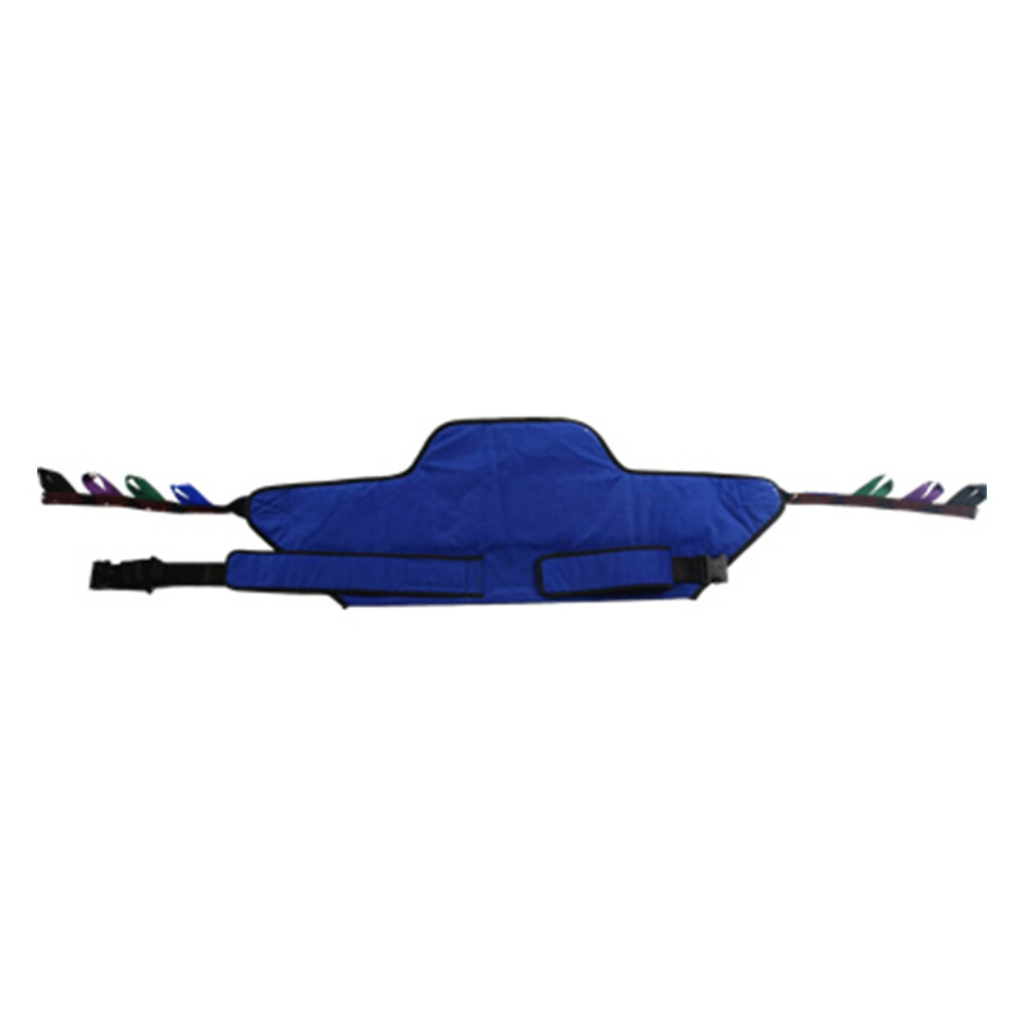
Invacare Stand-Assist SlingPremier Series Stand-Assist Sling
Intended for partially dependent, cooperative users with meaningful weight-bearing ability and head and neck control. Compatible models include the Reliant 350, Get-U-Up and ISA family.
Stand-Assist Sling · Up to 600 lbProactive Sit-to-Stand Sling
A solid nylon standing sling designed to support the lower back and torso of an appropriate partial-weight-bearing patient during compatible powered stand-assist transfers.
A standing sling does not turn a sit-to-stand lift into a full-body Hoyer lift.
If the patient cannot tolerate standing, cannot participate sufficiently, or requires head-to-toe suspension support, changing to a stronger standing sling does not solve the underlying problem. The transfer method itself may need to change.
Scenario C · Caregiver Is Carrying the Transfer
What If the Patient Helps, but the Caregiver Is Still Doing Most of the Work?
Think in a Continuum
If the caregiver is repeatedly pulling under the arms, lifting at the waist or supplying most of the force needed to get the patient upright, the question is no longer simply whether the patient “can stand.” The amount of assistance required is becoming part of the equipment decision.
01Assisted Transfer
Patient performs most of the movement and needs limited human assistance.
02Manual Stand Aid
Patient can actively rise but benefits from a structured standing and transport device.
03Powered Sit-to-Stand
Patient participates and bears appropriate weight but needs mechanical assistance to rise.
04Full-Body Patient Lift
Patient requires body-weight support rather than relying on a standing transfer.
This explains why two people who both say “I need a sit to stand device for my elderly parent” may actually need completely different equipment. One parent may be able to pull up into a Protekt Dash. Another may need the actuator and sling support of a Protekt STS 500. A third may no longer be appropriate for standing transfers at all.
Can they stand but not get up?Can they bear weight on both legs?Do their knees buckle?Am I lifting most of their weight?Can they stay upright once raised?Has their ability changed recently?
Scenario D · Changing Transfer Ability
How Do You Know When a Sit-to-Stand Device Is No Longer Enough?
Quick Answer
The warning sign is not simply that standing has become “harder.” A sit-to-stand device may no longer match the transfer when weight-bearing becomes unreliable, the patient cannot remain appropriately upright, participation becomes insufficient, or the caregiver is effectively supporting the patient's body weight despite using the device.
Weight-bearing becomes unpredictable
Being able to stand sometimes is different from being able to participate reliably in repeated transfers.
Legs repeatedly buckle
Sudden loss of lower-body support can fundamentally change whether a standing transfer remains appropriate.
Cannot maintain upright positioning
Increasing trunk or head-control problems may require a transfer method that provides substantially more body support.
Caregiver still supports most weight
If the equipment is not actually removing the need for heavy manual lifting, reassessment may be necessary.
This is the semantic bridge between a sit-to-stand lift and a Hoyer lift. A powered stand assist still assumes that standing is an appropriate part of the transfer. A full-body patient lift instead supports the patient within a sling and mechanically transfers their body weight without requiring the same standing ability.
“They can sometimes stand” is not always enough information.
When transfer ability is inconsistent or declining, the important question becomes whether standing remains a reliable and appropriate transfer method—not whether the patient managed to stand yesterday. A clinician or qualified care professional should reassess the transfer method when functional ability has materially changed.
Continue by SituationJump to the transfer situation that best matches the patient's current ability.
Patient Transfer Chairs
When a Patient Transfer Chair Fits the Transfer Better Than a Sling-Based Workflow
Some transfers become difficult not because the patient needs more lifting power, but because repeating a sling-based setup for every move has become the hardest part of the routine. A bed-to-chair transfer in the morning, toilet transfer later, move to a dining chair, and another transfer back to bed can mean repeated sling placement, attachment and repositioning throughout the day.
A patient lift transfer chair approaches that problem differently. Instead of suspending the patient beneath a boom, it keeps an appropriate user supported in a seated transfer system while the seat height is raised or lowered to align with compatible surfaces. That makes the category particularly interesting when the daily problem is repeated seated surface-to-surface movement.
The Key Difference
A patient transfer chair is not simply a Hoyer lift with a seat attached. Its entire transfer mechanic is different. The patient remains in a supported seated position while the chair is aligned with the starting and destination surfaces. That can simplify some daily routines, but it does not replace the full-body support of a sling lift when the patient requires suspended lifting.
Featured Seated Transfer Solution
MedCare Mobility Electric Patient Lift Transfer Chair
The MED112 is built around repeated seated transfers. Its electric seat adjusts from approximately 17 to 31 inches, the base width adjusts for different approach situations, and the chair includes both a solid seat and a commode seat with removable bucket.
Its value is not that it replaces every Hoyer lift. It is that it solves a different problem: moving an appropriate patient between compatible seated surfaces without setting up a hanging sling for each transfer.
What If the Patient Needs Bed, Chair and Toilet Transfers Throughout the Day?
Quick Answer
When the patient can tolerate and maintain the seated position required by the device, a patient transfer lift chair can make repeated surface-to-surface transfers more direct because the patient remains supported in the chair between destinations rather than being placed into a sling for every move.
MorningBed to seated surface
The seat height can be adjusted to align more closely with the starting surface.
BathroomToilet or commode
The included commode seat creates a toileting pathway without changing to an entirely separate chair.
DaytimeChair or wheelchair
Seated alignment can simplify repeated chair-to-chair routines when surface heights and access are compatible.
EveningReturn to bed
The same electric seat-height adjustment helps match the destination surface again.
This is where the phrase patient lift transfer chair describes the product more accurately than simply calling it a transport chair. The chair does not only move the patient across the room; its electric lift function changes the seat height so the caregiver can align the patient with different surfaces.
Scenario B · Sling Setup Is the Main Difficulty
What If Applying a Sling for Every Transfer Is Becoming the Most Difficult Part?
Quick Answer
For an appropriate seated patient, a transfer lift chair can remove the sling-application step from many routine seated transfers. That can be especially meaningful when the transfer itself is manageable but repeated sling positioning, leg-section placement and attachment are what make the day difficult.
Consider a caregiver who can safely position the patient upright but struggles every time the sling has to be worked behind the back and beneath the thighs. If the patient does not require full-body suspension and can use a seated transfer system safely, the chair-based method changes the workflow rather than merely changing the sling.
“Do I have to put a sling under them every time?”
Not with a chair-based seated transfer method when the patient and surfaces are appropriate for that system.
“What if they cannot lean enough for sling placement?”
That can make a seated transfer chair worth investigating, provided the patient can still tolerate and remain safely positioned in the chair.
“Is a transfer chair safer than a Hoyer lift?”
Not universally. They use different transfer mechanics and have different patient requirements. The correct method depends on the patient and environment.
“Can it replace all of our Hoyer transfers?”
No. A patient who needs full-body suspended support may still require a sling-based patient lift.
Scenario C · Multiple Destination Surfaces
Can a Patient Transfer Chair Help With Bed, Toilet, Chair and Vehicle Transfers?
Quick Answer
Potentially—but compatibility depends on the height and geometry of every surface involved. A patient transfer chair should be evaluated against the actual bed, toilet, chair or vehicle rather than assuming that one device automatically fits every destination.
Bed
The destination should fall within the chair's approximately 17"–31" seat-height range, and the base must be able to approach closely enough for alignment.
Toilet / Commode
The MED112 includes a commode seat and removable bucket, but bathroom doorway width, toilet clearance, turning room and base geometry still need to fit.
Wheelchair / Chair
Seat height, armrest configuration, chair footprint and the ability to position the transfer chair directly beside the destination all matter.
Vehicle
Some vehicle transfers may be possible when seat height, door opening, sill height and approach angle align. Vehicle compatibility should never be assumed without measuring.
Doorway / Hall
The chair's passable width is approximately 28.3 inches with the legs closed, so the narrowest route between rooms needs to be checked.
Patient
The user must remain within the 330 lb capacity and be appropriate for supported seated transfers rather than requiring full-body suspension.
The product's adjustable height does not eliminate the need to measure. A 17"–31" seat range is useful only when the starting and destination surfaces can actually be approached and aligned within that range.
Scenario D · Different Transfer Mechanics
When Is a Patient Transfer Chair Fundamentally Different From a Hoyer Lift?
Quick Answer
A patient transfer chair moves an appropriate patient in a supported seated position and adjusts the chair height to align with surfaces. A Hoyer-style patient lift supports the patient in a sling and suspends their body beneath the lifting boom. They solve different transfer problems.
Patient Transfer Lift ChairThe chair moves with the patient.
The patient remains seated in the transfer system while it is rolled between compatible surfaces. Electric height adjustment helps match beds, toilets, chairs and other destinations.
Hoyer / Full-Body Patient LiftThe sling supports the patient's body.
The patient is mechanically lifted within an appropriate sling and transferred while suspended beneath the boom. This provides a different level and type of body support.
That difference explains why a patient lift transfer chair can be particularly attractive for repeated seated routines but should not be presented as a universal replacement for a Hoyer lift. A patient with poor seated tolerance, complex positioning requirements, or a need for full-body support may still require a sling-based system.
Conversely, when the patient remains appropriate for seated transfers and the main challenge is moving repeatedly among beds, chairs, toilets or other compatible surfaces, a chair-based workflow can address a problem that a traditional sling lift was never specifically designed to simplify.
Where the MED112 fits best:
the MedCare Mobility Electric Patient Lift Transfer Chair is most compelling when the care routine involves repeated seated transfers, changing surface heights, toileting needs, limited caregiver desire to apply a sling repeatedly, and environments where its adjustable base and dimensions can be properly accommodated.View the MED112 Patient Lift Transfer Chair →
Continue by SituationJump to the transfer situation that best matches the patient's current needs.