


22
Oct
Most Comfortable Wheelchair (2026): How to Match the Chair to How You Sit All Day
Most wheelchair discomfort has a cause you can see: sliding forward, slumping, leaning, sore hips, swollen legs, tired shoulders. Each one points to a specific feature, and that feature points to a specific chair. This guide works from the problem to the fix, across the brands we carry: Invacare, McKesson, Karman Healthcare, Proactive Medical and Drive Medical.
What is the most comfortable wheelchair?
The most comfortable wheelchair is the one that fits your body and matches how many hours you sit. The seat should be about 1 to 2 inches wider than your hips, deep enough to support your thighs, and low enough that your feet rest flat. Then match the chair to the day:
- Sit most of the day and get tired or slump: a reclining or tilt-in-space chair, such as the Invacare Tracer SX5 Recliner, Proactive Chariot-RC or Karman VIP-515.
- Push yourself all day: a lightweight, adjustable chair with a supportive seat, such as the Karman S-Ergo 115, Invacare 9000 XT or Proactive Chariot IV XTC.
- Need a wider seat: a true heavy duty chair sized to your hips, such as the Proactive Titus or Invacare Tracer IV.
- Only use a chair for outings: a padded transport chair, such as the Karman S-115 TP or Invacare EasyGlide.
If you are still deciding between a manual chair, a transport chair and a power chair, start with our guide to choosing a wheelchair. If you want the parts and measurements explained in depth, our wheelchair knowledge base covers them. This page is about one thing: comfort over long hours.
What makes a wheelchair comfortable depends on how you use it
A chair that feels fine for a 20 minute doctor visit can be miserable by hour six. Before comparing models, be honest about how the chair will be used. That single answer changes what "comfortable" means.
| Who is sitting | Typical time in the chair | What decides comfort | Chair type to look at |
|---|---|---|---|
| Full-time user who self-propels (spinal cord injury, MS, amputation, long-term disability) | 8 to 16 hours a day | Seat fit, back support, a light frame that is easy to push, a good cushion | Lightweight adjustable or ergonomic chair |
| Senior who sits most of the day | 6 to 12 hours a day | Posture support, a seat low enough for the feet, a way to rest or nap | Hemi-height standard chair, recliner or tilt-in-space |
| Someone recovering from surgery or an injury | Weeks to a few months | Leg support, easy transfers, a fair price for short-term use | Standard chair with elevating legrests |
| Stroke survivor or anyone with one-sided weakness | Varies | Seat height that lets one foot steer, armrests that help transfers | Hemi or dual-axle chair |
| Larger user | Varies | Seat width and depth that actually fit, a frame rated well above body weight | Heavy duty or bariatric chair |
| Part-time user (long walks, travel, outings) | An hour or two at a time | Padding, ride quality, how easily the chair folds and lifts | Transport chair or featherweight wheelchair |
| Someone who needs regular pressure relief or cannot shift their own weight | Most of the day | Changing position without sliding | Tilt-in-space chair |
Why is my wheelchair uncomfortable, and what fixes it?
Most complaints we hear come down to a small set of problems. Find the one you are seeing, then look at the fix and the chairs built for it. Every chair named here is covered in detail further down.
| What you notice | Likely cause | The fix | Chairs that have it |
|---|---|---|---|
| Sliding forward in the seat | Seat too deep, cushion too soft, or a recline that pulls the body down | Correct seat depth, an anti-thrust cushion, or a chair that tilts instead of reclining | Karman VIP-515 Tilt-in-Space, Karman MVP-502 Ergonomic Recliner (anti-slide V seat), Drive Medical Lynx (depth adjusts 16 to 18 in) |
| Slumping, getting tired, dozing off | Upright back with no way to rest | A high back that reclines, or tilt-in-space | Invacare Tracer SX5 Recliner, Proactive Chariot-RC Reclining Wheelchair, McKesson Reclining Wheelchair |
| Leaning to one side | Seat too wide, weak trunk, or a sagging sling seat | Narrower seat, solid cushion, tension-adjustable back, lateral support | Right-size the seat; add a tension-adjustable back |
| Feet do not reach the floor | Seat too high for the person | Hemi height (about 17.5 in) through a dual axle | Proactive Chariot II Hemi, Invacare Tracer EX2, Drive Medical Silver Sport 2 |
| Hips squeezed against the armrests | Seat too narrow | Seat 1 to 2 in wider than the hips; heavy duty frame if needed | Proactive Titus Bariatric, Invacare Tracer IV, Karman KN-920W |
| Swollen or aching legs | Legs hanging down for hours | Elevating legrests | McKesson Dual Axle with Elevating Legrests, Proactive Chariot-RC Reclining Wheelchair, Invacare Tracer SX5 Recliner |
| Sore tailbone or pressure spots | Weight sitting on a small area for too long | A pressure-relief cushion and regular position changes; tilt for people who cannot shift themselves | Karman VIP-515 Tilt-in-Space; see our cushion guide |
| Shoulder or wrist pain from pushing | Heavy chair or rear wheels set too far back | A lighter frame and an adjustable axle position | Invacare 9000 XT, Karman S-Ergo 115, Proactive Chariot IV XTC |
| Back pain after an hour or two | Back angle and height that do not match the spine | Adjustable back angle and height, or an ergonomic contoured seat | Proactive Chariot IV XTC (5 to 20 degree back angle), Karman S-Ergo 115 |
| Hard transfers in and out | Fixed arms and footrests in the way | Flip-back or removable arms, swing-away footrests | Drive Medical Lynx, Invacare Tracer IV, McKesson Bariatric Dual Axle |
| Dreading car trips | Chair too heavy for the caregiver to lift | A lighter chair or a transport chair for outings | Karman LT-980, Karman S-115 TP Ergonomic Transport, Proactive Astra Aluminum Transport |
Is a reclining or tilt-in-space wheelchair more comfortable?
Short answer: for someone who sits most of the day, yes. A recliner lets the back lean down while the seat stays put, which helps with fatigue, naps, and leg and back relief. A tilt-in-space chair tips the whole seat and back together, which shifts pressure off the bottom without changing the hip angle, so the person does not slide forward.
Reclining wheelchair vs tilt-in-space: which one?
Pick a recliner when the main goal is resting, napping or lying back, and the person can stay positioned when the back goes down. Pick tilt-in-space when the person slides down in a recliner, cannot shift their own weight, or sits nearly all day and needs regular pressure relief. Recliners usually cost less; tilt chairs cost more but keep posture intact.
A few differences between the recliners below matter more than the price. The Invacare, Proactive and McKesson recliners go all the way to 180 degrees. The Karman MVP-502 stops at 160 degrees, but its V-shaped seat is designed to stop sliding, and at 36 lb it is far easier to lift into a car than the steel recliners. The Proactive Chariot-RC is the one to look at for a wider body, with seats up to 24 in and a 500 lb rating on the 22 and 24 in sizes.

Invacare Tracer SX5 Recliner
Best for: Long days in the chair, napping, or needing to lie back for leg and back relief.
- Back reclines 90 to 180 degrees
- 16 x 16 in or 18 x 16 in seat
- 250 lb capacity (16 and 18 in seats)
- Dual axle: 17.5 or 19.5 in seat height
- Desk-length arms, elevating legrests; 53 lb without riggings
From $620
View options
Proactive Chariot-RC Reclining Wheelchair
Best for: Someone who sits most of the day, slumps or dozes, and may need a wider seat.
- Reclines 90 to 180 degrees, 32 in back, headrest extension standard
- Seat widths 16 to 24 in
- Capacity 300 lb (16/18 in), 350 lb (20 in), 500 lb (22/24 in)
- Elevating legrests and rear anti-tippers standard
- Seat-to-floor 20 in; 58 to 62 lb
From $360
View options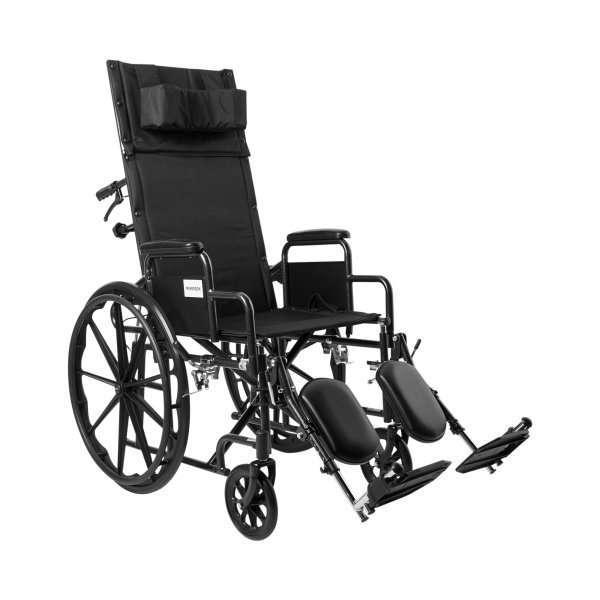
McKesson Reclining Wheelchair
Best for: A full recliner at a lower price for home or facility use.
- Hydraulic recline up to 180 degrees
- 18 in seat (300 lb) or 20 in seat (350 lb)
- 16 in seat depth, 20.5 in seat height
- Headrest extension, swing-away elevating legrests
- Rear anti-tippers, carbon steel frame
From $399
View options
Karman MVP-502 Ergonomic Recliner
Best for: People who slide forward when reclined and families who still need to lift the chair into a car.
- Back reclines 93 to 160 degrees
- Patented anti-sliding V-shaped seat
- 36 lb without riggings, aircraft-grade aluminum, folds
- 16, 18 or 20 in seat; 250 lb capacity
- Arms adjust when reclined; removable elevating legrests
From $2,060
View options
Karman VIP-515 Tilt-in-Space
Best for: Full-time sitters who need regular pressure relief or who slide down in a recliner.
- Tilts 0 to 35 degrees as one unit
- 38 lb without footrests, T6 aluminum, folds to 15 in wide
- 16 or 18 in seat; 250 lb capacity
- Flip-back height-adjustable arms
- Removable headrest
From $1,970
View optionsWe also carry more high back reclining wheelchairs. If the person no longer propels at all and mostly sits in one room, a geri chair can be a better fit; our geri chair guide compares the two.
What is the most comfortable wheelchair for all-day use if you self-propel?
Short answer: a lightweight chair that can be adjusted to your body, with a supportive seat. When you push yourself all day, comfort is as much about your shoulders as your seat. A lighter frame and a well-placed rear axle mean less effort on every push, and a seat that fits keeps you from sliding or leaning by afternoon.
Do ergonomic or contoured seats really help?
For many people they do. Karman's S-shaped seat on the S-Ergo 115 is designed to spread weight evenly across the thighs and hips instead of loading the tailbone, and to reduce slipping forward. The Proactive Chariot IV XTC takes a different route: its back angle adjusts from 5 to 20 degrees and its back height from 17 to 19 in, so the back can be set to match the spine. The Invacare 9000 XT lets the center of gravity be adjusted, so the chair can be set up to roll more easily for an experienced user. The Drive Lynx adjusts seat depth from 16 to 18 in, which matters for taller users whose thighs hang off a short seat.
A good cushion still matters on any of these. Even the best frame will feel hard after hours on a thin sling seat.

Karman S-Ergo 115
Best for: Self-propellers who sit for hours and want a contoured seat in a very light chair.
- 25 lb without footrests
- Patented S-shaped ergonomic seat
- 16, 18 or 20 in wide x 17 in deep
- 250 lb capacity
- Folding frame; quick-release wheels and suspension available
From $620
View options
Proactive Chariot IV XTC
Best for: Daily users who need the back angle, seat depth and seat height set to their body.
- Back angle adjusts 5 to 20 degrees; back height 17 to 19 in
- Seat 16 to 22 in wide, 16 to 18 in deep
- Dual axle: 19.5 in or 17.5 in hemi height
- 300 lb (16/18 in) or 350 lb (20/22 in)
- Under 35 lb basic configuration; flip-back arms
From $399
View options
Invacare 9000 XT
Best for: Full-time users who push themselves and want the chair balanced for easier rolling.
- Adjustable center of gravity
- 16, 18 or 20 in seat; 16 in deep
- Dual axle: 19.5 in adult or 17.5 in hemi height
- Space saver desk arms
- 31 lb without front riggings
From $585
View options
Drive Medical Lynx
Best for: Active adults who load the chair often and want the seat depth to fit their thighs.
- 28 to 29 lb depending on seat width
- 16, 18 or 20 in seat; depth adjusts 16 to 18 in
- Seat-to-floor 17.5 to 19.5 in
- 275 lb capacity
- Quick-release wheels; limited lifetime warranty
From $725
View options
Karman LT-980
Best for: Part-time users and travelers who mostly need a chair that is easy to lift.
- 24 lb without footrests (frame 13 lb)
- 18 x 16 in seat
- 250 lb capacity
- Compact folding frame
- Flat-free wheels
From $400
View optionsWeight and folding are covered in depth in our lightweight wheelchair buying guide, and you can browse all lightweight wheelchairs here. If pushing is becoming painful no matter which chair you use, a power chair may be the comfortable answer; see our electric wheelchair guide.
What is the most comfortable wheelchair for the elderly?
Short answer: for most older adults, a chair with a hemi seat height (about 17.5 in), a seat sized to the hips, and padded arms that help with standing up. If they sit most of the day and get tired, move to a reclining or tilt-in-space chair. For outings only, a padded transport chair is often enough.
Three things come up again and again with seniors:
- Feet that do not reach the floor. A standard 19.5 in seat is too high for many older adults. Dual-axle chairs like the Proactive Chariot II Hemi, Invacare Tracer EX2 and McKesson Dual Axle with Elevating Legrests drop to about 17.5 in, so feet rest flat and the person can scoot or steer with their feet.
- Slumping and dozing. When an older parent falls asleep in the chair or slides down by mid-afternoon, an upright chair is working against them. A recliner such as the Proactive Chariot-RC Reclining Wheelchair or Invacare Tracer SX5 Recliner, or the Karman VIP-515 Tilt-in-Space tilt chair, lets them rest safely.
- Swollen ankles. Legs hanging for hours tend to swell. Elevating legrests, standard on the McKesson Dual Axle with Elevating Legrests and on the recliners above, raise the legs.
For someone with dementia who tries to stand up without help, a chair alarm pad can alert a caregiver; we carry chair sensor pads that work in wheelchairs. Keep the chair low and stable, and lock the brakes for every transfer.
Our older guide to wheelchairs for elderly people covers the general types; this section focuses on comfort.
Which standard wheelchair is most comfortable for everyday or short-term use?
Short answer: a dual-axle standard chair with padded removable arms, sized to the hips, and elevating legrests if the legs need support. These chairs cost less, fold, and suit people recovering from surgery or using a chair part of the day at home.
After knee, ankle or hip surgery, the leg often needs to stay raised. That is why we point people to chairs with elevating legrests, like the McKesson Dual Axle with Elevating Legrests, or the Drive Medical Silver Sport 2 with its elevating leg rest option. After a stroke, the hemi seat height on the Proactive Chariot II Hemi lets the stronger foot do the steering. The Invacare Tracer EX2 is a solid everyday chair from Invacare with the same dual-axle height choice.

Proactive Chariot II Hemi
Best for: Shorter users and people who steer with their feet, including after a stroke.
- Dual axle: 19.5 in or 17.5 in hemi height
- 16, 18 or 20 in seat; 16 in deep
- 300 lb (16/18 in) or 350 lb (20 in)
- Swing-away footrests or elevating legrests
- 42 to 44 lb steel frame; 3 year limited warranty
From $225
View options
Invacare Tracer EX2
Best for: Everyday and short-term use at home, at a fair price.
- 36 lb carbon steel frame
- 16 to 20 in seat widths, 16 in deep
- Dual axle: 19.5 in adult or 17.5 in hemi height
- 250 lb capacity
- Folds; heavy-duty inner liners option
From $310
View options
McKesson Dual Axle with Elevating Legrests
Best for: Recovery after knee, ankle or hip surgery, or legs that swell when they hang down.
- Swing-away elevating legrests
- 18 in wide x 16 in deep seat
- Seat height 17.5 to 19.5 in (dual axle)
- 300 lb capacity
- Removable padded desk-length arms
From $225
View options
Drive Medical Silver Sport 2
Best for: A dependable standard chair with no tires to pump.
- 16, 18 or 20 in seat
- 250 lb (16 in), 300 lb (18 in), 350 lb (20 in)
- Dual axle: 17.5 or 19.5 in seat height
- Detachable padded desk arms
- Flat-free urethane tires; limited 3 year warranty
From $239
View optionsSee all standard manual wheelchairs.
What is the most comfortable wheelchair for a larger person?
Short answer: a heavy duty chair whose seat is 1 to 2 in wider than the hips and whose rated capacity is comfortably above the user's weight. A chair that squeezes the hips is uncomfortable no matter how good the padding is, and a seat that is too shallow leaves the thighs unsupported.
Seat depth is the detail people miss. The Invacare Tracer IV and the Proactive Titus Bariatric both offer an 18 in deep seat (the Titus also comes 20 in deep on the larger sizes), which supports longer thighs. The Titus goes up to a 30 in seat and 700 lb; the Karman KN-920W runs from 20 to 28 in with the capacity rising by width; the McKesson Bariatric Dual Axle is the budget pick with a 22 or 24 in seat. If the person also needs to recline, the Proactive Chariot-RC above comes in 22 and 24 in seats rated for 500 lb.

Proactive Titus Bariatric
Best for: Larger users who need real width and depth, not a squeeze.
- Seat widths 22 to 30 in
- 500 lb (22/24 in) or 700 lb (26 to 30 in)
- Seat depth 18 or 20 in
- Seat-to-floor 20.5 in, hemi 18.5 in
- 56 to 64 lb; 24 in urethane rear wheels
From $395
View options
Invacare Tracer IV
Best for: Larger users who want an 18 in deep seat for thigh support.
- 20, 22 or 24 in wide x 18 in deep seat
- 350 to 450 lb depending on size and setup
- Reinforced carbon steel, dual cross-braces
- Dual axle: 17.5 or 19.5 in seat height
- Removable padded desk or full arms
From $475
View options
McKesson Bariatric Dual Axle
Best for: A 22 or 24 in seat on a budget.
- 22 or 24 in wide seat
- 450 lb capacity (22 in model)
- Dual axle: 17.5 or 19.5 in seat height
- Detachable padded desk-length arms
- Folds to about 12.5 in wide (22 in model)
From $345
View options
Karman KN-920W
Best for: Users who need a very wide seat and a capacity matched to that width.
- Seat widths 20 to 28 in
- 300 lb to 600 lb capacity by width
- Steel frame; adjustable seat height
- Detachable padded desk arms
- Double-padded vinyl upholstery
From $549
View optionsBrowse every bariatric wheelchair we carry.
Is a transport chair as comfortable as a wheelchair?
Short answer: for short trips, it can be. For long days, usually not. Transport chairs are pushed by a caregiver, have small rear wheels and lighter padding, and are built to be light and easy to fold. Small wheels feel every crack in the sidewalk, so for longer outings look for larger rear wheels and a better seat.
The Karman S-115 TP Ergonomic Transport is the comfort pick here: it uses Karman's S-style seat and rolls on 14 in rear wheels instead of the 8 in wheels most transport chairs use. The Proactive Astra Aluminum Transport weighs 19 lb for caregivers who lift it often. The Invacare EasyGlide Transport is the lowest-cost option and folds to 9 in wide, and the McKesson Lightweight Transport Chair is rated for 300 lb.

Karman S-115 TP Ergonomic Transport
Best for: Caregivers who want a light chair that is also comfortable for longer outings.
- 22 lb without riggings
- S-style ergonomic seat
- 16, 18 or 20 in seat; 250 lb capacity
- 14 in flat-free rear wheels
- Swing-away footrests; folds to 12 in wide
From $603
View options
Proactive Astra Aluminum Transport
Best for: Short trips where the caregiver lifts the chair often.
- 19 lb aluminum frame
- 19 in seat, 16 in deep, 19 in seat height
- 250 lb capacity
- Padded full-length arms, seat belt
- Swing-away footrests; folding back
From $185
View options
Invacare EasyGlide Transport
Best for: Doctor visits and errands on a tight budget.
- 19 in padded seat
- 250 lb capacity
- Steel or 25 lb aluminum frame
- Folds to 9 in wide
- 8 in wheels front and rear; push-to-lock brakes
From $125.99
View options
McKesson Lightweight Transport Chair
Best for: Riders up to 300 lb who need a light aluminum transport chair.
- Aluminum frame
- 19 in seat
- 300 lb capacity
- Swing-away footrests
- Breathable nylon upholstery; fold-down back
From $189
View optionsSee all transport chairs. If the person can push themselves some of the time, a featherweight wheelchair like the Karman LT-980 gives you both options.
Most comfortable wheelchairs compared: seat, back, capacity and weight
Specs come from each manufacturer's product page or spec sheet and match our listings. Weights marked * are without footrests or riggings. Prices are our starting prices as of October 2026 and change with seat size and options.
| Wheelchair | Brand | Type | Seat widths | Comfort feature | Capacity | Weight / notes | From |
|---|---|---|---|---|---|---|---|
| Invacare Tracer SX5 Recliner | Invacare | Recliner | 16, 18 in | Recline 90 to 180 deg; dual axle | 250 lb | 53 lb* | $620 |
| Proactive Chariot-RC Reclining Wheelchair | Proactive Medical | Recliner | 16 to 24 in | Recline 90 to 180 deg; 32 in back | 300 to 500 lb | 58 to 62 lb | $360 |
| McKesson Reclining Wheelchair | McKesson | Recliner | 18, 20 in | Hydraulic recline up to 180 deg | 300 / 350 lb | Headrest extension | $399 |
| Karman MVP-502 Ergonomic Recliner | Karman | Recliner | 16, 18, 20 in | Recline 93 to 160 deg; anti-slide V seat | 250 lb | 36 lb* | $2,060 |
| Karman VIP-515 Tilt-in-Space | Karman | Tilt-in-space | 16, 18 in | Tilt 0 to 35 deg | 250 lb | 38 lb* | $1,970 |
| Karman S-Ergo 115 | Karman | Ergonomic lightweight | 16, 18, 20 in | S-shaped ergonomic seat | 250 lb | 25 lb* | $620 |
| Proactive Chariot IV XTC | Proactive Medical | Adjustable lightweight | 16 to 22 in | Back angle 5 to 20 deg; dual axle | 300 / 350 lb | Under 35 lb* | $399 |
| Invacare 9000 XT | Invacare | Adjustable lightweight | 16, 18, 20 in | Adjustable center of gravity; dual axle | 250 lb | 31 lb* | $585 |
| Drive Medical Lynx | Drive Medical | Ultralight | 16, 18, 20 in | Seat depth 16 to 18 in; seat height 17.5 to 19.5 in | 275 lb | 28 to 29 lb | $725 |
| Karman LT-980 | Karman | Featherweight | 18 in | Compact folding frame | 250 lb | 24 lb* | $400 |
| Proactive Chariot II Hemi | Proactive Medical | Standard / hemi | 16, 18, 20 in | Hemi height 17.5 in (dual axle) | 300 / 350 lb | 42 to 44 lb | $225 |
| Invacare Tracer EX2 | Invacare | Standard | 16 to 20 in | Dual axle 17.5 or 19.5 in | 250 lb | 36 lb | $310 |
| McKesson Dual Axle with Elevating Legrests | McKesson | Standard, elevating legrests | 18 in | Elevating legrests; dual axle | 300 lb | 40 lb | $225 |
| Drive Medical Silver Sport 2 | Drive Medical | Standard | 16, 18, 20 in | Dual axle 17.5 or 19.5 in | 250 to 350 lb | Flat-free tires | $239 |
| Proactive Titus Bariatric | Proactive Medical | Bariatric | 22 to 30 in | Seat depth 18 or 20 in; hemi 18.5 in | 500 / 700 lb | 56 to 64 lb | $395 |
| Invacare Tracer IV | Invacare | Heavy duty | 20, 22, 24 in | Dual axle 17.5 or 19.5 in | 350 to 450 lb | 18 in deep seat | $475 |
| McKesson Bariatric Dual Axle | McKesson | Heavy duty | 22, 24 in | Dual axle 17.5 or 19.5 in | 450 lb (22 in) | 18 in deep seat (22 in) | $345 |
| Karman KN-920W | Karman | Bariatric | 20 to 28 in | Adjustable seat height | 300 to 600 lb | Desk arms, 24 in mag wheels | $549 |
| Karman S-115 TP Ergonomic Transport | Karman | Transport, ergonomic | 16, 18, 20 in | S-style seat; 14 in rear wheels | 250 lb | 22 lb* | $603 |
| Proactive Astra Aluminum Transport | Proactive Medical | Transport | 19 in | Padded full-length arms | 250 lb | 19 lb | $185 |
| Invacare EasyGlide Transport | Invacare | Transport | 19 in | Folds to 9 in wide | 250 lb | 25 lb (aluminum) | $125.99 |
| McKesson Lightweight Transport Chair | McKesson | Transport | 19 in | Swing-away footrests | 300 lb | Aluminum frame, nylon seat | $189 |
Sources: Invacare, McKesson, Karman Healthcare, Proactive Medical and Drive Medical product pages and spec sheets; our product listings, October 2026.
Which wheelchair is most comfortable for your situation?
If you only read one part of this page, read this. These are the chairs we would point a friend to, by situation.
- Sits 8 or more hours a day and gets tired: Invacare Tracer SX5 Recliner, or the Proactive Chariot-RC Reclining Wheelchair
- Slides down in the chair: Karman VIP-515 Tilt-in-Space, or the Karman MVP-502 Ergonomic Recliner
- Pushes themselves all day: Karman S-Ergo 115, or the Invacare 9000 XT
- Wants to set the back angle and seat depth: Proactive Chariot IV XTC, or the Drive Medical Lynx
- Older adult whose feet do not reach the floor: Proactive Chariot II Hemi, or the Invacare Tracer EX2
- Recovering from knee or hip surgery: McKesson Dual Axle with Elevating Legrests, or the Drive Medical Silver Sport 2
- Larger user who needs a 22 in seat or wider: Proactive Titus Bariatric, or the Invacare Tracer IV
- Very wide seat up to 28 in on a steel frame: Karman KN-920W, or the McKesson Bariatric Dual Axle
- Caregiver lifting the chair into a car: Karman S-115 TP Ergonomic Transport, or the Proactive Astra Aluminum Transport
- Travel and part-time use: Karman LT-980, or the Drive Medical Lynx
- Lowest cost for outings: Invacare EasyGlide Transport, or the McKesson Lightweight Transport Chair
- Full recline on a budget: McKesson Reclining Wheelchair, or the Invacare Tracer SX5 Recliner
How can I make a wheelchair more comfortable?
Before replacing a chair that fits, try these. Most cost little and make a real difference.
- Upgrade the cushion. A foam or gel cushion spreads pressure far better than a bare sling seat. For sliding, an anti-thrust cushion such as the Protekt Gel Anti-Thrust has a built-in barrier at the front. Our cushion knowledge base explains the types.
- Check the seat depth. You should be able to fit two or three fingers between the front edge of the seat and the back of the knee. Too deep causes slumping; too shallow leaves the thighs unsupported.
- Set the footrests. Thighs should rest level on the seat. Footrests set too high push weight onto the tailbone; too low leaves the legs dangling.
- Adjust armrest height. Arms that are too low make people lean; too high pushes the shoulders up. Many desk arms adjust.
- Add back support. A tension-adjustable back can add lumbar support and help with a rounded upper back.
- Change position. Shifting weight, leaning side to side, or tilting at regular intervals helps prevent sore spots on long days.
Wheelchair comfort questions people ask
What is the most comfortable wheelchair?
The most comfortable wheelchair is one that fits your body and suits how long you sit. For full days with fatigue or slumping, a reclining or tilt-in-space chair such as the Invacare Tracer SX5 Recliner, Proactive Chariot-RC or Karman VIP-515. For people who push themselves, a light adjustable chair such as the Karman S-Ergo 115 or Invacare 9000 XT. For larger users, a properly wide chair such as the Proactive Titus or Invacare Tracer IV.
What is the most comfortable wheelchair for all day use?
For all-day sitting, choose a chair with a supportive, well-fitted seat, a good cushion, and a way to change position. Self-propellers do well in an adjustable lightweight chair like the Proactive Chariot IV XTC or Karman S-Ergo 115. People who cannot change position themselves are usually more comfortable in a tilt-in-space chair like the Karman VIP-515.
What is the most comfortable wheelchair for the elderly?
For most older adults, a dual-axle chair set at hemi height (about 17.5 in) so the feet rest flat, with padded removable arms. The Proactive Chariot II, Invacare Tracer EX2 and McKesson Dual Axle all offer that height. If they sit most of the day and get tired, a recliner like the Proactive Chariot-RC is more comfortable.
Is a reclining wheelchair more comfortable?
For people who sit for long periods, usually yes. A recliner lets the back lean down for rest, naps and relief, and most come with elevating legrests and a headrest. The Invacare Tracer SX5 Recliner, Proactive Chariot-RC and McKesson Reclining Wheelchair all recline to 180 degrees.
What is the difference between a reclining and a tilt-in-space wheelchair?
A reclining chair opens the angle between the seat and the back. A tilt-in-space chair tips the seat and back together, so the hip angle stays the same and the person does not slide forward. Tilt is better for pressure relief and for people who slide in a recliner; reclining is better for lying back to rest.
What type of wheelchair is best for long-term sitting?
For long-term sitting, look for an adjustable chair that can be fitted to the user, plus a pressure-relief cushion. If the person cannot shift their own weight, a tilt-in-space chair is the standard choice. If they can, a lightweight adjustable chair or a recliner usually works well.
Are lightweight wheelchairs more comfortable?
A lighter chair is not softer to sit in, but it is easier to push and lift, which makes the whole day more comfortable for self-propellers and caregivers. The Karman S-Ergo 115 is 25 lb without footrests and adds an ergonomic seat; the Drive Lynx is 28 to 29 lb with an adjustable seat depth.
Is a transport chair as comfortable as a wheelchair?
For short trips, a padded transport chair can be comfortable. For long outings, most are less comfortable than a wheelchair because of their small wheels and thinner padding. The Karman S-115 TP is an exception worth knowing: it has an ergonomic seat and 14 in rear wheels.
What is the most comfortable wheelchair for a heavy person?
One whose seat is 1 to 2 in wider than the hips and whose capacity is well above the user's weight. The Proactive Titus offers 22 to 30 in seats and up to 700 lb; the Invacare Tracer IV has an 18 in deep seat and up to 450 lb; the Karman KN-920W goes from 20 to 28 in wide.
What wheelchair is best after hip or knee surgery?
A standard chair with elevating legrests, so the leg can stay raised, and removable arms for easier transfers. The McKesson Dual Axle with Elevating Legrests and the Drive Medical Silver Sport 2 with its elevating leg rest option are good, affordable choices for short-term use.
How do I make a wheelchair seat more comfortable?
Add a good cushion first; it makes the biggest difference. Then check that the seat depth leaves two or three finger widths behind the knee, set the footrests so the thighs are level, and adjust the armrests so the shoulders relax. For sliding, an anti-thrust cushion helps.
How do I know what size wheelchair I need?
Measure across the widest part of the hips while seated and add 1 to 2 in for the seat width. For seat depth, measure from the back of the hips to the back of the knee and subtract about 2 in. Our wheelchair knowledge base walks through every measurement.


